
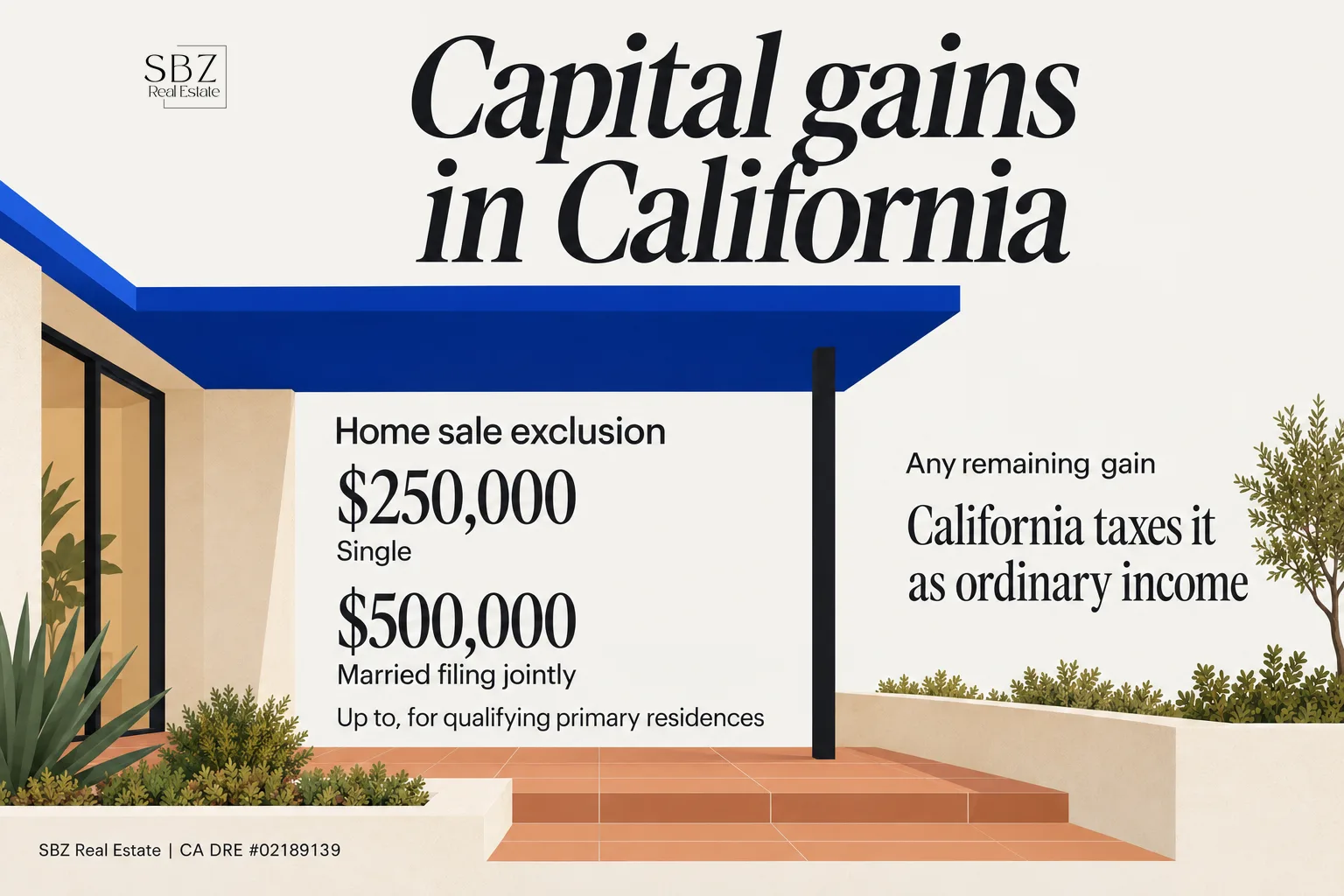
If the house was your primary residence and you lived there at least two of the last five years, you can usually exclude up to $250,000 of gain from tax, or $500,000 if you're married and file jointly. California follows the same exclusion. Any gain above that limit is taxed by the IRS at capital gains rates, and California taxes it as ordinary income.
This matters more here than in most states. Many Southern California owners have held their homes long enough that the gain may be larger than the exclusion. Knowing roughly where you stand before you list affects your pricing, your timing, and what you actually walk away with.
How is capital gains on a home sale calculated?
The gain is the difference between what you net from the sale and your adjusted basis in the home. It isn't the sale price minus what you paid.
In real terms, the math works like this:
- Amount realized: the sale price minus selling expenses such as commissions, escrow and title fees, and transfer taxes.
- Adjusted basis: your original purchase price, plus certain closing costs from the purchase, plus the cost of capital improvements.
- Gain: amount realized minus adjusted basis.
The line most sellers miss is capital improvements. A room addition, a new roof, a remodeled kitchen, solar, new HVAC, or a pool all add to your basis. Routine repairs and maintenance don't. If you've kept receipts and permits over the years, pull them out now, because they can meaningfully reduce your taxable gain. Many of the same selling costs that lower your gain also show up on a seller net sheet, so it helps to build both together.
Who qualifies for the $250,000 / $500,000 exclusion?
The home sale exclusion comes from Section 121 of the Internal Revenue Code. To claim the full amount, you generally need to meet three tests:
- Ownership test: you owned the home for at least two years during the five years before the sale.
- Use test: you lived in it as your main home for at least two years during that same five-year window. The two years don't have to be consecutive.
- Look-back test: you haven't claimed the exclusion on another home sale in the previous two years.
For married couples filing jointly, either spouse can meet the ownership test, but both must meet the use test to get the full $500,000. A surviving spouse may still qualify for the $500,000 exclusion if the home is sold within two years of the spouse's death, as long as the other requirements were met.
What if you don't meet the two-year rule?
You may still qualify for a partial exclusion if you sold because of a job change, a health reason, or certain unforeseen circumstances. The exclusion is prorated based on how much of the two-year period you actually met. IRS Publication 523 explains the qualifying reasons, and a tax professional can confirm whether your situation fits.
Does California tax capital gains differently than the IRS?
Yes, and this is the part that surprises people. The federal government taxes long-term capital gains (assets held more than a year) at preferential rates of 0%, 15%, or 20%, depending on income. Higher earners may also owe the 3.8% Net Investment Income Tax on taxable gain.
California has no separate capital gains rate. The Franchise Tax Board taxes your gain as ordinary income, at the same rates as your wages, which top out at 12.3%. Income above $1 million carries an additional 1% Mental Health Services Tax. A large taxable gain can also push you into a higher state bracket for that year.
The good news is that California conforms to the federal home sale exclusion, so the first $250,000 or $500,000 of qualifying gain is generally excluded at the state level too.
Will escrow withhold California tax from my proceeds?
Possibly. California requires real estate withholding on many sales, generally 3⅓% of the total sales price, reported on FTB Form 593. It's a prepayment toward your state tax, not an additional tax.
Sellers who qualify for the principal residence exclusion can usually certify an exemption on Form 593 so nothing is withheld. Your escrow officer will provide the form during the transaction. If you aren't sure how escrow handles this step, our guide to how escrow works in California walks through it.
What about rental properties and second homes?
The Section 121 exclusion applies only to your main home. Selling a rental, vacation home, or investment property works differently:
- The full gain is taxable. There's no $250,000/$500,000 exclusion.
- Depreciation recapture applies. Depreciation you claimed (or were allowed to claim) on a rental is generally taxed federally at a rate of up to 25%, and California taxes it as ordinary income.
- Mixed-use homes get complicated. If you rented a home before moving into it, part of the gain may not qualify for the exclusion, even if you meet the two-year rule.
For investment property, a 1031 exchange lets you defer the gain by reinvesting in another like-kind property. We cover the timelines and rules in 1031 exchanges in Los Angeles. If you're repositioning a portfolio rather than cashing out, our piece on building a Southern California rental portfolio explains how sales and purchases fit together.
Are there other ways capital gains on a California home get reduced?
A few situations change the math considerably:
- Inherited homes. Heirs generally receive a "stepped-up" basis equal to the home's fair market value at the date of death, which often wipes out most of the gain built up during the original owner's lifetime.
- Community property. In California, when a spouse dies, community property can receive a step-up on both halves, not just the deceased spouse's share. That can matter a great deal for long-held homes. How title was held is important here.
- Timing the sale. If you're close to the two-year mark, waiting a few months can make the difference between a partial exclusion and a full one. Pricing still has to make sense for the market, and our guide to pricing your home to sell in Los Angeles covers that side.
How is the sale reported?
Escrow or the title company typically issues Form 1099-S to report the sale. If your entire gain is excluded and you meet certain conditions, you may not receive one or need to report the sale at all. Otherwise, the sale goes on Form 8949 and Schedule D of your federal return, and the corresponding forms on your California return.
What should you do before you list?
Here's what we tell every seller who has owned for a long time: run the tax picture before you set the price. A practical checklist:
- Pull your original closing statement from the purchase.
- Gather receipts, permits, and contracts for every capital improvement.
- Confirm the dates you lived in the home and any periods it was rented.
- Estimate your selling costs. Our breakdown of closing costs for California home sellers is a good starting point.
- Sit down with a CPA or tax professional to model your federal and California liability.
A broker isn't a substitute for tax advice, and this article isn't tax advice either. Our job is making sure your sale proceeds, timing, and paperwork line up with what your tax advisor recommends. That coordination is part of how we handle selling your home, from the first net sheet to the final closing statement.
If you're weighing a sale and want a clear view of what you'd actually walk away with, reach out to us. A quick conversation costs nothing.
Frequently asked questions
Do I pay capital gains tax if I sell my house in California?
Not if your gain is within the exclusion. If the home was your primary residence for two of the last five years, up to $250,000 of gain ($500,000 for married couples filing jointly) is generally excluded from both federal and California tax. Gain above that amount is taxable.
What is the California capital gains tax rate on a home sale?
California has no separate capital gains rate. Taxable gain is taxed as ordinary income at your regular state rate, which tops out at 12.3%, plus an additional 1% on income above $1 million.
Does buying another house avoid capital gains tax in California?
No, not for a primary residence. Buying a replacement home doesn't defer the gain. That rule was repealed federally in 1997 and replaced by the current exclusion. Deferral through a 1031 exchange applies only to investment or business property.
Can I reduce my capital gains with home improvements?
Yes. Capital improvements such as additions, remodels, a new roof, or solar increase your adjusted basis, which lowers your taxable gain. Routine repairs and maintenance don't count, so keep receipts and permits.
Is California tax withheld when I sell my home?
California generally requires withholding of 3⅓% of the sales price on FTB Form 593. Sellers who qualify for the principal residence exclusion can usually claim an exemption so nothing is withheld.
