
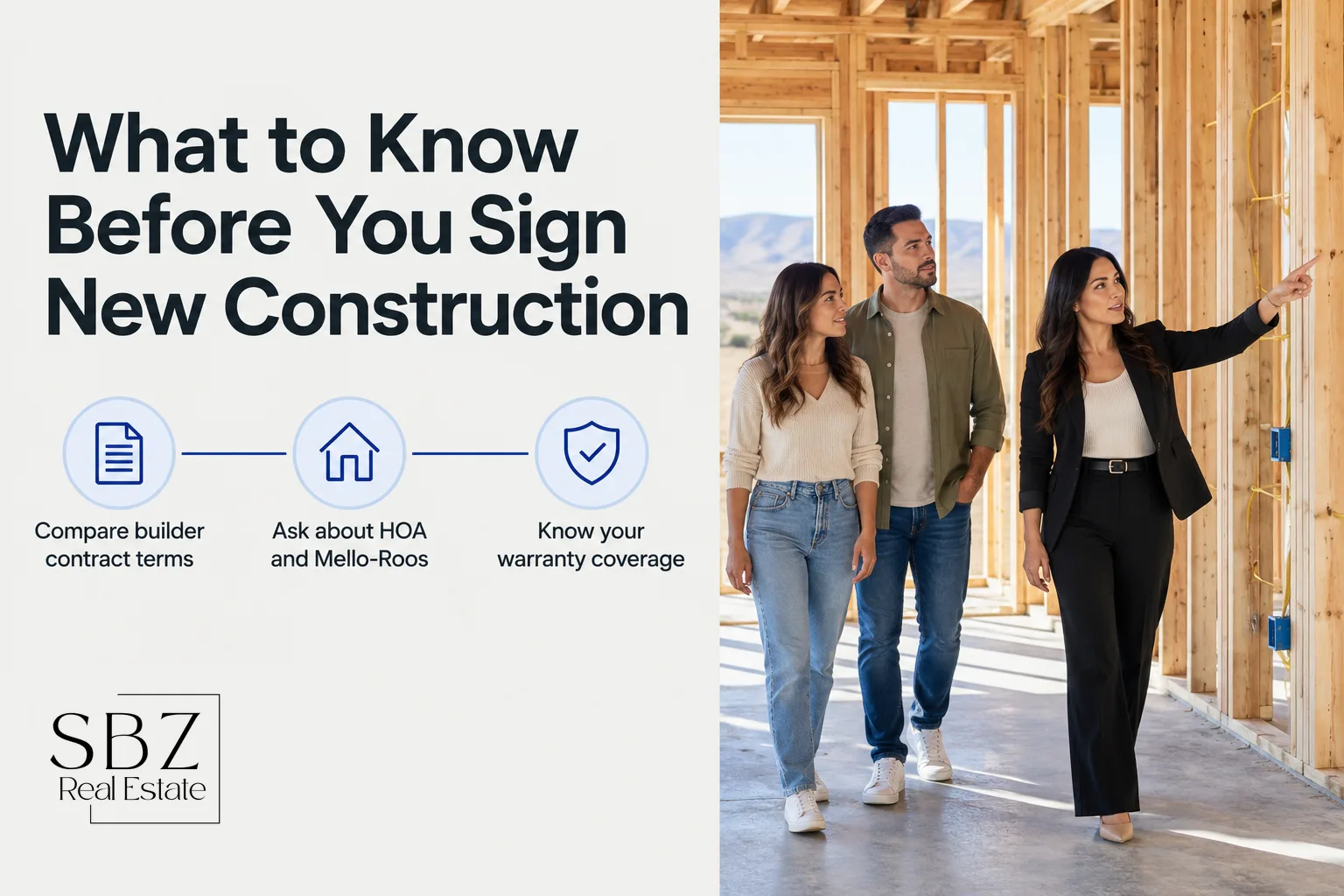
New construction in the Antelope Valley gives buyers something resale rarely can — a home built to your specifications, with modern systems and a builder warranty behind it. But the process works differently than a standard purchase, and a few things catch buyers off guard if they're not prepared.
The Antelope Valley — Palmdale, Lancaster, Quartz Hill, and the surrounding communities — has seen a steady pipeline of new developments in recent years. Land availability and relative affordability make it one of the more active new construction markets in Los Angeles County. If you're considering a new build, here's what to understand before you walk into a model home.
How is buying new construction different from buying a resale home?
The most important thing to understand is that the builder's on-site sales office works for the builder — not for you. The agents in those model homes are paid by the developer, represent the developer's interests, and are not obligated to counsel you the way an independent broker would.
That doesn't make them adversarial, but it does mean you want your own representation before your first visit. Many builders require that you register your agent on day one; if you've already toured unrepresented, some builders won't allow an agent to step in afterward. It's a small logistical detail with real financial consequences. Having an independent buyer's agent typically costs you nothing — the builder pays the co-op commission — but losing that representation early can mean losing the objective guidance you need most.
What should I look for in a builder contract?
Builder purchase contracts are drafted by the builder's attorneys, and they tend to favor the builder in ways a standard California Residential Purchase Agreement does not. A few things worth examining closely:
- Earnest money terms. Builder contracts often require larger deposits — sometimes 2–5% of the purchase price — and may treat them as non-refundable under conditions that would trigger a refund in a standard resale transaction.
- Completion timelines. New construction timelines slip. Contracts typically include broad completion windows and limit your remedies when builds run long.
- Price lock provisions. Confirm in writing whether your purchase price is fixed or subject to adjustment based on materials costs or market conditions.
- What's actually included. The base-price home often looks quite different from the model. Know exactly which finishes, appliances, and structural options are standard versus priced as upgrades.
Have an experienced real estate attorney or broker review the contract before you sign. This is not a step to skip.
Are builder upgrades worth paying for at the design center?
Sometimes — but the math deserves attention. Design center upgrades are typically marked up substantially above what you'd pay to have the same work done independently after close. Flooring, cabinetry, countertops, and appliances are where buyers most often overspend relative to the value they get.
Here's what I tell buyers: structural upgrades — an extra bedroom, a larger garage, a secondary suite — are usually worth doing at the builder stage because they're genuinely expensive to add after the fact. Cosmetic finishes are often better handled post-close, when you have more options and better pricing through your own contractors.
That said, if the builder is offering a financing incentive tied to using their preferred lender, run the full numbers before deciding. A meaningful rate buydown or closing cost credit can more than offset the upgrade markup. Compare the complete picture, not just the headline incentive.
What warranties does a new construction home in California carry?
California law provides minimum warranty protections for new construction, independent of any builder warranty. Under the Right to Repair Act (SB 800), builders are responsible for defined construction defects for varying periods — typically one year for fit-and-finish items, four years for water intrusion issues, and ten years for structural defects.
Most builders also offer a third-party structural warranty. Read these carefully: they include exclusions, claim procedures, and conditions that affect whether coverage applies when you actually need it.
One thing buyers often overlook — schedule a third-party home inspection before close, even on a brand-new home. New construction inspections surface framing issues, HVAC problems, insulation gaps, and grading deficiencies that become your responsibility once escrow closes. Builders may push back on this, but a professional inspection is your right and one of the most cost-effective protections you have.
What should I know about HOAs and Mello-Roos in Antelope Valley new developments?
Most Antelope Valley master-planned communities include HOA membership. Before you sign, review the CC&Rs, the HOA operating budget, and the reserve fund disclosures the builder is required to provide under California law.
Pay particular attention to the reserve study — it projects how much the HOA is setting aside for future repairs and maintenance. An underfunded reserve is a liability you inherit. Also examine HOA dues during the builder phase: in some developments, initial dues are set artificially low until the community is fully built out, then rise once the developer transfers control to the homeowners association.
Mello-Roos districts are common in newer Antelope Valley developments. These are special tax assessment districts that fund infrastructure — roads, schools, utilities — and they add to your annual property tax bill, sometimes meaningfully. Your escrow officer will disclose the Mello-Roos assessment in the preliminary title report. Make sure you've reviewed that number and factored it into your full housing cost before you finalize your budget.
How long does the new construction buying process take?
From signed purchase contract to move-in, Antelope Valley production builders typically estimate eight to fourteen months, depending on the phase of development and the floor plan selected. Quick-move-in inventory homes — already under construction or completed — close considerably faster.
Build timelines are affected by permit approvals, supply chain, and weather, and builder contracts generally include protection for delays outside the developer's control. Build flexibility into your own plans: if you're currently renting, a short-term extension clause or month-to-month arrangement is worth securing before you give notice on your current place.
Frequently asked questions
Do I need a real estate agent to buy a new construction home in the Antelope Valley?
You're not legally required to have one, but it's almost always in your interest. Builder on-site agents represent the seller. An independent buyer's agent reviews the contract, negotiates on your behalf, and helps you understand what you're committing to — typically at no cost to you, since builders pay the co-op commission.
Can I negotiate price on a new construction home?
Builders are generally more flexible on upgrades, closing costs, and financing incentives than on base price — particularly on quick-move-in inventory they're motivated to close. A buyer's agent who works regularly with builders understands where there's room to negotiate and how to approach it.
What is Mello-Roos and how does it affect my monthly costs?
Mello-Roos is a special tax assessment common in newer California developments, used to fund infrastructure like roads, utilities, and schools. It's added to your annual property tax bill and disclosed in escrow. The amount varies by district, so review the disclosure carefully and factor it into your total housing cost alongside the base tax and HOA dues.
Should I get a home inspection on a brand-new home?
Yes. New construction is not exempt from defects, and a pre-close inspection lets you raise issues while the builder is still on-site and contractually responsible for corrections. It's one of the most cost-effective protections available to you as a buyer.
What's the difference between a production home and a quick-move-in home?
A production home is built to your selections from the ground up after you sign the purchase contract. A quick-move-in is already under construction or completed — you buy it largely as configured, with limited customization options. Quick-move-ins typically close faster and occasionally carry more negotiating leverage, since builders have carrying costs on completed inventory.
If you're weighing a new construction purchase in the Antelope Valley and want a straightforward conversation about what to expect, SBZ Real Estate is glad to help. Reach us at sbzre.com or 818-696-0888 — a quick conversation costs nothing.