
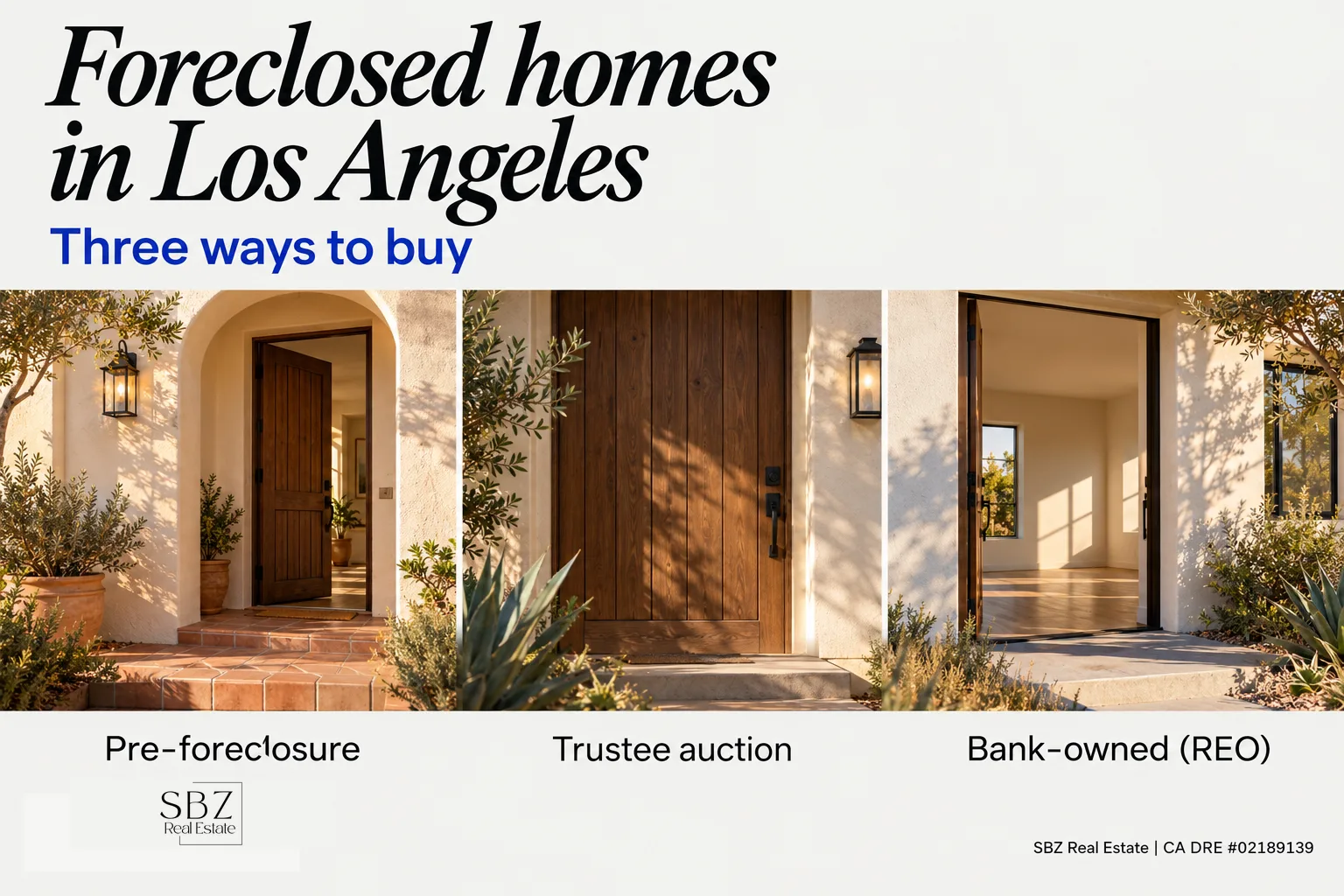
Foreclosed homes in Los Angeles come up for sale in three ways. You can buy during pre-foreclosure, often as a short sale. You can bid at a trustee's auction. Or you can buy after the lender has taken the home back as a bank-owned property, known as an REO. Each route has its own rules, timeline, and risks. Picking the right one matters more than finding a "deal."
Buying a foreclosure can be a real opportunity, but it seldom works the way people expect. Here's what actually matters if you're looking at foreclosed homes in Los Angeles County.
How does foreclosure work in California?
Most California home loans are secured by a deed of trust, not a mortgage. That lets lenders foreclose without going to court, which is called a nonjudicial foreclosure. The process follows a set order under the California Civil Code. First the trustee records a Notice of Default. After a required waiting period, it records and publishes a Notice of Trustee's Sale. Then the property goes to public auction.
The order matters to buyers because each stage is a different buying window. Owners can still sell or catch up on payments before the auction. After the auction, the home either goes to a winning bidder or reverts to the lender.
What are the three ways to buy a foreclosed home in Los Angeles?
Pre-foreclosure (including short sales)
In pre-foreclosure, the owner still holds title and is behind on payments. If they owe more than the home is worth, the sale may need lender approval as a short sale. Buyers can usually inspect, use normal financing, and close through escrow. The trade-off is time, because lender approval can drag on, and the owner may still cure the default and keep the home.
Trustee's sale (the auction)
This is the "courthouse steps" route. It's fast and comes with real risk:
- Payment is due at or right after the sale, usually by cashier's check. There's no time to get a loan.
- You can't inspect the inside. You're buying a property you may never have been inside.
- The home may be occupied, and removing occupants is a separate legal process.
- Some liens survive the sale. Senior liens and unpaid property taxes can stay with the property, so a title review before you bid is essential.
- The sale may not be final right away. For one-to-four unit homes, California law gives certain eligible bidders, including tenants and prospective owner-occupants, a window after the auction to match or beat the winning bid.
Auctions mostly suit experienced investors with cash ready and a clear exit plan.
Bank-owned (REO) properties
If nobody bids enough at auction, the lender takes the property back and usually lists it for sale through a listing agent. For most buyers this is the easiest route. You can tour the home, schedule inspections, and often use regular financing. You'll also see foreclosures listed by HUD and by Fannie Mae through its HomePath program, each with its own offer process.
How do you find foreclosed homes in Los Angeles?
REO listings appear in the same search tools as any other home, and many sites let you filter for bank-owned or foreclosure status. Pre-foreclosure activity appears in public records, since Notices of Default and Notices of Trustee's Sale are recorded with the Los Angeles County Registrar-Recorder/County Clerk. Trustee sale notices are also published and posted at the property.
The thing most buyers miss is that the listing is only the start. In practice, the hard part is working out which properties are worth pursuing. You need to know the right price for the condition, the repairs, and the true total cost to close. A broker who can pull comparable sales and run a proper CMA will save you from overpaying for something that only looked cheap.
What's different about making an offer on a bank-owned home?
REO purchases look like normal sales, but a few things work differently:
- Bank addenda. Lenders attach their own addenda, and these typically override parts of the standard California purchase agreement. Read them closely. They often limit seller disclosures, repairs, and the bank's liability.
- As-is condition. Banks rarely make repairs. Your inspection contingency is for learning what you're buying, not for negotiating fixes.
- Slower responses. Offers may go through an asset manager or several layers of approval, so expect counteroffers and replies to take longer than with an individual seller.
- Your financing must fit the home's condition. A home with major defects may not qualify for some loans. Renovation loans exist for this, but they add steps.
Escrow still works the way it normally does. If you haven't bought in California before, it helps to understand how escrow works before you're on a bank's deadline.
What should you check before buying a foreclosure?
Foreclosed homes have often gone without maintenance for a while, and sometimes they've been vacant. Before you commit, check:
- A full home inspection, plus specialist inspections (roof, sewer line, foundation, HVAC) wherever the general inspector flags concerns.
- Utilities. Vacant homes may have the power, gas, or water shut off, and you may need them turned on before inspections can be done properly.
- Permits. Look for unpermitted additions or garage conversions, which are common across Los Angeles County.
- Title. Get a preliminary title report showing any liens, HOA balances, or assessments that stay with the property.
- Total cost, not purchase price. Add repairs, carrying costs, and closing costs to the price. If you're investing, compare that total against the property's after-repair value.
Older homes deserve extra care. Many of the same issues we see in older Antelope Valley homes also show up in foreclosures across the San Fernando Valley and beyond.
Are foreclosed homes in Los Angeles actually cheaper?
Sometimes, but it isn't guaranteed. A foreclosure may be priced below similar homes because of its condition, the as-is terms, or how motivated the lender is. Desirable REOs can still draw several offers. Whether a foreclosure is a good buy depends on the specific property, the repairs it needs, and what nearby homes have actually sold for, not on the word "foreclosure."
Location matters too. Supply and pricing vary a lot across the county, from Palmdale and Lancaster to the San Fernando Valley and the Glendale–Burbank corridor. Our community market guides are a good place to see how individual areas are trending.
Should you use a broker to buy a foreclosure?
For a bank-owned or short-sale purchase, yes, in most cases. Representation usually costs a buyer less than people assume, and the work is detailed: reading bank addenda, timing contingencies, pricing a home whose condition doesn't match the comps, and keeping the deal moving with an institution that isn't in a hurry. Investors building toward several properties can also use our guide to building a Southern California rental portfolio.
At SBZ Real Estate, the broker you work with is the one who handles your deal from first showing to closing. If you're thinking about a foreclosure, or just want a second opinion on one you've found, a quick conversation costs nothing. You can also learn more about how we work with buyers.
Frequently asked questions
Can I get a mortgage to buy a foreclosed home in Los Angeles?
For bank-owned (REO) homes and short sales, usually yes, as long as the property's condition meets your loan program's standards. Trustee auctions generally need cash or certified funds at the time of sale, so standard financing doesn't work there.
Can I see inside a foreclosed home before buying it?
You can usually tour and inspect REO and short-sale properties during your contingency period. At a trustee's auction you generally can't get inside, which is one of the biggest risks of buying that way.
What happens if someone is still living in a foreclosed home?
At auction, occupied homes are common, and the buyer is responsible for the legal process of gaining possession. That process depends on whether the occupant is the former owner or a tenant, so talk to a California real estate attorney before bidding on an occupied property.
How do I find foreclosed homes in Los Angeles County?
Bank-owned homes show up on standard listing searches, often with a foreclosure filter. Pre-foreclosure and auction notices are recorded with the Los Angeles County Registrar-Recorder/County Clerk and published publicly. A local broker can help you sort out which ones are worth a closer look.
Do foreclosed homes come with seller disclosures?
Lenders that sell REO properties are often exempt from some of the disclosures a typical California homeowner must give, and their addenda usually limit what they provide. That makes your own inspections and title review even more important.
