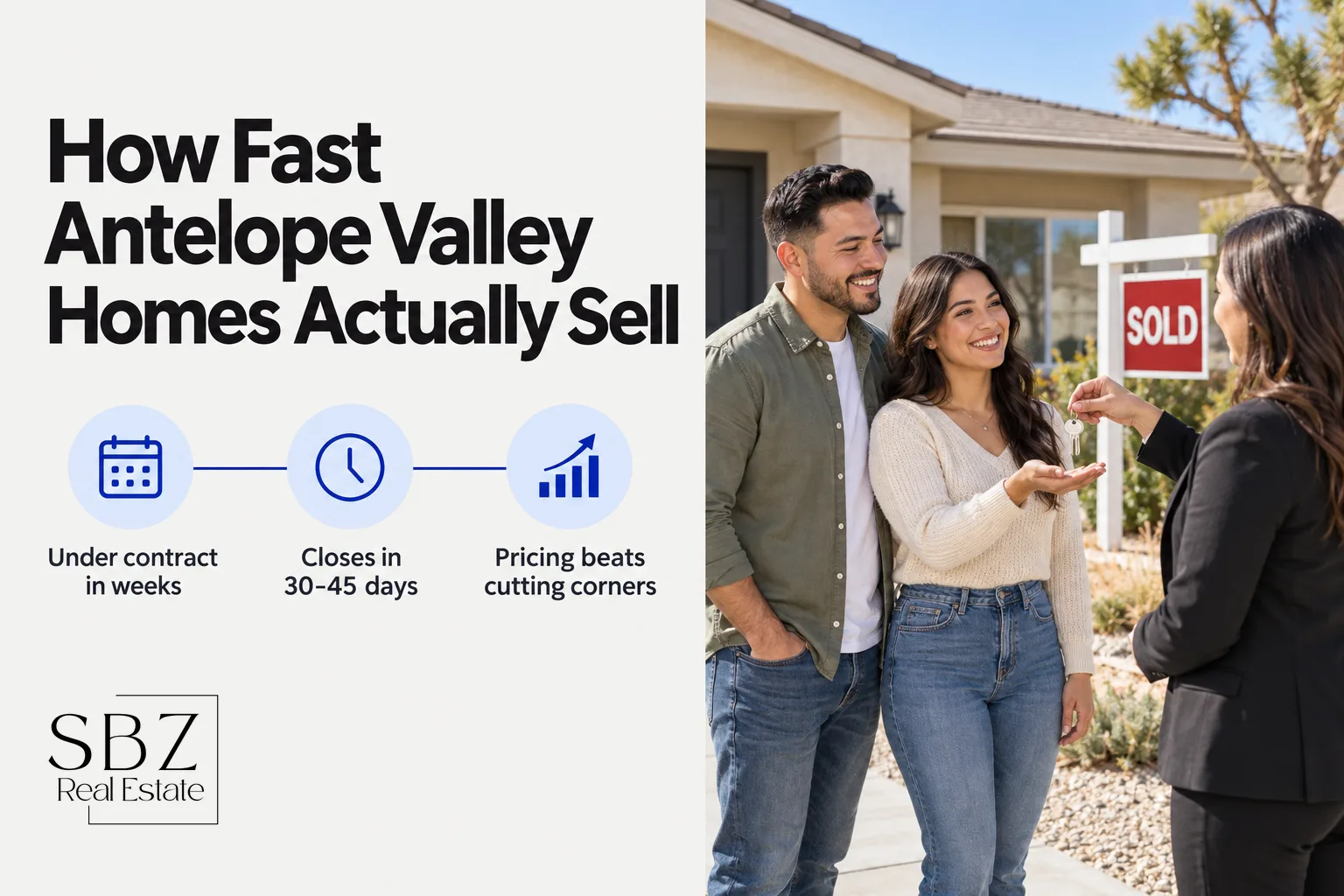
In general terms, a well-priced home in the Antelope Valley — Lancaster, Palmdale, Quartz Hill, and the surrounding areas — tends to go under contract within the first few weeks of listing, with escrow adding another 30 to 45 days before closing. So from the day you list to the day you hand over keys, a lot of sellers are looking at somewhere around six to ten weeks total, though that range moves depending on price point, condition, and what's happening in the broader market that month.
That's the honest, general answer. The real one — the one that actually matters for your specific house — depends on a handful of things we walk every seller through before we ever put a sign in the yard.
What actually determines how fast a house sells here?
Price is the biggest lever, by far. A home priced accurately for its condition and comps tends to attract serious buyers immediately; a home priced even five to ten percent over market often sits, then eventually sells for less than it would have with the right number from day one. That's the thing most sellers miss — the first two weeks on market are when you get the most eyes and the most leverage, and an inflated list price burns through that window.
Condition matters almost as much. Buyers financing with FHA or VA loans — common in the Antelope Valley given the mix of first-time buyers and military-connected households near Edwards Air Force Base — are subject to appraisal and inspection standards that can stall or kill a deal if a roof, HVAC system, or electrical panel needs work. Addressing the obvious issues before listing, rather than after an inspection report flags them, keeps a transaction moving instead of restarting the clock.
Financing type on the buyer's side changes the escrow length, too. A cash offer can close in two to three weeks. A conventional loan usually needs 30 days. FHA and VA loans, with their additional underwriting and appraisal requirements, often run closer to 30-45 days and sometimes longer if the appraisal comes in low or repairs are required as a condition of the loan.
How long does each stage of the sale actually take?
Here's how the timeline typically breaks down, in real terms:
- Prep and listing (1-2 weeks): Photos, minor repairs, decluttering, and getting the listing live. Homes that skip this step and list "as-is" with phone photos usually sit longer and net less.
- Time to offer (1-4 weeks): In a balanced Antelope Valley market, well-priced homes often see offers within the first two to three weeks. Overpriced homes can sit for months.
- Offer to close of escrow (30-45 days): Once you accept an offer, California's standard residential purchase agreement gives buyers contingency periods for inspection, appraisal, and loan approval — typically 17 days for inspections and roughly 21-30 days for loan approval, running partly in parallel.
- Contingency removal to closing: Once contingencies are removed, closing usually follows within a week or two, assuming title and the lender's final documents are in order.
None of this is a guarantee on any individual sale — every escrow has its own variables — but it's the general shape of how a straightforward transaction moves through the process.
Does the season affect how fast a home sells in the Antelope Valley?
Yes, to a degree. Spring and early summer tend to bring more buyer traffic across most Southern California markets, including the Antelope Valley, partly because families try to close before the school year starts. Late fall and the holiday stretch typically see fewer showings, though the buyers who are looking during that window tend to be more motivated, which can offset the lower volume.
I wouldn't build your entire strategy around timing the season, though. A well-prepared, correctly priced home in December will often outperform a poorly prepared one listed in April. Condition and pricing do more work than the calendar does.
What can a seller do to sell faster without cutting corners?
A few things consistently make a measurable difference, based on what we see across listings in Lancaster, Palmdale, and Quartz Hill:
- Price to the current comps, not last year's comps. Markets shift, and pulling sales from six months ago can put you out of step with what's actually closing now.
- Handle the inspection items you already know about. If you know the water heater is on its last leg or there's a roof issue, address it or disclose it and price around it — don't let a buyer's inspector find it first.
- Get the house genuinely show-ready. Decluttering, a deep clean, and basic curb appeal work do more for buyer perception than most sellers expect.
- Be realistic about financing contingencies. If your buyer pool is likely to include FHA or VA buyers, know that upfront and build the timeline accordingly rather than being surprised by it mid-escrow.
Is the Antelope Valley market currently faster or slower than average?
Market pace shifts throughout the year and from one price band to another, so any specific "days on market" figure quoted today could be outdated by the time you're reading this. What holds true is that inventory levels, interest rates, and local buyer demand all move the needle, and the most reliable way to know where things stand right now for a specific property is to look at what's actually closed in your immediate area over the last 30-60 days — not a valley-wide average.
If you're weighing whether to list soon or wait, that's a conversation worth having before you make any decisions, not after.
Frequently asked questions
How many days on market is normal in the Antelope Valley?
It varies by season, price point, and neighborhood, so there isn't one number that holds true year-round. A current comparison of recently sold, similar homes in your specific area is a more reliable gauge than any general average.
Can I sell my house in 30 days in Lancaster or Palmdale?
It's possible, particularly with a cash buyer and an accurate list price, but it isn't something any broker can guarantee. Financing type, inspection findings, and how the home is priced relative to current comps all affect whether a 30-day timeline is realistic for your situation.
Does an FHA or VA buyer slow down the sale?
It can extend the escrow period somewhat compared to a conventional or cash buyer, mainly due to additional appraisal and underwriting steps. It doesn't have to derail a sale — knowing that upfront just means building it into your timeline expectations.
What's the fastest way to sell a house in the Antelope Valley?
Accurate pricing based on current comps and addressing known repair issues before listing are the two factors that most consistently shorten time on market. Beyond that, a lot comes down to buyer demand in your specific price range at the time you list.
Should I wait for spring to list my house?
Spring often brings more buyer traffic, but a well-prepared home priced correctly can perform well in any season. If your circumstances call for selling sooner, it's worth a conversation about what the current market actually looks like rather than defaulting to conventional timing.