
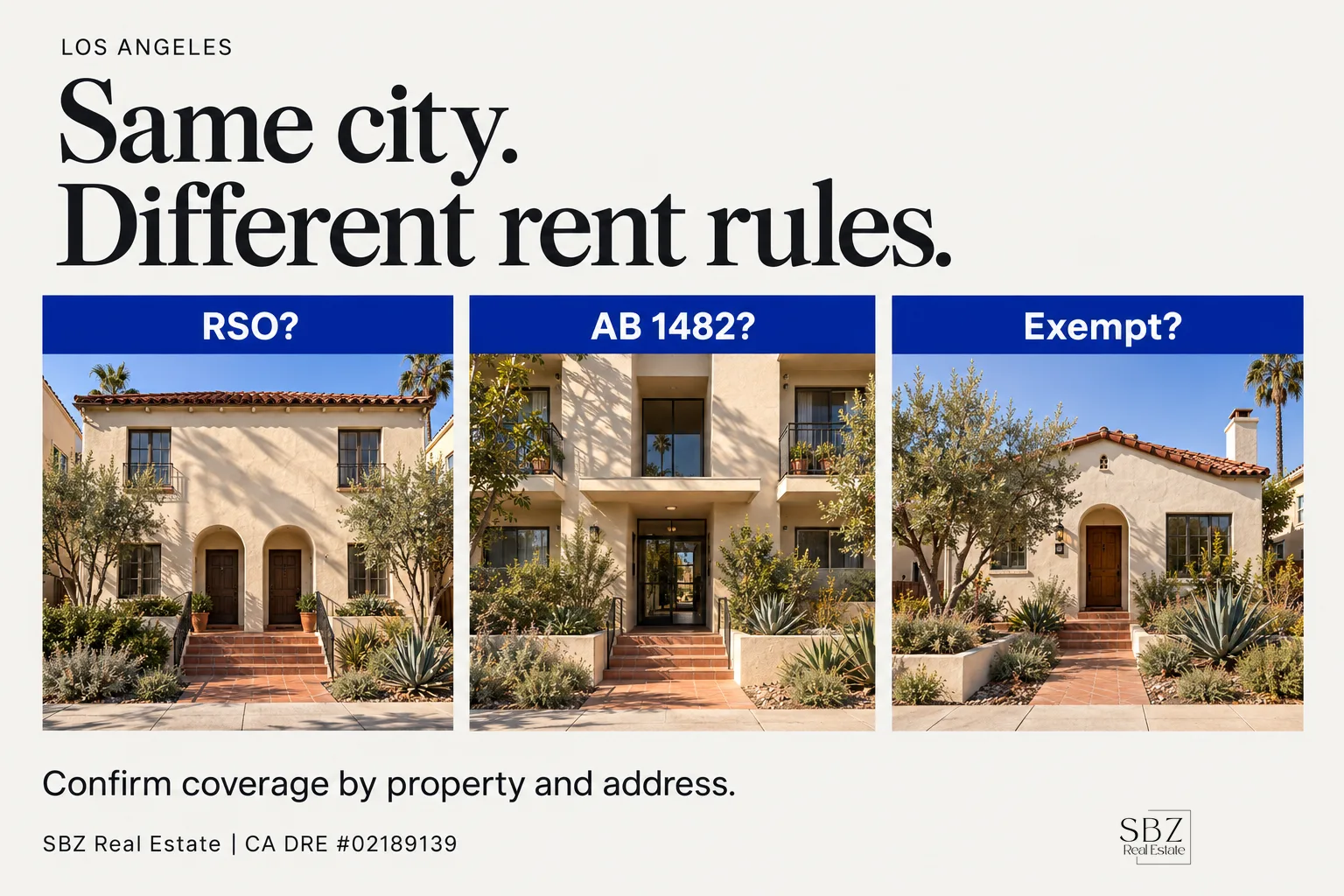
The amount a landlord can raise rent in Los Angeles depends on which rules cover the unit. Rent-stabilized units in the City of Los Angeles (generally buildings with a certificate of occupancy dated on or before October 1, 1978) are limited to a small annual percentage set by the city. Most other older rentals fall under California's statewide cap of 5% plus local inflation, never more than 10% in a 12-month period. Some properties, including many newer buildings and qualifying single-family homes, are exempt from both caps.
That's the short version. In practice, the hard part is working out which category a property belongs to. Landlords and buyers who are evaluating a rental often get this wrong, and the mistake can cost them on both sides of the deal.
Is the unit covered by the Los Angeles RSO?
The City of Los Angeles Rent Stabilization Ordinance (RSO) is the strictest layer. It generally covers rental units in buildings with two or more units whose original certificate of occupancy was issued on or before October 1, 1978. It also covers some older properties that were later converted. Single-family homes are usually outside the RSO. The exception is a lot that holds two or more houses.
For RSO units, the Los Angeles Housing Department (LAHD) publishes the allowable annual increase. Increases usually take effect each July 1, and a landlord can raise the rent only once in any 12-month period. The percentage is tied to the Consumer Price Index and has a floor and a ceiling. The City Council has revised that formula recently, including how it treats landlord-paid utilities. Because the number can change from year to year, check LAHD's current figure before you serve a notice or underwrite a purchase. Don't rely on a percentage you remember from last year.
RSO units also need to be registered with the city each year. A landlord who hasn't registered a unit or paid the registration fee generally can't legally collect a rent increase on it.
What if the unit isn't under the RSO? (AB 1482)
Many Los Angeles rentals that aren't covered by the RSO are covered by the Tenant Protection Act of 2019, usually called AB 1482 (California Civil Code §1947.12). Under this state law:
- The maximum increase in any 12-month period is 5% plus the percentage change in the regional Consumer Price Index, capped at 10% total.
- The increase is measured from the lowest rent charged at any point in the prior 12 months.
- The allowed amount can be taken in no more than two increments within that 12-month window.
- AB 1482 is currently scheduled to expire at the start of 2030 unless the Legislature extends it.
AB 1482 also includes just-cause eviction protections, so a landlord can't sidestep the cap by ending a tenancy without a qualifying reason once the tenant has been there long enough.
Which properties are exempt from rent caps?
This is where owners most often make mistakes. Common exemptions from AB 1482 include:
- Newer construction. Housing that received its certificate of occupancy within the last 15 years is exempt. This is a rolling window, so a building that's exempt today may not be in a few years.
- Single-family homes and condos owned by individuals. A home qualifies only if it isn't owned by a corporation, a REIT, or certain LLCs with a corporate member, and the lease includes the specific written exemption notice required by the statute. Without that notice language, the exemption may not apply.
- Owner-occupied duplexes. A duplex where the owner lives in one unit as their principal residence, and has lived there since the start of the tenancy, is exempt.
Separately, the Costa-Hawkins Rental Housing Act bars cities from imposing local rent control on single-family homes, condos, and buildings first occupied after February 1, 1995. That's one reason many Los Angeles houses fall outside the RSO even when they're decades old.
If you're building a Southern California rental portfolio, confirm each property's status before you close. Don't assume.
Does it matter which city the property is in?
Yes, quite a bit. "Los Angeles" covers dozens of separate cities, and the City of LA's RSO stops at the city limits. Some neighboring cities have their own rent control. Pasadena, for example, has a voter-approved rent stabilization charter amendment. Unincorporated areas of Los Angeles County are governed by the County's own rent stabilization ordinance.
In places without a local ordinance, AB 1482 is usually the controlling rule for covered units. That's generally the case for many rentals in Palmdale and Lancaster. Our guide to the Antelope Valley rental market for landlords goes deeper on that region. Local rules can change, so verify the current ordinance for the exact address, not just the general area.
How much notice does a tenant have to get?
Under California Civil Code §827, a month-to-month tenant must receive at least 30 days' written notice for an increase of 10% or less. An increase of more than 10% requires 90 days' notice. A tenant on a fixed-term lease generally can't have their rent raised mid-lease unless the lease itself allows it.
The City of Los Angeles adds another rule. For many units not covered by the RSO, if a landlord raises rent by more than 10% within a 12-month period, a tenant who chooses to move out instead may be entitled to relocation assistance. In real terms, an aggressive increase that is technically allowed can still come with a significant cost.
Are there any other limits on rent increases?
During a declared state or local emergency, California Penal Code §396 generally limits rent increases to 10%. This applied across Los Angeles County after the January 2025 wildfires. Before you raise rent during or after an emergency period, check whether an order is still in effect for your area.
What this means if you're buying or selling a rental
Rent rules show up directly in a property's numbers. A building full of below-market RSO tenancies can't be raised to market rent on the new owner's timeline. Its net operating income reflects that, and so does a realistic price. On the other hand, an exempt single-family rental or a newer building gives the owner much more flexibility.
Here's what actually matters when you evaluate an income property:
- The certificate of occupancy date. It tells you whether the RSO or the 15-year AB 1482 exemption could apply.
- The ownership structure. It affects whether a single-family exemption is available.
- The current rent roll and lease terms. These include the lowest rent charged in the last 12 months.
- RSO registration status, if applicable.
- Whether the exemption notice is actually in the leases.
Sellers benefit from having this organized before listing. It answers a buyer's first questions and supports the price. If you're thinking about selling an income property, our selling page explains how we approach it. If you're moving gains into a different property, a 1031 exchange may be worth discussing with your tax advisor.
This article is general information, not legal advice. Rent rules change, and individual situations vary, so confirm specifics with LAHD, your city's housing department, or a landlord-tenant attorney.
If you're weighing whether to hold, raise rents, or sell a Los Angeles rental, a quick conversation costs nothing. Reach out to our team and we'll help you look at the full picture.
Frequently asked questions
How much can a landlord raise rent in Los Angeles this year?
It depends on the unit. RSO units follow the annual percentage LAHD publishes, typically effective July 1. Most other covered units follow AB 1482's cap of 5% plus regional CPI, up to 10% in 12 months.
Does rent control apply to single-family homes in Los Angeles?
Usually not under the city's RSO, because of the Costa-Hawkins Act. A single-family home can still be covered by AB 1482 unless it's owned by an individual and the lease includes the required exemption notice.
How often can a landlord raise rent in Los Angeles?
RSO units can be raised once in any 12-month period. Under AB 1482, the total allowed increase can be split into no more than two increments within 12 months.
Can a landlord raise rent to market rate when a tenant moves out?
Generally yes. Under the Costa-Hawkins Act, landlords can usually set a new starting rent when a unit is voluntarily vacated, and the caps then apply to future increases. Some exceptions exist, so confirm the rules for the specific unit.
How much notice is required for a rent increase in California?
Month-to-month tenants must get 30 days' written notice for increases of 10% or less, and 90 days' notice for increases over 10%.
