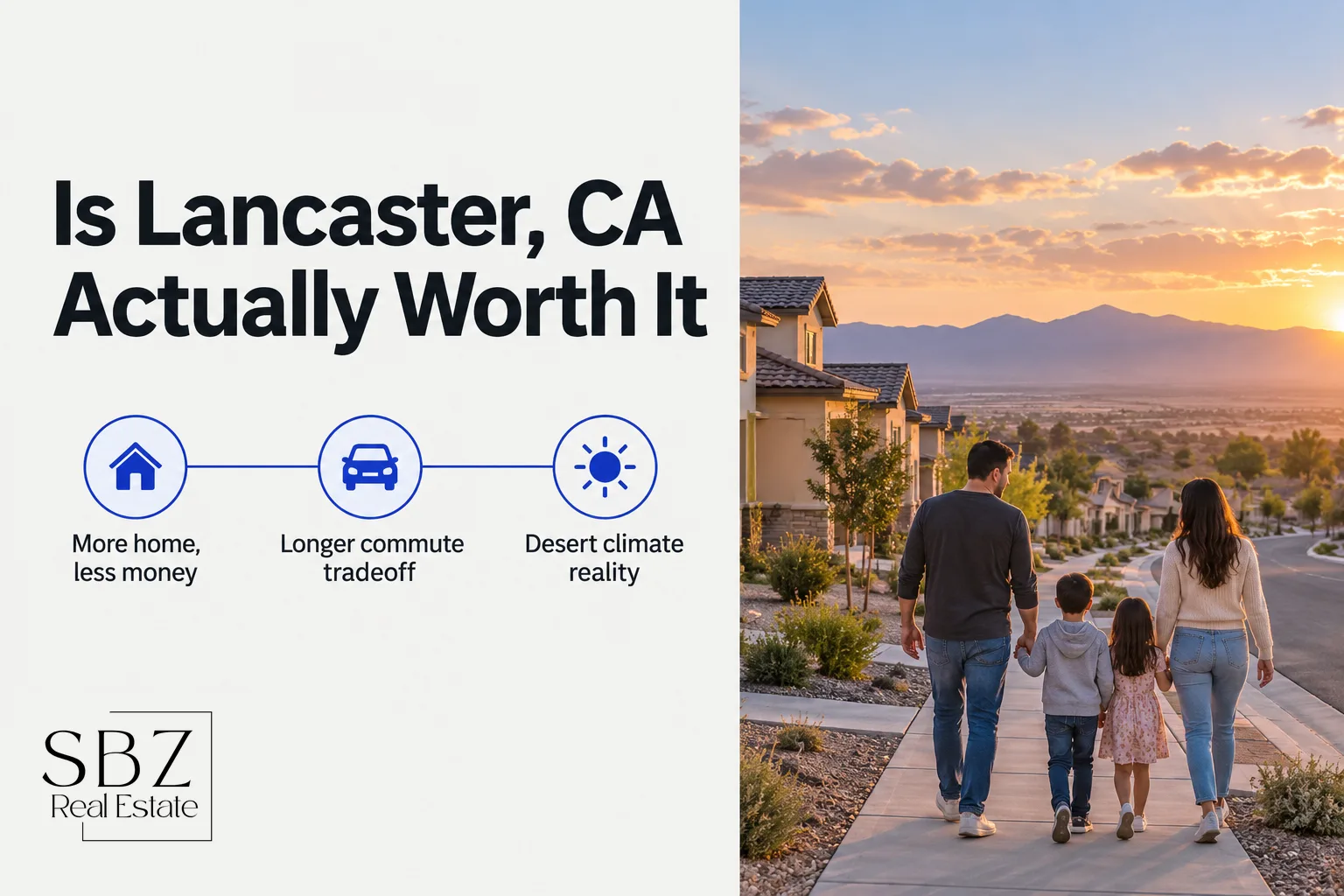
Lancaster, CA is a good fit for buyers who want significantly more home and land for their budget than they'd find in the Los Angeles basin, and who don't mind a longer commute or a high-desert climate in exchange. It's not the right fit for everyone, and the answer really depends on what you're trading off. Here's what I tell people who ask me this question directly, because I hear it a lot.
Lancaster sits in the Antelope Valley, the high-desert region of northern Los Angeles County, about an hour to 90 minutes from downtown LA depending on traffic and time of day. It's a different world from Sherman Oaks or Woodland Hills in terms of pace, price, and topography — and that's exactly why so many buyers end up looking here.
What does housing actually cost in Lancaster compared to LA?
This is the number one reason people move to the Antelope Valley. In general terms, a buyer's dollar goes noticeably further in Lancaster than in most of the San Fernando Valley or coastal LA — you're typically looking at larger lot sizes, more square footage, and newer construction for a comparable or lower price point. Market conditions shift, so I'd rather walk a specific buyer through current comps than quote a number that's stale in six months.
What stays consistent is the shape of the tradeoff: Lancaster and neighboring Palmdale and Quartz Hill give you more physical house — often three or four bedrooms with a yard — where that same budget in Burbank or Glendale might land you a condo or a much smaller single-family home.
What's the commute really like?
Be honest with yourself about this before anything else. The Antelope Valley Metrolink line runs into Union Station, and the 14 Freeway connects down to the 5, but rush-hour traffic through the pass adds real time to any commute into the LA basin or San Fernando Valley. If your job is remote, hybrid with a couple days in-office, or based locally in the Antelope Valley — Edwards Air Force Base and the aerospace corridor employ a large share of the area — the commute question mostly disappears. If you're driving into Studio City or Encino five days a week, it's worth mapping your actual door-to-door time before you commit, not just the mileage.
What's the climate and terrain like?
High desert means real seasons — hot, dry summers with temperatures regularly above 95-100 degrees, cooler nights than the LA basin gets, and winters that can bring frost and occasional snow on the surrounding hills. It's a drier climate overall than most of coastal or valley LA, with less marine layer and more open sky. Some people find that a relief after years of LA humidity and haze; others miss being closer to the coast. It's a genuine personal preference, not a right-or-wrong answer.
What is there to do in Lancaster day to day?
Downtown Lancaster has put real investment into the BLVD corridor on Lancaster Boulevard — restaurants, a farmers market, and community events through the year. The Antelope Valley Poppy Reserve draws visitors every spring when the wildflowers bloom, and the Antelope Valley itself has more open space and hiking access than you'll find close-in. It's a quieter day-to-day pace than LA proper, with a stronger small-town or suburban feel depending on the neighborhood.
How does Lancaster compare to Palmdale and Quartz Hill?
I get this question almost as often. Palmdale sits just south of Lancaster and has a similar profile — newer housing stock, similar commute considerations, its own downtown revitalization efforts. Quartz Hill, technically an unincorporated community bordering Lancaster, tends to have slightly larger lots and a more rural feel. None of these is objectively "better" — the right one depends on your specific priorities around lot size, home age, proximity to the 14 Freeway, and budget. If you're cross-shopping the Antelope Valley, it's worth looking at all three before narrowing in.
Who tends to move to Lancaster, and why?
In my experience, the buyers who end up happiest in Lancaster are the ones who've done the math on their commute, prioritize space and a lower price per square foot over proximity to the coast, and are comfortable with a high-desert climate. That includes remote workers no longer tied to an LA office, buyers relocating from more expensive parts of Southern California who want to stretch their budget further, and people who work in the aerospace and defense corridor already anchored in the Antelope Valley. The thing most buyers miss is testing the actual commute — at the actual time they'd be driving it — before they fall in love with a floor plan.
Is now a good time to buy in Lancaster?
I'd rather have that conversation directly than give you a generic answer, because it depends on your timeline, your financing, and what's happening in the specific price range you're shopping. What I can tell you in general terms: inventory and pricing in the Antelope Valley move differently than the LA basin, and a broker who's actively working this market day to day can tell you where a specific listing sits relative to recent comps — not just what a national headline says about "the market."
Frequently asked questions
Is Lancaster, CA safe?
Safety varies block by block in any city, and I'd encourage buyers to look at current, area-specific crime data for the exact neighborhood they're considering rather than relying on a city-wide reputation in either direction. I'm happy to point clients toward public data sources for any specific address or neighborhood they're evaluating.
How far is Lancaster from Los Angeles?
Lancaster is roughly 60-70 miles from downtown Los Angeles, which typically translates to a 60-90 minute drive depending on time of day and traffic through the Antelope Valley Freeway (the 14). Metrolink service is also available for commuters heading into Union Station.
Is Lancaster part of Los Angeles County?
Yes. Lancaster is an incorporated city within Los Angeles County, located in the Antelope Valley in the northern part of the county — not to be confused with Lancaster, Pennsylvania.
What is the cost of living like in Lancaster compared to the rest of LA County?
Housing is generally the biggest gap — Lancaster tends to offer more square footage and larger lots for a lower price point than most of the San Fernando Valley or coastal LA. Other costs like utilities and gas are broadly comparable to the rest of Southern California, though summer cooling costs can run higher given the desert heat.
Should I buy in Lancaster or Palmdale?
Both are worth comparing directly rather than picking based on reputation alone — they have similar commute profiles and price ranges, with differences that show up more at the neighborhood level than the city level. If you're weighing the two, a quick conversation about your specific priorities costs nothing, and I can walk you through current listings in both.