
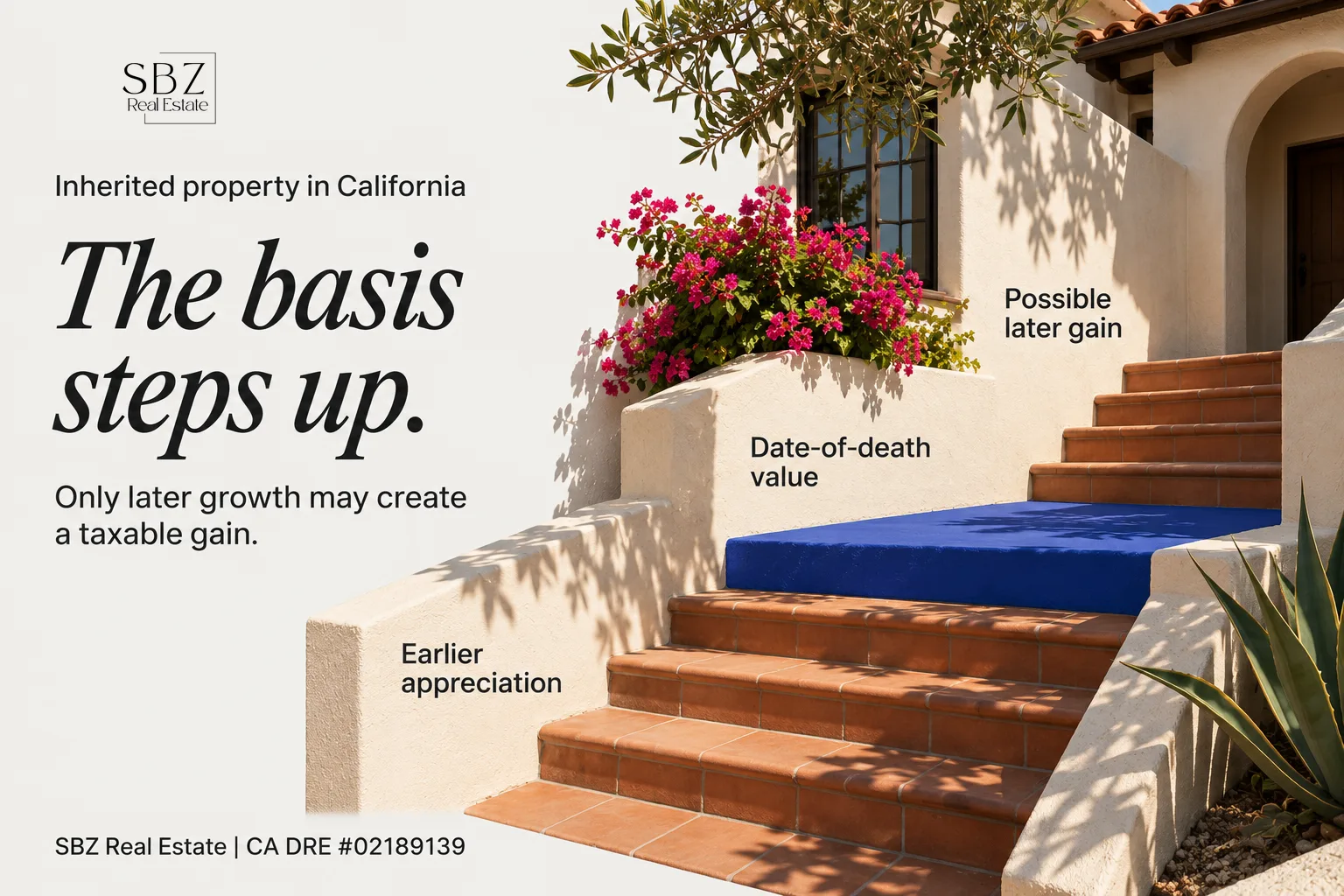
Yes, you can owe capital gains tax on inherited property in California, but usually only on the growth that happens after the person passed away, not on the decades of appreciation before it. That's because inherited property generally receives a "stepped-up basis" to its value on the date of death. For many heirs who sell within a reasonable window, the taxable gain turns out to be small.
This is general education, not tax advice. Your CPA should run the actual numbers, but understanding the framework first makes every conversation with your tax professional and your broker more productive.
Does California tax capital gains on inherited property?
California doesn't have a separate capital gains tax. The state taxes a gain from selling real estate as ordinary income on your California return, using its regular income tax brackets. Federal capital gains tax is a separate layer on top.
Two points matter for heirs. First, there is no California inheritance tax and no California estate tax. Receiving the property itself is not a taxable event for the heir. Second, tax only comes into play when the property is sold and the sale price exceeds your basis.
What is stepped-up basis, and why does it matter so much?
Basis is, roughly, the number you subtract from the sale price to find your gain. If a parent bought a home decades ago for a modest price, their original basis would be low and a sale would produce a large gain. When you inherit, federal tax law resets the basis to the property's fair market value on the date of death (Internal Revenue Code section 1014).
In real terms: if the home was worth $X on the date of death and you sell it for roughly $X, your taxable gain is close to zero, regardless of what the original owner paid. The decades of appreciation effectively go untaxed.
Some details worth knowing:
- Community property gets a double step-up. In California, when one spouse dies, both halves of community property generally receive the new basis, not just the decedent's half.
- Holding period is automatically long-term. Inherited property is treated as held long-term no matter how quickly you sell it, so the lower long-term federal rates apply.
- Gifts during life are different. If the owner gave you the home before death, you generally take over their original basis, with no step-up. This is one reason families are often better off with inheritance than a lifetime transfer.
How do you figure out the date-of-death value?
The cleanest method is a retrospective appraisal by a licensed California appraiser, with an effective date matching the date of death. Estates that file a federal estate tax return may already have one. Keep the report with your tax records, because it's the document that supports your basis if the sale is ever questioned.
A broker's opinion of value or a comparative market analysis can help you plan and price, and you can read more about how a CMA works, but for tax-basis purposes a formal appraisal is the safer paper trail.
When does an heir still owe capital gains?
The step-up covers appreciation through the date of death. Anything the property gains after that is yours to report. Common situations where a gain appears:
- You hold the property for a while and the market rises. If the home was worth $X at death and sells later for more, the difference (less selling costs and qualifying improvements) is your gain.
- You make improvements. Capital improvements add to basis and can reduce the gain; routine repairs generally don't.
- You sell for less than the stepped-up value. That can produce a loss, and the tax treatment of losses depends on whether the property was a personal residence or held for investment. Ask your CPA.
Selling costs reduce the gain too. For a sense of what those typically include, see what sellers actually pay in California.
How does Prop 19 change the picture?
Prop 19 is a property tax rule, not a capital gains rule, but it shapes what heirs decide to do. Under Prop 19, the parent-to-child exclusion from reassessment applies only if the child makes the home their primary residence within a limited time, and only up to a set value cap. Otherwise the property is reassessed to current market value, which can raise the annual property tax bill considerably.
That reassessment risk is why many heirs who don't plan to live in the home choose to sell, and the stepped-up basis is what makes selling relatively tax-friendly. Our guide to inheriting a house in California under Prop 19 walks through the occupancy and value-cap rules in detail, and the broader property tax exemption overview covers how other exemptions interact.
What does the sale process look like for an inherited home?
The path depends on how the property is titled. If it was in a living trust, the successor trustee can often sell without court involvement. If it passes through probate, the executor may need court authority, and timing can stretch. Either way, an heir or trustee typically takes these steps:
- Get a date-of-death appraisal for basis.
- Decide whether anyone will occupy the home, rent it, or sell it.
- Have the home evaluated for condition. Many inherited homes need work, or sell as-is. See selling a house as-is in California for the disclosure obligations that still apply.
- Price and market the property with a local broker who knows the neighborhood, whether that's Palmdale, Glendale, or the San Fernando Valley.
- Report the sale to the IRS and California with your CPA.
If you're a trustee or executor, our sellers' page outlines how we approach a sale, and the people involved are often managing grief and logistics at the same time as the paperwork. A calm, well-sequenced plan matters.
What about an inherited rental or investment property?
The step-up applies to rental property too, which also resets depreciation. Depreciation the previous owner claimed does not carry over as a tax bill to you in the usual case. If you want to keep investing rather than cash out, a 1031 exchange can defer gain on a later sale, though an heir generally must hold the property for investment, and the rules are technical. Talk to a qualified intermediary and your CPA before listing.
Frequently asked questions
Is there capital gains tax on inherited property in California?
California has no separate capital gains tax, but it taxes gains as ordinary income, and the federal government taxes them too. For inherited property, the stepped-up basis means you're generally taxed only on appreciation after the date of death.
Do I pay taxes just for inheriting a house in California?
No. California has no inheritance tax or estate tax, and receiving a home is not itself taxable income to the heir. Tax questions arise when you sell, or when property taxes are reassessed under Prop 19.
What is the cost basis of an inherited home?
Generally the fair market value on the date the owner died. A licensed appraiser's retrospective appraisal is the standard way to document it.
Is inherited property always long-term for capital gains purposes?
Generally yes. Inherited property is treated as long-term regardless of how long you hold it before selling.
Should I sell an inherited house or keep it?
It depends on whether you'd occupy it, the Prop 19 property tax effects, the home's condition, and your finances. A short conversation with a broker and a CPA before deciding is worthwhile. If you'd like to talk it through, reach out to SBZ Real Estate; a quick conversation costs nothing.