The property tax exemption most California homeowners are asking about is the homeowners' exemption: a $7,000 reduction in the assessed value of the home you own and live in as your primary residence. It lowers your taxable value, not your tax bill by $7,000, so the savings are modest but real. It is also easy to miss if you never file the claim.
Here is how it works in practice, who qualifies, and what to do if you've just bought a home.
What is the $7,000 homeowners' exemption?
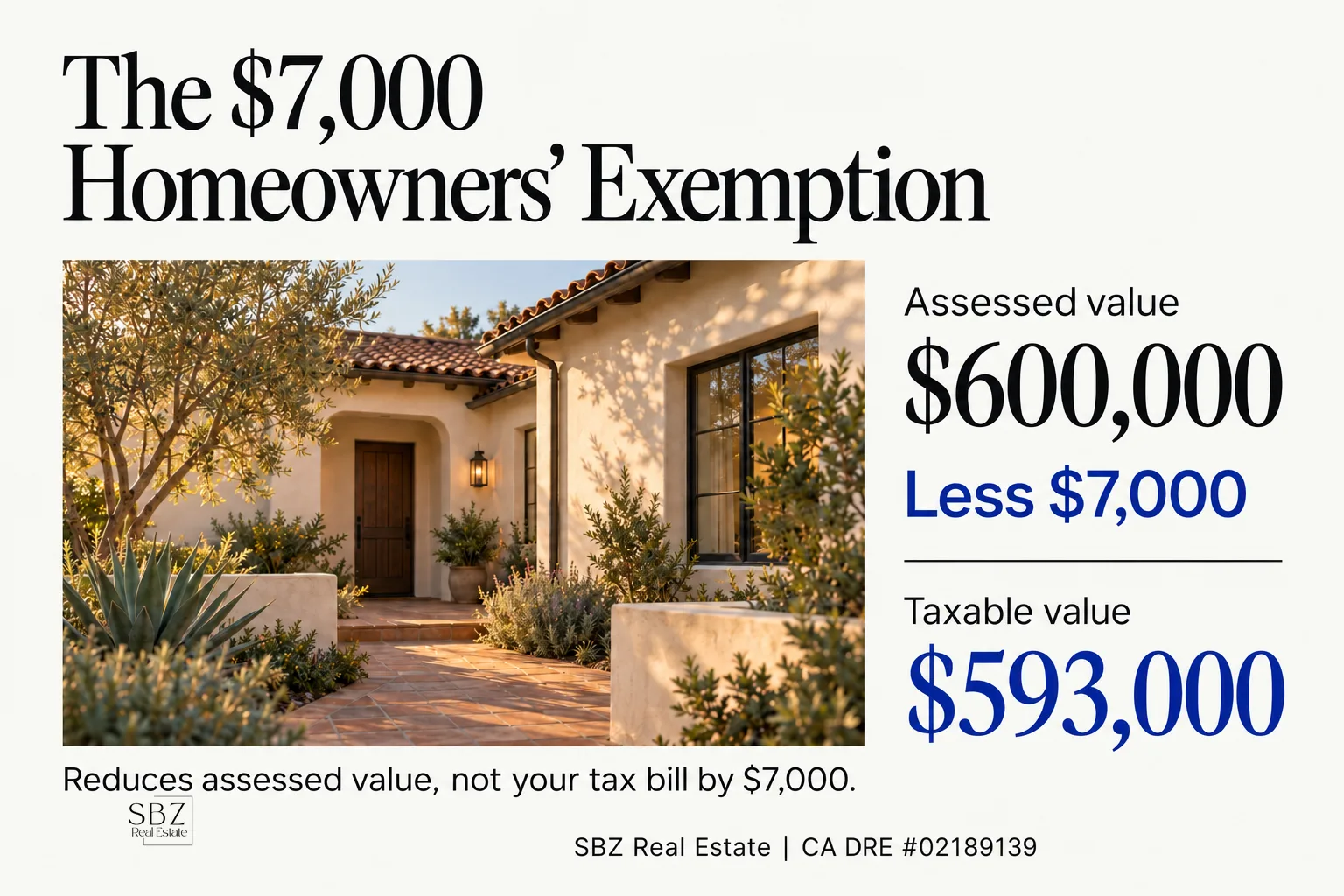
Under California law, the county assessor subtracts $7,000 from the assessed value of a qualifying owner-occupied home before applying the tax rate. If your home is assessed at $600,000, you are taxed as though it were assessed at $593,000.
Because the base property tax rate under Proposition 13 is 1% of assessed value, the exemption is worth roughly $70 a year on that base rate. Voter-approved bonds and special assessments are calculated separately, and some may not be reduced by the exemption. Check your own bill for the exact picture.
It is a small line item, but it is a permanent one. Once it is on your record, it continues each year as long as you own and occupy the home.
Who qualifies for the homeowners' exemption?
You generally qualify if all of the following are true:
- You own the property, or are buying it under a qualifying arrangement.
- It is your principal place of residence.
- You occupied it as your primary home on January 1, the lien date for the tax year.
There is no age or income test. It applies to houses, condominiums, and many manufactured homes you own and live in. It does not apply to rental properties, second homes, or vacation homes, and you can only claim it on one residence at a time.
How do you claim it?
You file a Homeowners' Property Tax Exemption claim with your county assessor's office. The county typically mails the form after a recorded change in ownership, but you shouldn't count on it. If you haven't received one within a few months of closing, contact the assessor and ask.
Timing matters. A claim filed by February 15 earns the full exemption for that tax year. Claims filed after that date may receive only a partial exemption, and there are limits on how late you can file. Confirm the current deadlines with your county, since they can be adjusted.
If you're still choosing where to buy, our buying guide walks through the full process, and the first-time home buyer guide for California and the Antelope Valley covers the costs that surprise people after closing.
Does the exemption lower my whole tax bill?
No, and this is the thing most buyers miss. The exemption reduces assessed value, so it only affects the portion of your bill tied to value. Direct charges, such as special district fees and parcel taxes, usually aren't reduced.
If your area carries a special tax on top of the base rate, it's worth understanding that separately. We explain one common example in what Mello-Roos taxes are and whether Antelope Valley homes have them.
What other property tax exemptions exist in California?
The homeowners' exemption is the one nearly every owner-occupant can use, but it isn't the only relief available. Others are narrower:
- Disabled veterans' exemption. Veterans with qualifying service-connected disabilities, and in some cases their unmarried surviving spouses, may qualify for a larger exemption. Amounts are adjusted periodically, and income limits apply to the higher tier.
- Veterans' exemption. A smaller exemption exists for certain veterans who meet residency and property-ownership limits.
- Welfare, religious, and charitable exemptions. These apply to qualifying nonprofit organizations and their property, not to private homeowners.
Each has its own claim form and filing requirements through the county assessor. Don't assume one exemption stacks with another without checking.
Is Prop 19 a property tax exemption?
Not technically, though people often group it with exemptions because it also reduces what you pay. Proposition 19 lets eligible homeowners who are 55 or older, severely disabled, or victims of certain disasters carry their existing assessed value to a replacement home. That is a base-year value transfer, not a deduction.
Prop 19 also changed the rules for passing a home to children. If that's your situation, read inheriting a house in California under Prop 19. If you're thinking about moving and want to keep your current base, see how to transfer your property tax base under Prop 19.
What happens when you sell or buy a different home?
The exemption belongs to the home you live in, not to you personally. When you sell, it ends with that property. When you buy and move into a new primary residence, you file a new claim for it. The old one doesn't follow you.
Sellers should also factor tax consequences into the bigger financial picture. Our articles on capital gains when selling a house in California and the cost of selling a house in California cover those pieces, and our selling page explains how we approach pricing and planning.
To see how your own parcel is assessed, the guide to real property search in California shows how to look up a home or parcel. Local property tax details also differ by area, so it helps to compare communities like Palmdale and Lancaster before you decide.
For questions about your specific bill or eligibility, the county assessor or a qualified tax professional is the right source. If you're weighing a purchase or sale and want to understand the ownership costs involved, get in touch. A quick conversation costs nothing.
Frequently asked questions
Is the California homeowners' exemption automatic?
No. You have to file a claim with your county assessor. The county often mails a form after a change in ownership, but if you don't receive one, request it yourself.
Can I claim the exemption on a rental or second home?
No. The homeowners' exemption applies only to your principal place of residence. Rental properties, vacation homes, and second homes don't qualify.
What if I miss the February 15 deadline?
You may still be able to file late for a partial exemption for that year, subject to the county's deadlines. Contact your county assessor promptly to find out what applies.
Where can I find the $7,000 property tax exemption form?
Your county assessor's office provides the homeowners' exemption claim form, and most counties post it on their websites. Use the county where the property is located.
Does the exemption reduce my taxes by $7,000?
No. It reduces your property's assessed value by $7,000, which at the base 1% rate saves roughly $70 a year on that portion of the bill.