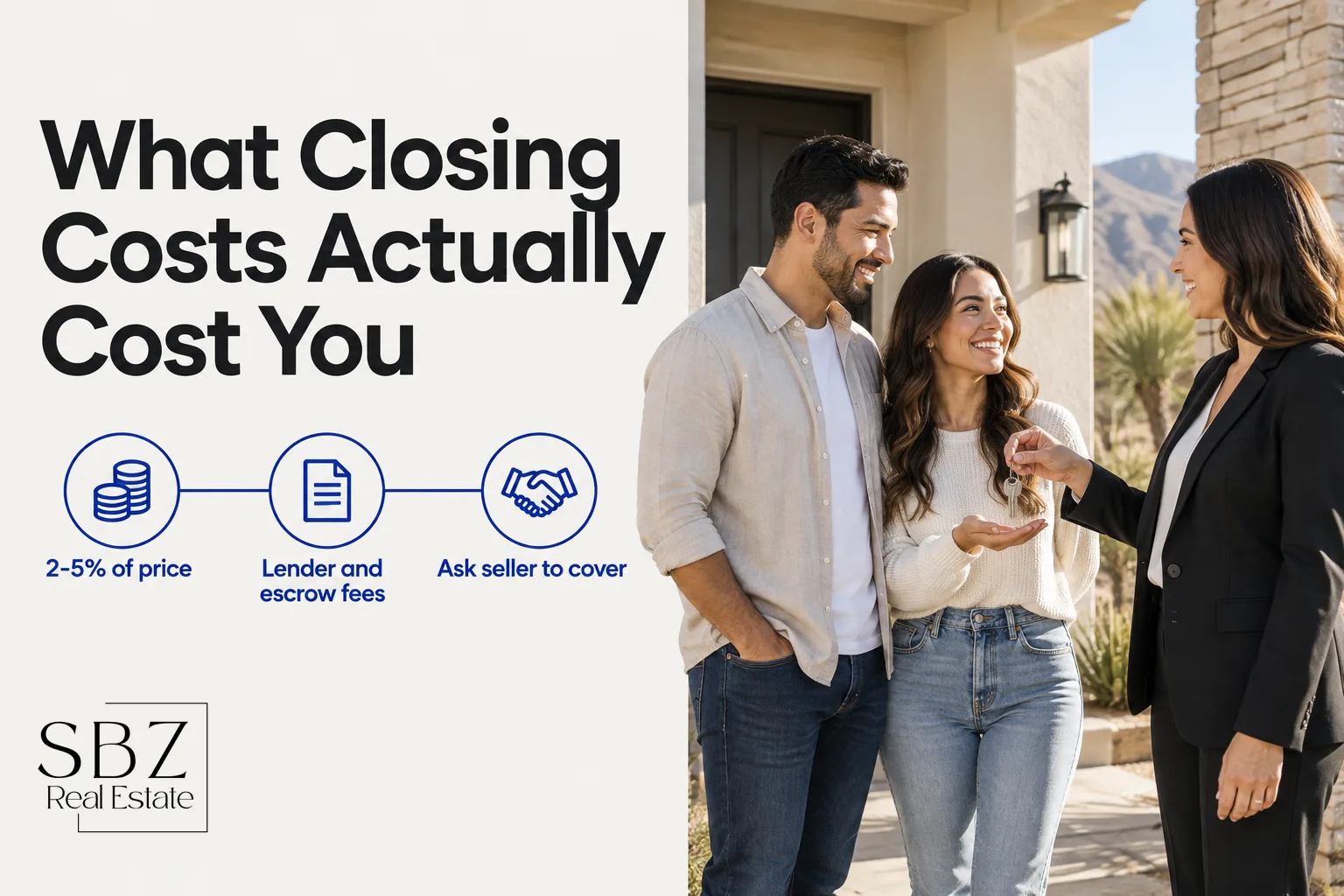
Closing costs for Antelope Valley home buyers typically run between 2% and 5% of the purchase price — on a $400,000 home, that's $8,000 to $20,000 due at the close of escrow, on top of your down payment. Knowing what makes up that number before you go under contract makes for a much smoother transaction.
Most buyers focus on the down payment and forget that closing costs are a separate, day-of-closing expense. Here's a clear breakdown of what you'll see on your Closing Disclosure — and a few things you may actually be able to negotiate.
What Lender Fees Will I Pay?
If you're financing the purchase — and most buyers in Palmdale, Lancaster, and Quartz Hill are — your lender's fees will likely be the largest single line on your closing statement.
Origination fee. This covers the lender's cost to process, underwrite, and fund the loan. It typically runs 0.5%–1% of the loan amount, though some lenders advertise "no-origination" products that roll the cost into a slightly higher rate instead.
Discount points. Optional, but worth understanding. One point equals 1% of the loan amount and buys down your interest rate. Whether points make sense depends on how long you plan to keep the loan — ask your lender to run the break-even math.
Appraisal fee. Most purchase loans require an independent appraisal confirming the property supports the sale price. Expect to pay $500–$800 in the Antelope Valley, often collected upfront before the appraisal is ordered.
Credit report, flood certification, and other third-party fees. These are usually small — $30–$75 each — but they show up on the Loan Estimate you'll receive within three business days of submitting a loan application.
What Are Title Insurance and Escrow Fees?
California uses escrow companies rather than attorneys to close residential transactions, so you'll see two sets of third-party charges here.
Escrow fee. The escrow company holds funds, coordinates all parties, and disburses money at closing. Fees vary by company and purchase price but typically run $1,500–$2,500 on a mid-range Antelope Valley transaction. In many deals this is split between buyer and seller — though that's a negotiable term.
Lender's title insurance. Your lender requires a title insurance policy protecting their interest in the property. It's a one-time premium paid at closing, calculated on the loan amount.
Owner's title insurance. This protects your interest as the new owner against any title defects that surface after closing — undiscovered liens, boundary disputes, or recording errors. It's technically optional, but it's worth having. A single unresolved title issue can cost far more than the premium.
Recording fees. Los Angeles County charges fees to record the deed and deed of trust in the public record. These are modest — generally under $200 total.
What Are Prepaids and Reserves?
This is the line that surprises buyers most, because it doesn't feel like a closing "cost" — it's money you're putting aside, not money you're spending — but it's real cash you need at the table.
Prepaid interest. You'll pay interest from the closing date through the end of that month. The later in the month you close, the smaller this line item.
Homeowner's insurance. Lenders require proof of an active policy at closing. You'll typically prepay the first year's premium — budget $1,200–$2,000 annually in the Antelope Valley, though premiums have shifted in recent years, so get a quote early in the process rather than the week before closing.
Property tax reserves. If your loan-to-value ratio is above 80%, your lender will likely require an impound account — meaning they collect property taxes and insurance with your monthly payment and pay those bills on your behalf. At closing, you'll need to fund this reserve, often covering several months of taxes upfront.
Los Angeles County's base property tax rate is 1%, with additional special assessments and local bonds that vary by parcel. Confirm the effective rate for your specific property with your escrow officer — it matters for budgeting.
Can I Negotiate Closing Costs?
Yes — and this is one of the more underused tools in a buyer's transaction.
Seller concessions. In many transactions, buyers ask the seller to contribute toward closing costs. This is especially common with FHA and VA loans, where sellers can contribute up to a program-capped percentage. Whether a seller will agree depends on market conditions — in a competitive multiple-offer situation it's a harder ask; in a slower market it's a reasonable negotiating point.
Lender credits. You can take a slightly higher interest rate in exchange for a lender credit that offsets closing costs. This reduces what you bring to the table at close, at the cost of a marginally higher monthly payment. It's the reverse of buying points, and it can make sense for buyers who are cash-constrained now but expect their income to grow.
Shop title and escrow. In California, buyers have the right to choose their own title and escrow providers. Comparing a couple of companies can save several hundred dollars with no difference in process.
What Do Closing Costs Look Like on a Real Number?
Here's an illustrative range for a $420,000 purchase in Palmdale with a conventional loan and 10% down:
- Lender fees (origination, appraisal, third-party): $4,000–$6,000
- Title insurance (lender's + owner's): $1,800–$2,400
- Escrow fee (buyer's share): $900–$1,200
- Recording fees: $150–$200
- Prepaids and reserves: $4,000–$6,500
Estimated total: $10,850–$16,300, or roughly 2.6%–3.9% of the purchase price. Your actual figure depends on the lender, the escrow company, your loan type, and when in the month you close.
These are general ranges to help you plan. Your Closing Disclosure — which you'll receive at least three business days before signing — will show the exact figures for your transaction.
If you're working through the numbers on an Antelope Valley purchase and want to walk through what your closing costs might look like, a quick conversation costs nothing. You can reach SBZ Real Estate at 818-696-0888 or hello@sbzre.com.
Frequently asked questions
How soon before closing will I know my exact costs?
Your lender is required to deliver the Closing Disclosure at least three business days before your scheduled closing date. That document shows every fee, credit, and prepaid item to the dollar. If any number looks different from the Loan Estimate you received when you applied, ask your lender to explain the change before you sign anything.
Who pays closing costs in an Antelope Valley home purchase — buyer or seller?
Both parties pay costs, but different ones. Buyers generally cover lender fees, their share of the escrow fee, lender's title insurance, and prepaids. Sellers typically cover the real estate commission, the owner's title insurance policy, and the county transfer tax — though most of these are negotiable in the purchase contract.
Can closing costs be rolled into the loan?
Not directly in a conventional purchase transaction. However, you can negotiate a slightly higher purchase price with the seller crediting back a portion toward your costs — sometimes called a seller concession — which has a similar effect. Some loan programs also allow lender credits to offset fees at the cost of a slightly higher rate.
Are closing costs in the Antelope Valley different from elsewhere in LA County?
The structure is the same across Los Angeles County. What varies is the purchase price — and since many costs are percentage-based, lower home prices in Palmdale and Lancaster mean lower absolute dollar amounts compared to coastal markets, even at the same percentage range.
When exactly do I pay closing costs?
Most closing costs are paid at or before the close of escrow, not when you make an offer. The exception is the appraisal fee, which lenders often collect when the appraisal is ordered — typically shortly after your offer is accepted. The remaining balance (down payment plus closing costs minus any credits) is wired to escrow on or before the closing date.