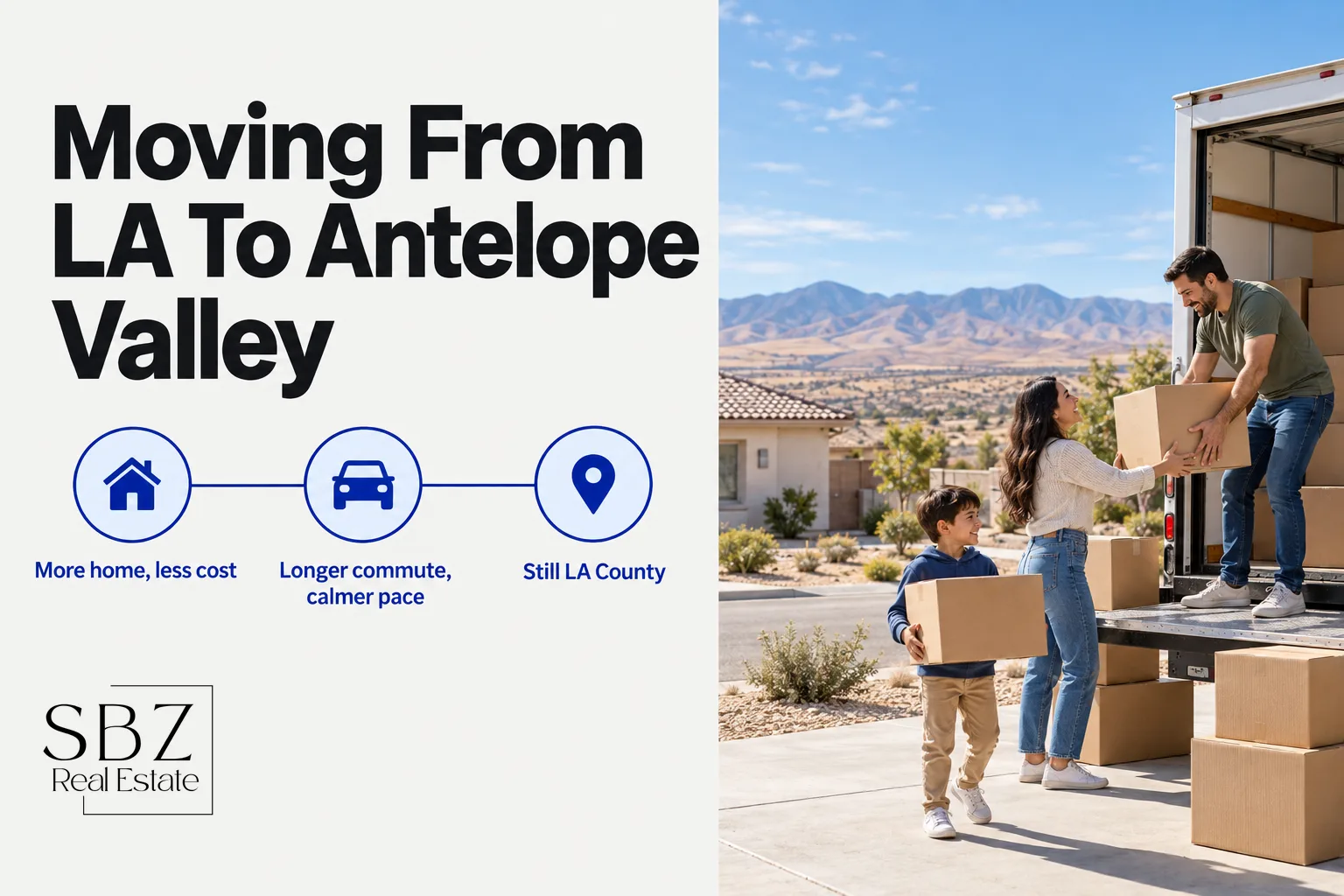
Moving from Los Angeles to the Antelope Valley typically means more purchasing power, a slower pace, and a commute that deserves a clear-eyed look before you sign anything. Here's what actually matters — from a brokerage that has guided buyers through this transition for over ten years.
Why are so many Angelenos moving to the Antelope Valley?
The primary driver is purchasing power. Palmdale, Lancaster, and Quartz Hill sit in northern Los Angeles County — roughly 60 miles from downtown LA — and home prices there have historically run well below the coastal and San Fernando Valley markets. Buyers who've been priced out of the Valley or are tired of paying premium prices for a smaller footprint often find that the Antelope Valley opens up options that simply aren't available closer in.
That said, this move is more than a financial transaction. It's a genuine lifestyle shift, and the buyers who make it happily are the ones who evaluated every dimension of it honestly — not just the price tag.
What does the commute to Los Angeles actually look like?
This is the question that deserves the most honest answer. Palmdale and Lancaster are accessible via the 14 Freeway (the Antelope Valley Freeway), which connects to the 5 and 210 through the Santa Clarita Valley. On a clear morning, the drive to the San Fernando Valley can run 45–60 minutes. At peak hours or in heavier traffic, build in more.
Metrolink's Antelope Valley Line is the other option — it runs from Lancaster and Palmdale south through the Valley to Union Station, and many commuters use it to sidestep the freeway entirely. If your job is near a rail stop, pricing out a monthly pass before you assume you'll be driving every day is worthwhile.
The commute is real, and the buyers who feel best about it are the ones who've done a test run on a weekday — not just mapped the distance on a Sunday afternoon.
How different is the climate from the rest of LA?
Meaningfully different. The Antelope Valley sits at roughly 2,500 feet in elevation and has a high-desert climate: hotter summers, colder winters, and substantially lower humidity than the coastal basin or the San Fernando Valley. Summer days regularly reach triple digits; winters can bring frost, and occasional snow isn't unheard of.
The wind is worth mentioning specifically. The area sits in a natural wind corridor, and spring can bring sustained, strong gusts. If you're accustomed to mild coastal weather year-round, that's an adjustment worth experiencing firsthand before you commit. Spending time out there in July or August — not just in spring — gives a much clearer picture of what the summer feels like at ground level.
What will your budget stretch to in the Antelope Valley compared to LA?
The comparison is stark enough that it changes what buyers are even shopping for. In much of greater LA, a given budget might land a smaller condo or a modest single-family home with a minimal lot. In Palmdale or Lancaster, that same budget typically opens up larger homes with yards, garages, and sometimes pools. Quartz Hill, a community west of Lancaster, tends to attract buyers looking for more land without leaving the Antelope Valley market.
Prices move with the broader Southern California market, and what's available in any given month depends on inventory. The point isn't to set a specific expectation — it's that the relative difference is real and worth understanding before you rule out the area or commit to it.
What does day-to-day life actually look like there?
Both Palmdale and Lancaster have grown substantially and offer the services most households need: major grocery chains, medical facilities, retail corridors, restaurants, and community services. The Antelope Valley Mall in Palmdale serves as the regional retail hub. Recreation options include Saddleback Butte State Park, accessible hiking in the surrounding desert, and the Antelope Valley California Poppy Reserve — one of the most-visited wildflower destinations in the state each spring.
What the area isn't is an urban core. If walkable density, a restaurant row, or proximity to entertainment venues is central to how you live, that's a real tradeoff to name honestly before you decide.
What should I know about buying in the Antelope Valley specifically?
A few things come up consistently with buyers new to this market:
- Mello-Roos and HOAs: Many newer communities in Palmdale and Lancaster carry both HOA dues and Mello-Roos special tax assessments — common in newer California developments. These affect your monthly payment and deserve close review before you make an offer.
- Well and septic: Some properties, particularly on larger lots, are on private well and septic rather than city water and sewer. That's not a dealbreaker, but it changes what you inspect and what you budget for ongoing maintenance.
- Solar agreements: Energy costs run higher in the desert, and many homes have solar installed. If that solar is under a lease or power purchase agreement, you'd assume those terms as the buyer. Understanding them is due diligence, not an afterthought.
- New construction options: The Antelope Valley has more active new construction than most LA submarkets. If you're considering a new build, be clear on what's included, what's an upgrade, and how completion timelines work in practice.
Frequently asked questions
Is the Antelope Valley part of Los Angeles County?
Yes. Palmdale, Lancaster, and Quartz Hill are all in northern Los Angeles County, California. Residents use county services, pay California property taxes under Proposition 13 rules, and are subject to all California state real estate law — the same framework as the rest of greater LA.
How long does it typically take to close on a home in the Antelope Valley?
A standard California residential transaction generally closes in 30 to 45 days from accepted offer, depending on financing type, inspection timelines, and any negotiated contingencies. Confirm your target timeline with your agent and lender early — it's easier to plan around than to compress at the end.
Should I use a local agent or can my current LA agent handle this?
There's no legal restriction either way, but an agent with direct experience in the Antelope Valley market — its neighborhoods, pricing dynamics, common inspection issues, and listing inventory — will typically give you a more accurate picture of what you're buying into. Hyperlocal knowledge matters in a market that moves differently from the rest of LA.
What new construction options exist in Palmdale and Lancaster?
Both cities have seen meaningful new construction activity in recent years, with several master-planned communities offering new builds at various price points. What's actively selling shifts with the market, so it's worth touring communities in person if new construction is a priority — model homes give you a clearer sense of layout, finishes, and what upgrades actually cost.
If you're seriously weighing this move, a conversation with someone who knows both sides of it is the most efficient first step. SBZ Real Estate has worked with buyers and sellers across this corridor for more than 10 years. Reach us at 818-696-0888 or hello@sbzre.com — no pressure, just a clear picture of what you're working with.
CA DRE #02189139