Commercial property is real estate used to run a business or produce rental income. That includes office, retail, industrial, and apartment buildings of five or more units. It is bought and valued differently from a home. The price follows the income the property produces, the financing is underwritten on the property as well as the borrower, and the due diligence goes much deeper. Here is how it works in California, and what to understand before you look at a single listing.
What counts as commercial property?
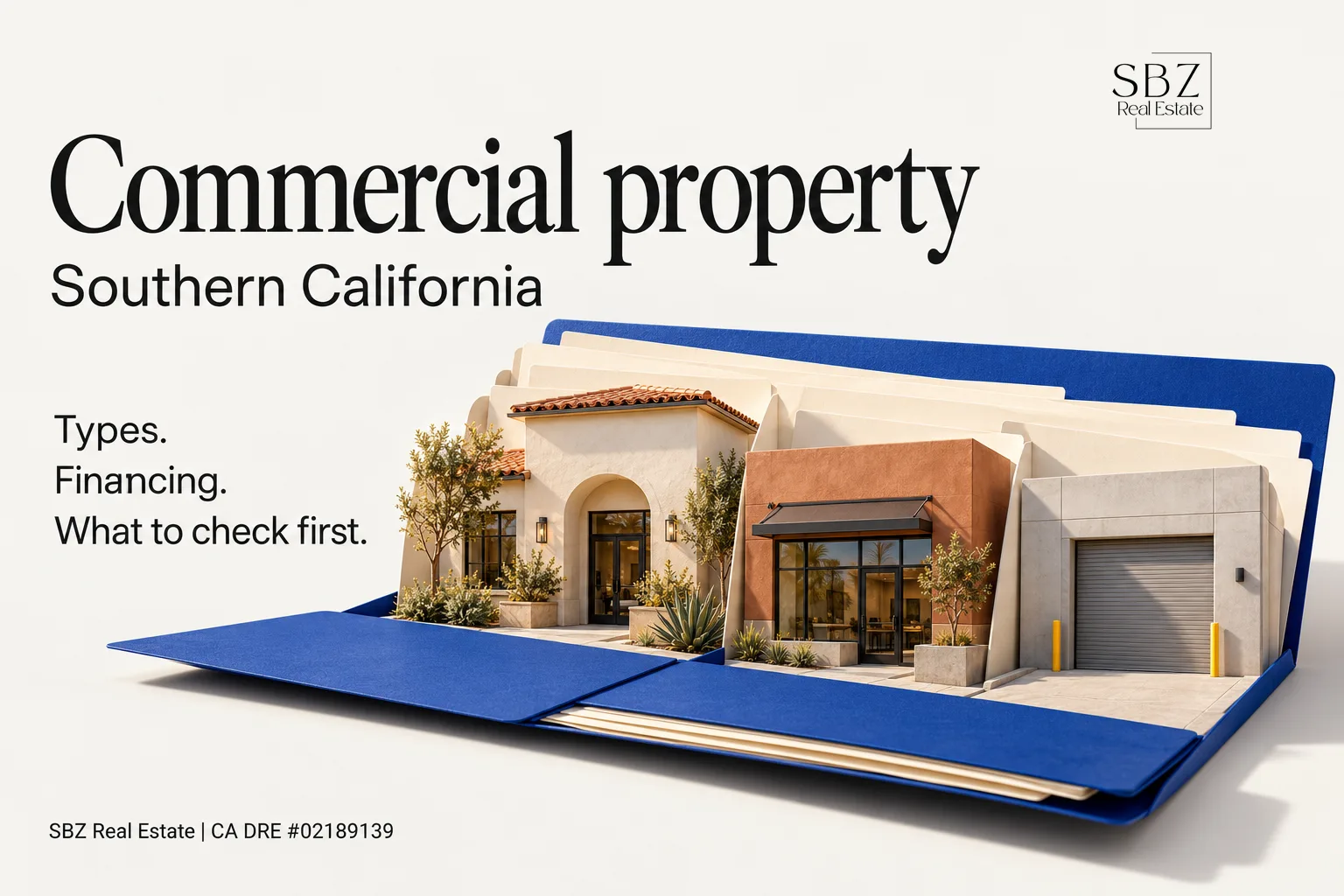
Most buyers searching for commercial property for sale are looking at one of these categories:
- Office: single-tenant buildings, small professional buildings, and multi-tenant suites.
- Retail: storefronts, strip centers, and standalone buildings. Restaurants fall here too.
- Industrial: warehouses, light manufacturing, flex space, and storage.
- Multifamily (5+ units): apartment buildings. Lenders treat them as commercial even though people live there.
- Mixed-use: retail or office on the ground floor, with residential above.
- Land: vacant or entitled parcels held for development or investment.
Residential property with one to four units is generally financed and appraised as a home. Once you pass four units, you are in commercial territory. That is a real dividing line for lenders and for how the property is valued.
How is commercial property valued?
A house is usually priced by comparing it to similar homes that recently sold. Income-producing commercial property is priced mostly on the income it generates.
The two numbers to understand are net operating income (NOI) and the capitalization rate. NOI is rental income minus operating expenses, before debt payments. The cap rate relates that income to the price. If you want the full breakdown, our plain-English guide to what NOI is in real estate walks through the math.
The thing most buyers miss is that the income has to be real and verifiable. Ask for the rent roll, the leases, and at least a couple of years of operating statements. A seller's pro forma, meaning projected numbers, is a sales document. The historical numbers are the facts.
How does financing differ from a home loan?
Commercial loans are underwritten differently from a conventional mortgage. Expect these differences, though specifics vary by lender and by property:
- Larger down payment. Lenders typically want more equity than they do for an owner-occupied home.
- Shorter terms with longer amortization. Many commercial loans come due in a set number of years, with a balloon payment, while payments are calculated on a longer schedule.
- Property-level underwriting. Lenders look at the property's income relative to its debt payments, along with your finances.
- Different rates and fees. Pricing usually differs from a home loan, so get quotes from more than one lender.
If you plan to run your own business out of the building, owner-occupied financing programs may apply. A commercial lender or mortgage professional is the right person to confirm what you qualify for before you make offers.
What should you check before making an offer?
Due diligence on commercial property is longer and more technical than a home inspection. A solid checklist includes:
- Zoning and permitted use. Confirm that your intended use is allowed. Do not rely on what the previous tenant was doing.
- Leases and tenant mix. Look at lease terms, renewal options, who pays taxes, insurance, and maintenance (a "triple net" lease shifts those costs to the tenant), and how close any tenant is to leaving.
- Physical condition. Roof, HVAC, parking, structure, and accessibility compliance. Professional inspections matter more here than on a typical house. Our overview of what a California home inspection covers is a useful starting point for how the report process works.
- Environmental history. Industrial and some retail sites can carry contamination concerns. A Phase I environmental site assessment is the standard first step.
- Title and survey. Look for easements, liens, and boundary questions.
- Property tax impact. In California, a purchase generally triggers reassessment, so your tax bill may look very different from the seller's. Ask a tax professional to model it.
Escrow runs on the same basic framework as a home sale, though the contingency periods are often longer. If the process is new to you, here is how escrow works in California.
Where does the Antelope Valley fit in?
Southern California commercial markets are very different from one another. A neighborhood retail building in the San Fernando Valley, a warehouse in the Inland Empire, and a small multifamily building in the Antelope Valley each trade on different logic. In communities like Palmdale and Lancaster, the questions are usually local: which corridors are zoned for what, how rental demand looks, and what a given building costs to operate.
Investors weighing smaller income properties may find it helpful to read how the Antelope Valley rental market looks for landlords before running numbers on any specific building.
Can a 1031 exchange help you buy commercial property?
Often, yes. Investors selling a rental or investment property sometimes use a 1031 exchange to roll the gain into a new property, including commercial property, rather than recognizing it right away. The rules are strict, especially around timelines and the use of a qualified intermediary. Our guide to 1031 exchanges in Los Angeles explains the framework, and your tax advisor should confirm how it applies to you.
How should you work with a broker on a commercial purchase?
Commercial real estate rewards specialization, and not every brokerage focuses on every property type. A good broker will tell you plainly whether a particular deal fits their experience. If you are unsure how titles and roles differ, here is what agent, broker, and Realtor actually mean.
SBZ Real Estate is a full-service residential brokerage serving the Antelope Valley, the San Fernando Valley, and Greater Los Angeles. It works with investors on rental and income-property strategy, and a good place to start is how investors build a Southern California rental portfolio with a broker. If your plans involve a property type outside that scope, a conversation can help sort out which kind of professional you need.
If you are weighing an income property and want a straight read on where to start, get in touch. A quick conversation costs nothing.
Frequently asked questions
What is the difference between commercial and residential property?
Residential property is used as housing, generally one to four units. Commercial property is used for business or is held mainly for income, including office, retail, industrial, and apartment buildings of five or more units. Valuation, financing, and leases all work differently.
Is an apartment building commercial property?
Lenders usually treat buildings with five or more units as commercial, even though the tenants live there. Properties with one to four units are generally financed as residential.
Do I need a bigger down payment for commercial property?
Typically, yes. Commercial lenders usually require more equity than a conventional home loan, and terms vary by lender, property type, and your financial profile. A lender can quote specifics for your situation.
Can I buy commercial property in an LLC?
Many buyers do, often for liability and ownership-structure reasons. Lenders may have their own requirements, so talk with an attorney and your lender before you sign a contract.
How long does a commercial purchase take?
It usually takes longer than a home purchase because of lease review, inspections, environmental checks, and lender underwriting. Contingency periods are negotiated in the contract, so the timeline depends on the property and the deal.