
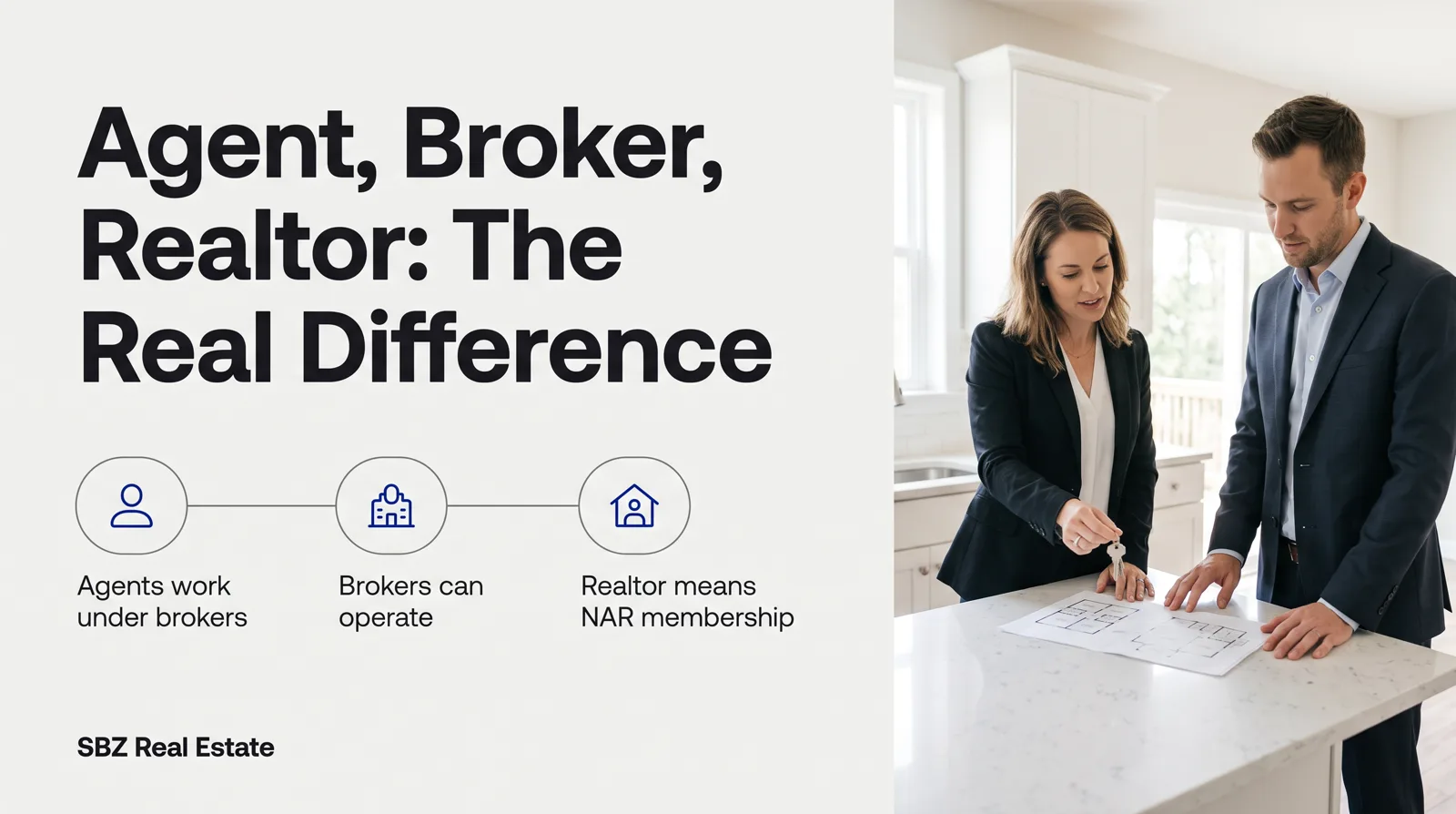
A real estate agent holds a state license to represent buyers and sellers but must work under a licensed broker. A broker has completed additional education and licensing that allows them to operate independently — and to supervise other agents. A Realtor is any agent or broker who is a dues-paying member of the National Association of Realtors.
These distinctions carry more weight than most people expect when you're deciding who to hire.
What Does a Real Estate Agent Actually Do?
A real estate agent is someone who has completed the state-required pre-licensing education and passed a licensing exam. In California, that means 135 hours of approved coursework and a written test administered by the Department of Real Estate.
Here's the part that surprises most people: a licensed agent cannot practice on their own. Every agent in California must hang their license with a licensed broker. That brokerage is the legal entity that holds responsibility for the agent's transactions, paperwork, and professional conduct. When you sign a listing agreement or a buyer representation agreement, you're contracting with the brokerage — not just the individual you're sitting across from.
That structure matters if anything goes wrong. A disclosure issue, a missed contingency, a contract dispute — the broker is ultimately responsible for resolving it.
What Makes Someone a Real Estate Broker?
A broker has gone further. In California, earning a broker license requires a minimum of two years of full-time licensed experience as an agent, plus eight college-level courses covering real estate law, finance, appraisal, economics, and related subjects — followed by a more rigorous state exam.
Once licensed, a broker can open their own firm, operate independently, and take on agents to supervise. Brokers carry a higher level of legal accountability for every transaction that runs through their office.
When you hire a brokerage to help you sell your home or navigate a purchase, you're drawing on that full legal and professional infrastructure — not just one person's license. The distinction is especially relevant when a deal gets complicated, which they often do.
Some brokers operate as solo practitioners under another brokerage (sometimes called a "broker-associate"), while others run their own firms. The title alone doesn't tell you the setup, so it's worth asking.
What Is a Realtor — and Is It a Separate License?
Realtor is a trademarked term, not a license category. It refers to any agent or broker who is a dues-paying member of the National Association of Realtors. NAR membership comes with a published code of ethics, but it doesn't change a person's underlying license or legal standing in a transaction.
Not every licensed agent is a Realtor, and not every Realtor is a broker.
In conversation, people use "agent," "broker," and "Realtor" as if they mean the same thing — they don't. If precision matters to you, ask the person you're considering working with exactly how they're licensed, who their broker of record is, and what the supervision structure looks like.
Does the Distinction Matter When You're Actually Buying or Selling?
Yes — and the moment it matters most is when something unexpected comes up.
If you're buying your first home in the Antelope Valley or elsewhere in California, broker oversight is a layer of protection. An experienced supervising broker can catch a contract clause that shouldn't be there or flag a disclosure that needs more attention before you're locked in. That backstop isn't bureaucracy — it's one of the reasons working through a licensed brokerage is different from working with an unlicensed referral.
For sellers, the brokerage manages your listing agreement, offer review, seller disclosures, and coordination with escrow from contract to close. Understanding what a seller net sheet covers and how your proceeds are structured is something your broker — or the broker behind your agent — should walk you through clearly before you sign anything.
What to Look For Beyond the License
A license is a minimum qualification, not a measure of quality. Here's what actually separates real estate professionals in a market like Greater Los Angeles or the Antelope Valley:
- Local knowledge, specifically. Do they understand the communities you're interested in at the neighborhood level? There's a meaningful difference between broad geographic coverage and genuine familiarity with how a specific market moves.
- Who's actually doing the work. On large teams, the lead agent may introduce themselves at the first meeting and then hand off everything else. In a boutique brokerage, one person manages the relationship from first conversation to closing.
- Transaction experience in your range and property type. Ask directly about deals they've personally worked in your price range — not team totals.
- Communication. This is a high-stakes process. The person handling your transaction should be reachable, clear, and proactive — not a source of uncertainty during the weeks between contract and close.
Questions like what closing costs to expect or when the best window to sell actually is are things a seasoned broker or agent should be ready to talk through without deflecting.
How SBZ Real Estate Is Set Up
SBZ Real Estate is a licensed California brokerage (CA DRE #02189139). Our clients work with the brokerage directly — not an agent whose license is held somewhere else. We've been in business for over 10 years, and the model we work from is straightforward: the broker you hire is the broker who works your deal.
We serve Greater Los Angeles and surrounding communities — from Palmdale and the Antelope Valley to Glendale, Burbank, Sherman Oaks, Studio City, and out to Irvine and Orange County. If you want to understand what working with us looks like before you pick up the phone, the about page is a good starting point.
When you're ready to talk through a move — buying, selling, or just thinking through timing — reach out. A conversation costs nothing.
Frequently Asked Questions
Can a real estate agent work without a broker in California?
No. California law requires every licensed agent to work under a licensed broker. The broker supervises their transactions and carries legal responsibility for their conduct. An agent cannot legally represent clients independently.
Is a broker automatically more experienced than an agent?
Not necessarily, though brokers have met a higher licensing bar — more education, more exam rigor, and a minimum period of licensed experience. What actually matters is how many deals the person has worked in your market, your price range, and your property type. Ask those questions directly.
Does it matter whether I work with a Realtor specifically?
Realtor membership signals adherence to a code of ethics, but it doesn't change someone's legal qualifications. Focus on license type, local knowledge, and track record rather than organizational membership when evaluating who to hire.
What's the difference between a listing broker and a buyer's broker?
The listing broker represents the seller and is responsible for marketing the property, managing disclosures, and coordinating the transaction on the seller's side. The buyer's broker represents the buyer's interests — including offer strategy, due diligence, and contract review. Both are disclosed in the California purchase agreement.
If I'm working with a team, who is responsible for my transaction?
There is always a broker of record whose license covers the entire operation. You have the right to ask who that broker is and how directly they're involved in your deal — not just the team as a whole. In a boutique brokerage, that question has a cleaner answer.