
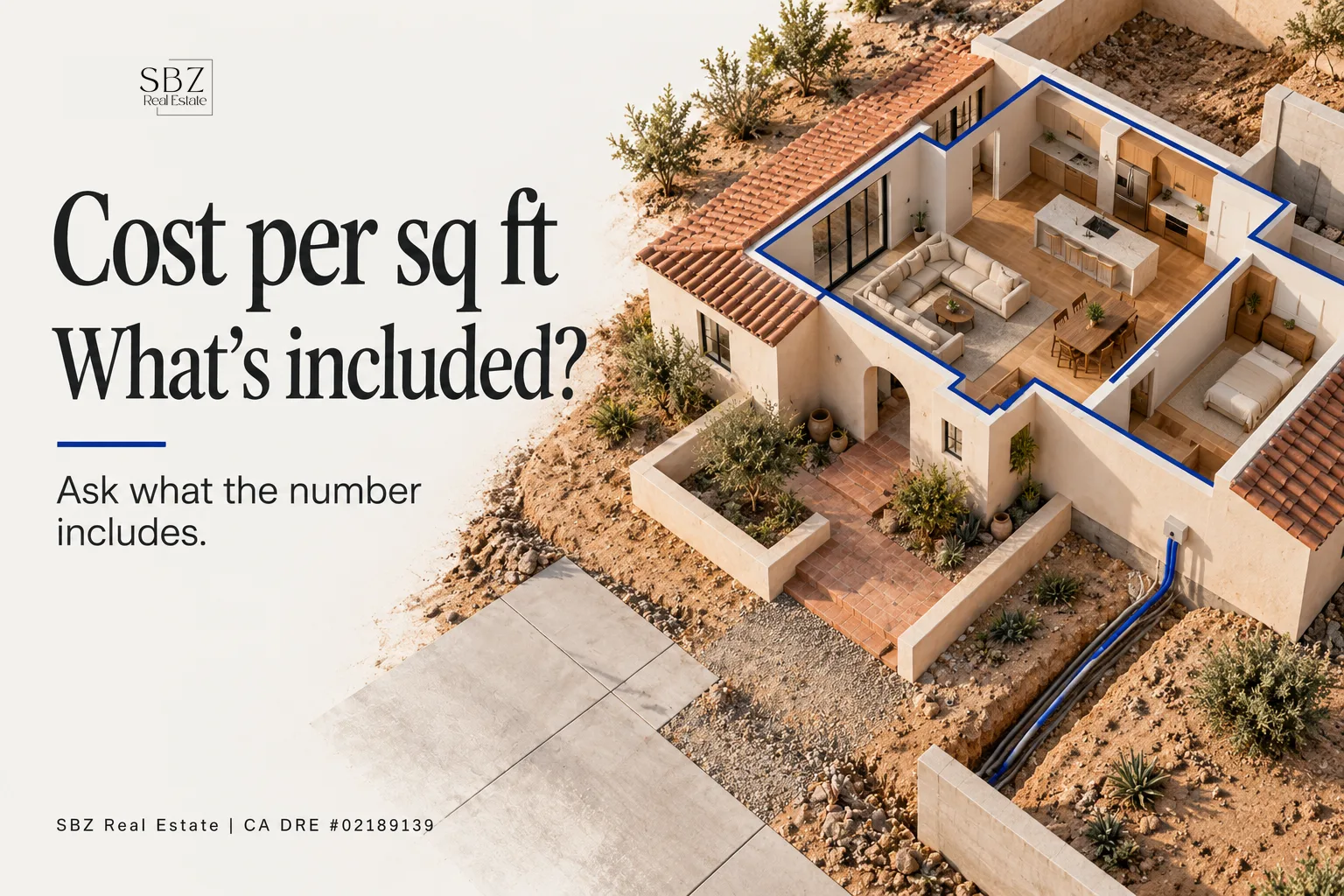
The average cost per square foot to build a home is a single figure that hides a wide range, and in Southern California it only means something once you know what the builder included. Any number you see online, mine included, is a starting point for conversation, not a quote. The real figure comes from a licensed contractor's written bid for your lot, your plans, and your finish level.
I'm not going to hand you a dollar-per-foot figure I can't tie to a current, named source. Construction costs move with materials, labor, and local rules. Instead, here is how the number is built, what usually gets left out of it, and how to use it to decide whether building or buying makes more sense.
What does "cost per square foot" actually mean?
It is total construction cost divided by finished, heated living area. Garages, covered patios, and unfinished spaces are usually priced differently or excluded, so two builders quoting "per square foot" may be measuring different things.
The same figure can mean very different scopes. One builder's number may cover only the framed structure and systems. Another's may include permits, landscaping, and appliances. When someone quotes a per-foot cost, ask what's in it before you compare it to anything else.
What drives the cost per square foot up or down?
Several things move the number more than square footage itself:
- Finish level. Cabinetry, flooring, countertops, windows, and fixtures can change the per-foot cost more than any structural decision.
- Home size and shape. Kitchens and bathrooms are expensive per foot, so a smaller home often costs more per square foot than a larger one. Complex rooflines and multiple stories add cost too.
- Site conditions. Slopes, poor soil, and the need for grading or retaining walls all add cost before a wall goes up.
- Labor and materials. Both shift with the market, which is why an old estimate can be badly out of date.
- Code requirements. California's energy code requires solar on most new low-rise homes, and homes in designated high fire hazard areas face additional ignition-resistant construction standards. Both affect the bottom line.
What costs usually sit outside the per-square-foot number?
This is the thing most would-be builders miss. The per-foot figure typically covers the house, not everything it takes to get to a finished, livable property. Ask whether your budget needs separate lines for:
- The land itself, which in many Southern California markets is the largest single cost.
- Site work: clearing, grading, driveway, and utility connections.
- Utilities. On some rural lots, that can mean a well or septic system instead of a simple connection to existing services.
- Permits, plan check, and impact fees charged by the city or county and school district.
- Design and engineering: architect, structural and soils engineers, and energy calculations.
- Surveys and reports. A boundary and topographic survey is usually your first step. Our guide on what land surveys cost in Southern California walks through what to expect.
- Landscaping, fencing, and finish extras that a base bid may not include.
- Financing and carrying costs: construction loan interest during the build, insurance, and a contingency reserve.
A sensible rule of thumb is to ask your contractor to separate "hard costs" (physical construction) from "soft costs" (everything else) in writing, then add your own contingency on top.
How do you get a realistic number for your lot?
Start with the lot, not the house. A few steps get you from a vague average to something you can plan around:
- Confirm what you can build. Zoning, setbacks, height limits, and any HOA or special-district rules come first. Your city or county planning department can tell you.
- Get a survey and a soils report so site surprises show up before you buy, not after.
- Collect at least two or three written bids from licensed California contractors, using the same plans and the same finish schedule so they compare fairly.
- Ask for an itemized breakdown instead of a lump sum.
- Build in a contingency. Unforeseen conditions are common on ground-up projects.
Verify any contractor's license status through the Contractors State License Board before you sign anything.
Is it cheaper to build or buy in the Antelope Valley?
Sometimes building looks attractive on paper because land in parts of the Antelope Valley has historically been more accessible than in the Westside or the San Fernando Valley. But a lower land price doesn't automatically mean a lower all-in price once site work, utilities, fees, and financing are added.
Comparing the two honestly means putting an all-in build budget next to what comparable existing homes are actually selling for. That is a job for a comparative market analysis. If you're unfamiliar with how it works, here's what a CMA is and how a broker builds one.
It also helps to look at the other side. A builder's finished home is brand new, but so are its unknowns, from warranty terms to what the contract allows you to change. Our piece on new construction homes in the Antelope Valley covers what to review before you sign with a builder, and what inspections turn up in older homes shows the trade-offs on the resale side.
If you're weighing specific areas, our pages on Palmdale and Lancaster are a good starting point for the local picture.
How should you finance and time a ground-up build?
Construction financing works differently from a standard mortgage. Lenders typically release funds in stages as work is completed, and you may be paying interest during the build while also paying for your current housing. Talk to a lender early about how your loan would be structured, and build your timeline with room for permit and inspection delays.
If part of your plan is a down payment on land or a home, see our guide on how much to put down on a house for a framework that applies to both purchases and builds.
What's the next step if you're weighing building against buying?
Gather three things: a rough all-in build budget from a contractor, a realistic read on what similar existing homes cost in your target area, and a clear sense of your timeline. Compared side by side, they usually make the decision clearer than any average will.
If you'd like a second set of eyes on that comparison, you can reach out here or read more about buying with SBZ Real Estate. A quick conversation costs nothing, and there's no pressure either way.
Frequently asked questions
What is the average cost per square foot to build a home?
There isn't one reliable average. It varies with location, finish level, site conditions, and what the builder includes. The most useful figure is an itemized bid for your specific lot and plans.
Is the cost per square foot higher for a smaller house?
Often, yes. Kitchens, bathrooms, and mechanical systems cost roughly the same whether the home is small or large, so those fixed costs spread over fewer square feet.
Does the per-square-foot cost include the land?
Usually not. Most quotes cover construction of the home only. Land, site work, permits, design fees, and financing are typically separate lines.
How do I know if building is cheaper than buying?
Add up the land, the full construction bid, soft costs, financing, and a contingency, then compare the total to the prices of comparable existing homes nearby. A local broker can help with the comparison side.
Who should I get a construction bid from?
Use a licensed California contractor, and verify the license through the Contractors State License Board. Get more than one written, itemized bid based on the same plans.
