
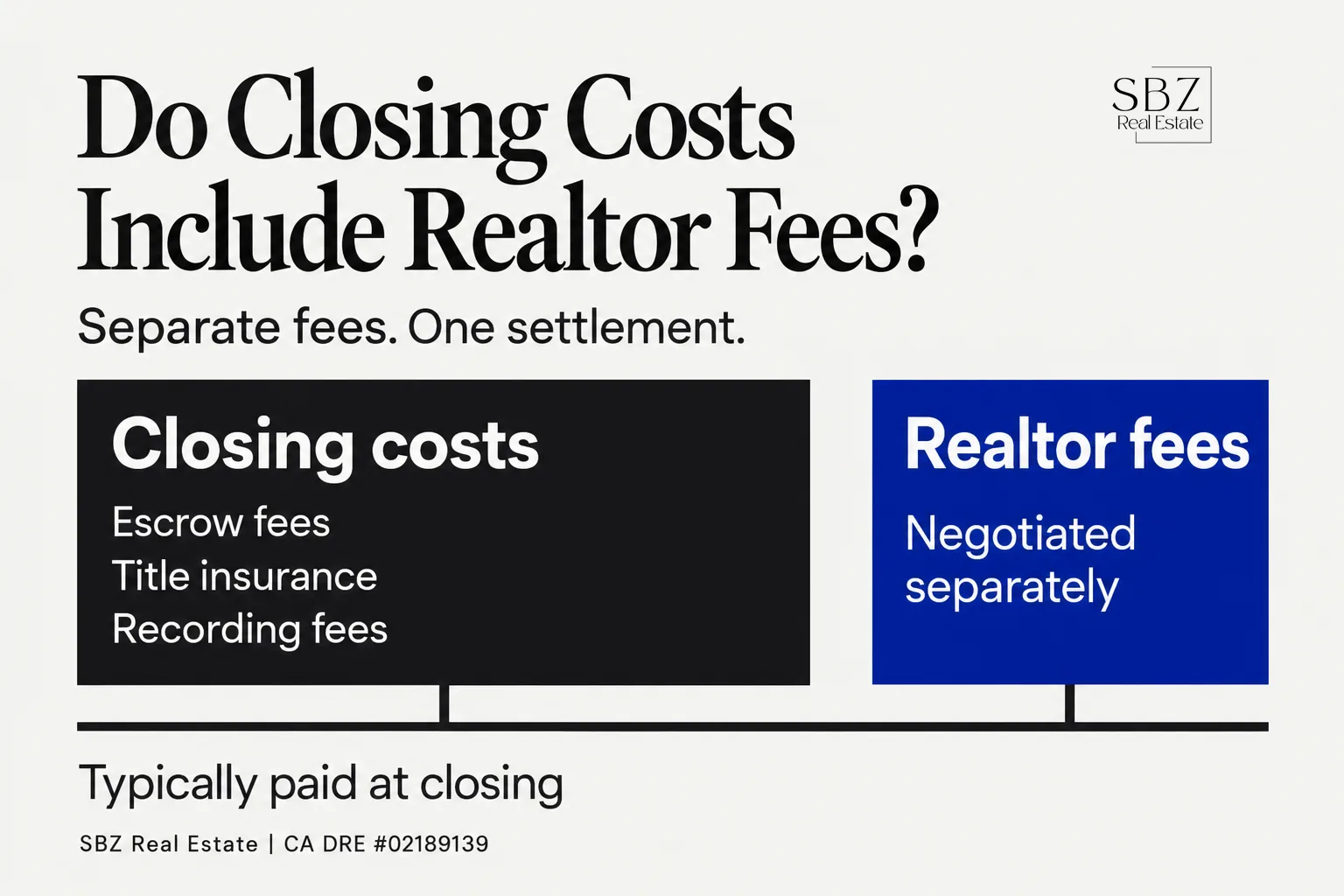
Technically, no. Realtor fees are a separate cost from standard closing costs, but they're almost always paid at the same moment, through escrow, at closing. That's why the two get lumped together so often, and why one surprises people more than any other line on the final settlement statement.
Here's how commissions actually move through a California transaction, who usually pays them, and what changed for buyers recently.
What's the difference between closing costs and realtor fees?
Closing costs are the fees for the services and paperwork that finish a sale: escrow, title insurance, recording fees, transfer taxes, lender charges, prorated property taxes, and HOA items. They exist whether or not an agent is involved.
Realtor fees, more precisely called real estate commissions or broker compensation, pay the brokerages that represent the buyer and the seller. They're set by the written agreement you sign with your brokerage, not by any government schedule, and they're negotiable. In real terms, a commission is a contract obligation that happens to get settled through escrow, not a closing cost.
Why do realtor fees show up with closing costs?
In California, the money changes hands in escrow. When the sale closes, the escrow officer pays out everyone who has a claim on the transaction from a single accounting: the seller's loan payoff, title and escrow fees, transfer taxes, and the brokers' commissions. All of it lands on the same settlement statement.
So if you're a seller looking at your final numbers, the commission sits a few lines away from the escrow fee and the title premium. Nobody hands the brokerage a check separately. If you'd like a clearer picture of that process, our guide on how escrow works in California explains each step.
Do sellers pay realtor fees out of closing costs?
Sellers typically pay their own listing brokerage's commission, and it comes out of the sale proceeds at closing. You don't bring cash to the table for it. It's deducted before your net funds are wired to you.
The thing most sellers miss is how big that line is compared with everything else. Commission is often the largest single deduction after the mortgage payoff, which is why we prepare an estimate before a home ever goes on the market. A seller net sheet lays out commission, escrow, title, transfer taxes, and payoffs side by side, so the number you walk away with isn't a guess.
For the full list of what sellers usually cover beyond commission, see what closing costs home sellers pay in California.
Do closing costs include realtor fees for the buyer?
This is where things changed. For a long time, the seller's listing agreement usually covered the buyer's agent too, so most buyers never saw a commission on their own paperwork. That arrangement is no longer automatic.
Following the National Association of REALTORS® settlement, practice rules that took effect in August 2024 require buyers working with a REALTOR® to sign a written agreement with their brokerage before touring homes. That agreement states how the buyer's brokerage gets paid and how much. From there, a few outcomes are possible:
- The seller agrees to pay it. Sellers can still offer to cover the buyer's broker, either up front or as a term negotiated in the purchase offer.
- The buyer requests a seller credit. The offer can ask the seller to contribute toward the buyer's broker compensation, paid through escrow.
- The buyer pays it directly. If the seller doesn't cover it, the buyer owes their brokerage under the signed agreement, usually paid at closing.
- A combination. The seller covers part, the buyer covers the rest.
If a buyer does pay some or all of their agent's compensation, it shows up on the buyer's side of the settlement statement and on the Closing Disclosure from the lender, usually in the "Other" section. So for buyers, the honest answer is that realtor fees can now appear with your closing costs, depending on what's negotiated.
Can a buyer finance their agent's commission into the loan?
Generally, no. Broker compensation isn't something most loan programs let you roll into the mortgage balance. It has to be covered by the seller, by the buyer's own funds, or by a seller credit the lender allows.
Seller credits come with limits. Loan programs cap how much a seller or other interested party can contribute toward a buyer's costs, and the caps vary by program and down payment. Before you write an offer that leans on a seller credit, ask your lender how much room your loan actually has. A good buyer's agent will coordinate that with your lender before the offer goes out.
How much are realtor fees in California?
There is no standard or legally set commission rate in California. Every commission is negotiated between the client and the brokerage, and the agreement should spell it out in writing, including whether it's a percentage of the price or a flat amount.
What actually matters in this market is what the fee buys. Pricing strategy, preparation, marketing, negotiation, and managing escrow through inspections and appraisal all affect your result far more than a small difference in rate. If you're weighing who to hire, it helps to understand the difference between an agent, a broker, and a REALTOR® and who will actually be handling your file day to day.
What closing costs are separate from realtor fees?
Whether you're buying or selling, these are the items that make up "closing costs" in the traditional sense. Who pays each one is negotiable and often follows local custom:
- Escrow fees. Paid to the escrow company for holding funds and documents.
- Title insurance. The owner's policy and, if there's a loan, the lender's policy.
- Documentary transfer tax. Charged by the county, and by some cities, when property changes hands.
- Recording fees. For recording the deed and loan documents with the Los Angeles County Registrar-Recorder (or the Orange County Clerk-Recorder).
- Lender fees. Origination, appraisal, credit report, and related charges (buyer side).
- Prorations. Property taxes, HOA dues, and sometimes Mello-Roos assessments, divided between buyer and seller by date.
- Natural hazard disclosure report, home warranty, and HOA document fees. Common in California transactions.
Buyers in Palmdale, Lancaster, and the rest of the high desert can find a local breakdown in our guide to closing costs for home buyers in the Antelope Valley.
How do you keep realtor fees from being a surprise?
Get everything in writing early, and read it before you sign. Here's what we suggest to every client:
- Sellers: Ask for a net sheet before listing, and decide up front whether you're willing to offer buyer broker compensation. It's a pricing and marketing decision as much as a cost decision.
- Buyers: Read your written buyer agreement carefully. Know the compensation amount, when it's owed, and what happens if the seller won't cover it.
- Both: Review the escrow estimated settlement statement a few days before closing, not at the signing table.
Whether you're selling your home or buying, the numbers should never be the part that catches you off guard.
Frequently asked questions
Are realtor fees part of closing costs?
Not technically. Realtor fees are commissions owed under your agreement with a brokerage, while closing costs cover escrow, title, taxes, and lender charges. Both are usually paid through escrow at closing, so they appear on the same settlement statement.
Does the buyer pay realtor fees in California?
Sometimes. Since August 2024, buyers working with a REALTOR® sign a written agreement stating their agent's compensation. The seller may still agree to cover it, but if they don't, the buyer is responsible for whatever isn't covered.
Are realtor commissions negotiable?
Yes. No law sets a commission rate in California. Fees are negotiated between you and the brokerage and spelled out in your listing or buyer agreement.
When is the realtor commission paid?
At closing. The escrow company pays the brokerages directly out of the transaction funds when the sale records, so sellers don't pay out of pocket beforehand.
Can a seller credit cover the buyer's agent fee?
Often, yes, if it's negotiated in the purchase contract and your loan program allows it. Lenders limit seller contributions, so confirm the allowable amount with your lender before writing the offer.
If you're planning a move anywhere from Palmdale to the San Fernando Valley and want to see what the numbers would look like for you, reach out to SBZ Real Estate. Asking costs nothing, and we'll answer it straight.
