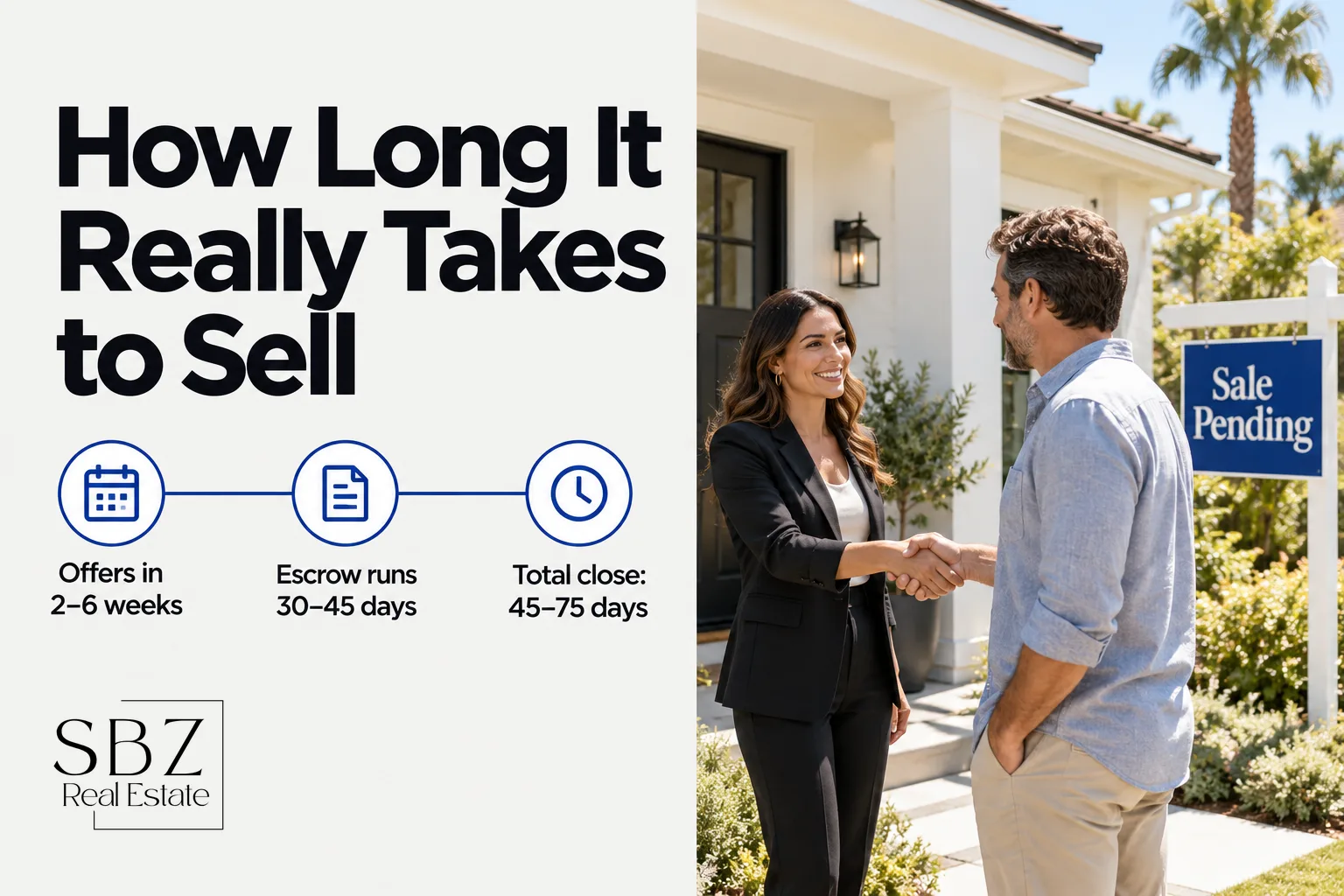
Most Southern California homes go under contract within two to six weeks of listing, and from the day you list to the day you hand over keys, the full process typically runs 45 to 75 days — though that range shifts meaningfully depending on your market, your price point, and how the property is prepared.
That's the honest answer. What I find most sellers actually want to know is which part of that timeline they can control — and there's quite a bit they can.
What Does "Time to Sell" Actually Mean?
There are really two phases here, and it helps to think of them separately.
Phase 1: Active marketing → accepted offer. This is the part most people picture when they ask "how long will it take." It starts the day your listing goes live on the MLS and ends when you sign an accepted purchase contract.
Phase 2: Accepted offer → close of escrow. This is the escrow and loan period. In California, a standard residential escrow runs 21 to 30 days for a conventional purchase, and 30 to 45 days when the buyer is financing with FHA or VA.
Add those together and you get the full picture.
How Long Is Phase 1? Getting an Offer in SoCal
What's typical right now across Greater Los Angeles and the Valley?
In well-priced, well-prepared homes in submarkets like the San Fernando Valley, the Westside, and established Orange County cities, offers tend to arrive within the first two weeks — often in the first weekend if the pricing and presentation are dialed in.
In slower-moving price bands (typically $2M+) or in markets with higher inventory, that window stretches. It's not uncommon for a seller to be in active marketing for four to six weeks before the right buyer surfaces.
The Antelope Valley has its own rhythm — pricing is different, buyer pool is different, and "days on market" targets should be calibrated to what's actually moving in that corridor, not statewide averages.
What makes some homes sit longer?
The three most common culprits I see, in order:
- Pricing above where the market actually is. Buyers are doing their homework. A home that's overpriced by 5–8% will typically generate showings but not offers — and then require a price reduction that costs more time than a sharper initial price would have.
- Presentation that needs work. A cluttered, poorly lit, or deferred-maintenance home takes longer to sell and sells for less. The pre-list preparation period (more on that below) is where time invested pays back with interest.
- Timing into a slow season. Summer in LA can be surprisingly soft — families are traveling, buyers are distracted. The fall and spring windows often see faster absorption.
How Long Is Phase 2? Escrow in California
California escrow is its own world, and it's worth understanding before you accept an offer.
Standard timelines by loan type
| Buyer's financing | Typical escrow length |
|---|---|
| All cash | 10–21 days (sometimes faster) |
| Conventional loan | 21–30 days |
| FHA or VA loan | 30–45 days |
| Jumbo loan | 30–45 days |
These are general ranges. A buyer with a fully underwritten pre-approval can sometimes move faster; a buyer whose file hits complications in underwriting can stretch these timelines.
What happens inside escrow that affects your clock?
- Inspections and repair negotiations. A buyer typically has 10–17 days to conduct inspections and submit a Request for Repair (RR). How you and your agent handle that response affects both timeline and net proceeds.
- Appraisal. Required for financed purchases. In a busy market, appraisers are sometimes backlogged by a week or more. A low appraisal can trigger renegotiation.
- Contingency removals. California's CAR purchase agreement includes inspection, loan, and appraisal contingencies — each with its own removal deadline. Until those are removed, the buyer can still exit. Your agent should be tracking these dates precisely.
- Lender pace. The buyer's lender controls a lot of what happens between contract and close. An experienced, responsive lender makes a real difference; a slow one can push your close date back by a week or two.
What Can You Do to Shorten the Timeline?
Start your pre-list preparation early
The sellers who move fastest are the ones who do the work before they list. That typically means:
- A pre-listing inspection so there are no surprise findings to negotiate mid-escrow
- Decluttering, staging (at minimum furniture editing), and professional photography
- Addressing obvious deferred maintenance — not a full renovation, but the items a buyer will flag on day one
- Gathering your HOA documents, disclosures, and any permit history so escrow can open clean
If you build in two to four weeks of prep before going live, you often recover that time on the back end with a faster, cleaner escrow.
Price it accurately from the start
The thing most sellers resist hearing is that a strategically priced home — one positioned to attract multiple interested buyers — creates a competitive dynamic that both speeds up the sale and often improves the final number. A home that needs price cuts loses that advantage, and every reduction extends your days on market.
This is where a broker who knows the micro-market isn't just a nice-to-have. It matters.
Accept an offer that's structured to close
Offer price isn't the only thing on the page. A cash offer with a 15-day close is a different proposition than a financed offer at a slightly higher price with a buyer who's still shopping lenders. Part of my job is helping sellers evaluate what an offer actually means in terms of certainty and timeline — not just the number at the top.
A Realistic Timeline, Start to Finish
Here's what a smooth, well-run sale in Southern California often looks like in practice:
| Phase | Timeframe |
|---|---|
| Pre-list prep (staging, inspections, disclosures) | 2–4 weeks |
| Active on market → accepted offer | 1–4 weeks |
| Escrow (conventional financing) | 21–30 days |
| Total, start to close | 45–75 days |
Cash transactions with a motivated buyer and a clean property can close in under 30 days from listing. Complex situations — probate, deferred maintenance, high price points, unusual title issues — can stretch to 90 days or more.
What If You're on a Hard Deadline?
Sometimes the timeline isn't flexible — a job relocation, an estate situation, a date you need to be moved by. That changes the strategy somewhat, and it's worth talking through early.
In those cases, I typically look at: whether a cash buyer pool makes sense (accepting a discount in exchange for speed and certainty), whether a leaseback provision after closing could give you more flexibility, and how we can structure the listing and escrow to front-load anything that might slow things down.
There are real options — they just require planning from the start, not at the last minute.
The Bottom Line
Selling a home in Southern California is rarely a two-week event, but it's also not the six-month ordeal some sellers brace for. Most well-prepared, accurately priced homes in this market are under contract within a month and closed within 30 to 45 days after that.
The variables that matter most — preparation, pricing, offer selection, and escrow management — are all things your broker should be actively working with you on, not just watching from the sideline.
If you're weighing a move and want to understand what the timeline realistically looks like for your specific property and situation, a quick conversation costs nothing. That's exactly the kind of planning that makes the process go smoothly when it's time to go.
Frequently asked questions
What are the two phases of a home sale?
Active marketing through an accepted offer, followed by escrow through closing.
What commonly slows the marketing phase?
Overpricing, weak presentation, and slower seasonal timing can extend it.
Can sellers shorten the timeline?
Preparation, accurate pricing, careful offer selection, and escrow management all help.
Related reading
- How to Choose a Real Estate Agent in Southern California
- How to Price Your Home to Sell in Los Angeles
- How Long Does It Take to Sell a House in the Antelope Valley?
- Best Time to Sell a House in California: What the Calendar Actually Tells You