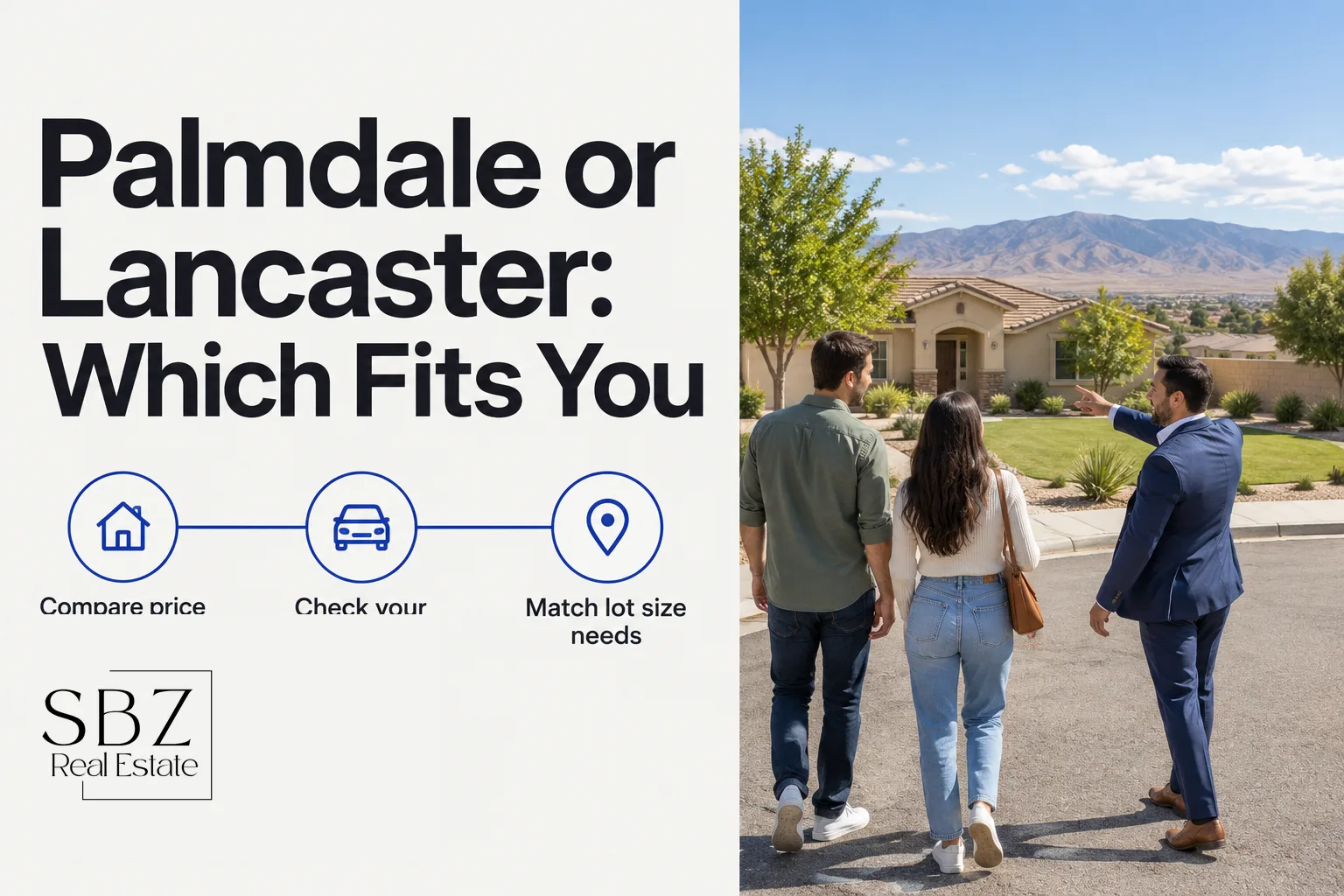
Neither city is objectively "better" — Palmdale tends to offer newer tract construction and slightly easier freeway access to the 14, while Lancaster tends to offer larger lots and a wider range of price points, from starter homes to acreage. The right answer depends on your commute, your budget, and what you actually want your day-to-day life to look like.
I get this question constantly from buyers who've been priced out of the San Fernando Valley and are looking north to the Antelope Valley for the first time. Both cities sit in the same high desert region of northern Los Angeles County, share a lot of the same infrastructure, and are close enough that people cross-shop them without thinking twice. But they're not identical, and the differences matter once you narrow down to a specific address.
What's the actual difference between Palmdale and Lancaster?
Geographically, they're neighbors — Palmdale sits to the south and east, Lancaster to the north, and the two cities' boundaries blur in places. The practical differences show up in housing stock and layout rather than anything dramatic.
Palmdale has done more infill and newer-build development over the last two decades, especially in areas like Anaverde and the east side near Pearblossom Highway. That means more homes built in the 2000s and later, with modern floor plans and HOA-managed communities. Lancaster has a broader mix — older ranch-style homes from the '70s and '80s, newer developments west of the 14, and rural parcels with real acreage if you go toward the edges of the city.
Lancaster functions as the Antelope Valley's civic hub — it's home to more of the government offices, the BLVD (its revitalized downtown corridor), and a stronger arts and events calendar. Palmdale leans more toward retail and industry, including its aerospace employment base tied to Air Force Plant 42.
Which city has better home prices?
Both cities run well below the Los Angeles County median, which is the entire draw for buyers leaving the Valley or the Westside. Within the Antelope Valley itself, pricing between the two is closer than people expect — the bigger swings happen neighborhood to neighborhood, not city to city.
That said, a few general patterns hold:
- Newer subdivisions in Palmdale (Anaverde, west Palmdale near the 14) tend to carry a premium for age and HOA amenities.
- Older Lancaster neighborhoods closer to the downtown core can be more affordable per square foot, though some need updating.
- Larger-lot and rural properties are more common — and often more affordable per acre — on Lancaster's outskirts.
- New-construction pricing in either city will run higher than resale, regardless of which side of the city line it's on.
Treat citywide averages as a rough starting point at best — two homes a mile apart can differ by $50,000 depending on age, lot size, and school attendance boundary. If you want a real number for your specific budget and timeline, that's a conversation, not a spreadsheet.
What's the commute like from each city?
This is usually the deciding factor for buyers still working in the Valley, Burbank, or downtown LA. Both cities sit along the 14 Freeway corridor, so the honest answer is: it depends on exactly where in each city you're looking, not which city you pick.
Palmdale generally sits a few miles closer to the Valley on the drive south, which can shave a few minutes off a daily commute — meaningful if you're doing it five days a week, less meaningful if you work from home most days or commute occasionally. Lancaster residents make the same drive; it's just a bit longer depending on which part of town you're in. Metrolink's Antelope Valley Line runs through both cities, with stations in each, so rail commuting is an option regardless of which side you choose.
If your daily commute is the top priority, look at drive times from the specific neighborhood you're considering, not the city boundary. I've had buyers assume Palmdale would automatically be faster and end up with a longer door-to-door time than a Lancaster listing closer to the freeway on-ramp.
Which city has better schools?
For elementary and middle school, Palmdale addresses fall mostly within the Palmdale School District, with Westside Union and Eastside Union serving parts of the area, while Lancaster addresses fall mostly within the Lancaster School District. For high school, both cities are served by the same district — the Antelope Valley Union High School District. Both regions have a range of school performance depending on the specific attendance boundary — this is genuinely block-by-block, not city-by-city.
If schools are a priority, pull the actual attendance boundary for the address you're considering before you write an offer. We always recommend cross-checking that against the district's own boundary maps rather than a general "this city has good schools" assumption, since a home two streets over can fall into a different school.
What about lot sizes and outdoor space?
If having room to build, garden, park an RV, or keep animals matters to you, Lancaster generally has the edge — especially the further west and north you go, where zoning allows for larger residential parcels and some agricultural or equestrian use. Palmdale's newer subdivisions tend to have tighter, more standardized lot sizes typical of planned communities.
That's a generalization, though. Palmdale has pockets with generous lots too, particularly in older, established neighborhoods on the east side. If lot size is a hard requirement, it's worth having your search filtered by acreage rather than by city name — the city line won't tell you what you actually need to know.
Is it better to buy new construction or resale in the Antelope Valley?
Both markets have active new-home builders, and both have solid resale inventory. New construction gets you modern efficiency standards, a builder warranty, and no deferred maintenance — but you'll pay a premium and often have less negotiating room than you would with a private-party resale seller.
Resale gives you more variety in lot size, mature landscaping, and — depending on the seller's situation — more flexibility on price and terms. In real terms, I tell buyers to decide on new-vs-resale first, then let that filter narrow the city question, because it often does more of the work than the city choice itself.
How do I decide which one is actually right for me?
Start with your non-negotiables, in this order: commute tolerance, budget ceiling, and lot size or property type. Once those three are locked in, the city choice usually answers itself — you'll find you're really choosing between three or four specific neighborhoods, not between Palmdale and Lancaster as abstract options.
The thing most buyers miss is that both cities are large enough to contain their own internal range — a starter home near the Lancaster/Palmdale line and a custom home on Lancaster's northwest edge have almost nothing in common except the city name on the mailing address. Comparing cities gets you in the right region. Comparing specific listings against your actual priorities is what gets you into the right home.
If you're weighing a move to the Antelope Valley and want a read on current inventory in both cities for your specific budget, a quick conversation costs nothing.
Frequently asked questions
Is Palmdale or Lancaster safer?
Public safety varies by specific neighborhood in both cities rather than by city as a whole, and current crime statistics for any address are available through the respective police department and county sheriff's public data. I'd encourage buyers to review those sources directly for the exact area they're considering rather than relying on general reputation.
Which city is growing faster, Palmdale or Lancaster?
Both cities have seen development activity in recent years, including new residential subdivisions and commercial growth tied to aerospace and logistics employment in the region. Growth patterns shift, so current building-permit data from each city's planning department is the most reliable source if this matters to your decision.
Is Palmdale or Lancaster closer to Los Angeles?
Palmdale sits slightly closer to the San Fernando Valley along the 14 Freeway, though the difference in drive time depends heavily on the specific neighborhood and time of day. Both cities are commutable via the Antelope Valley Metrolink line as well.
Can I get more land for my money in Lancaster than Palmdale?
Generally, yes — Lancaster has more areas zoned for larger residential and semi-rural parcels, particularly toward its western and northern edges. Palmdale has some larger-lot pockets too, so it's worth filtering any search by lot size directly rather than assuming by city.
Should I use the same agent to look at homes in both cities?
Yes — Palmdale and Lancaster are close enough that one broker with working knowledge of both markets can walk you through comparable listings side by side, which is usually more useful than researching each city in isolation.