
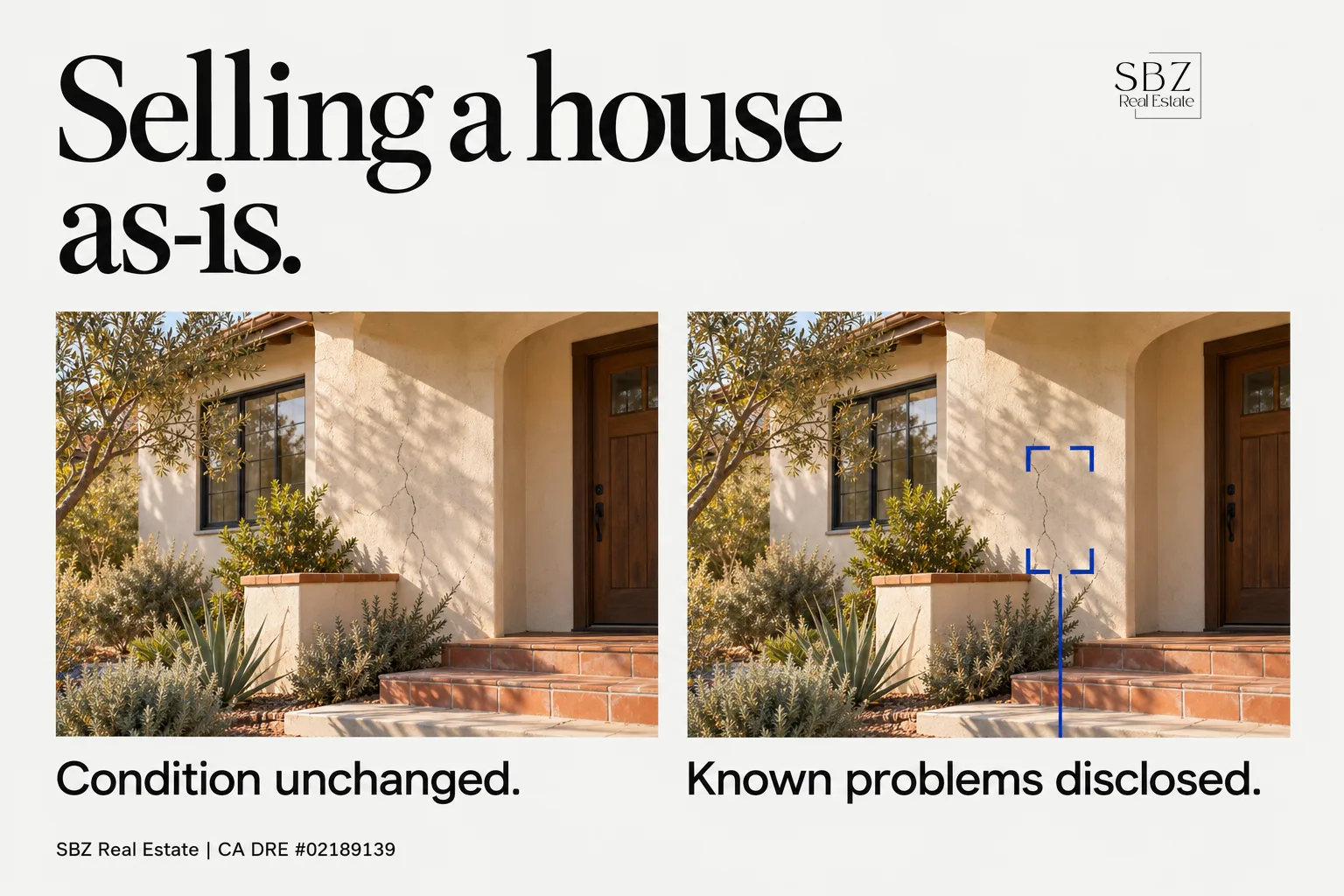
You can sell a house as-is in Southern California, either on the open market or to a cash buyer, and you don't have to make repairs. What as-is does not do is remove your disclosure obligations under California law. If you know about a problem, you still have to tell buyers about it.
Sellers usually choose as-is for a reason: an inherited property, a home that needs more work than the budget allows, a move on a short timeline, or just being tired of managing a house. Those are good reasons. Here's what actually matters so the decision works out well for you.
What does "as-is" actually mean in California?
In practice, "as-is" means you're telling buyers you won't make repairs or offer credits for the home's condition. The buyer accepts the property in its current state. The standard California purchase agreement already works this way. Buyers take the property in its present physical condition, and they keep the right to inspect it and cancel during their contingency period.
So "as-is" is mainly a positioning and negotiation stance, not a special kind of sale. A buyer can still order inspections, still find things, and still walk away within the contingency window. What changes is that you've said up front that repair requests aren't on the table, and buyers price their offers with that in mind.
Do I still have to disclose problems if I sell as-is?
Yes, and this is the thing most sellers miss. California generally requires sellers of one-to-four-unit residential property to provide a Transfer Disclosure Statement (TDS), along with a Natural Hazard Disclosure and, for homes built before 1978, a lead-based paint disclosure. Most listings also include a seller questionnaire covering things the TDS doesn't ask about.
An as-is clause doesn't protect a seller who hides a known defect. If you know the roof leaks, the sewer line backs up, or a room was added without permits, put it in writing. In real terms, thorough disclosure protects you. It's much harder for a buyer to make a claim after closing about something you told them before they bought.
Some transfers, such as certain court-supervised probate sales, are exempt from the TDS, but exemptions are narrow. Confirm yours with your agent and escrow before assuming anything.
What are my options for selling a house as-is?
Most Southern California sellers end up choosing between three paths:
- Sell to a cash investor or "we buy houses" company. This is the fastest and simplest option, usually with no showings and a flexible closing date. The trade-off is price. Investors base their offers on the home's after-repair value minus their repair costs, holding costs, and profit. Our guide to ARV in real estate explains how that math works.
- List as-is on the open market with a broker. Your home reaches owner-occupant buyers, contractors, and investors all at once, and competition between them can narrow the gap between a discount offer and fair value. You'll have showings and a contingency period, but more buyers get to bid.
- List mostly as-is, with light preparation. Sometimes a deep clean, hauling out debris, and fixing one or two inexpensive items noticeably widen the pool of buyers who can finance the home. Our guide on what to fix before listing your house covers which projects tend to be worth doing.
For homeowners who owe more than the home is worth, a short sale is a separate path with its own lender-approval process.
Is a cash offer always the better deal for an as-is home?
Not always. A cash offer can be the right choice when the timeline is tight or the home can't qualify for conventional financing. Still, it's worth comparing a cash offer against a realistic estimate of what the home could bring on the open market.
Here's what I tell every seller weighing this decision: compare the net proceeds, not the headline numbers. A higher list-side price comes with commissions, possible concessions, and more time. A cash offer may have lower closing costs but a lower price. A seller net sheet lays both scenarios out line by line, so you're comparing what actually reaches your bank account.
If you get a cash offer, ask the buyer for proof of funds, look at how long their inspection period is, and check whether the contract lets them renegotiate after inspecting. Some "as-is" cash offers come back with a lower number once the inspection is done.
How do I price a house that needs work?
Pricing a home in rough condition takes more judgment than pricing a move-in-ready home. A good comparative market analysis for an as-is property looks at three sets of comparable sales:
- Recent sales of similar homes in comparable condition
- Recent sales of renovated homes nearby, which sets the ceiling
- A realistic estimate of what the work would cost a buyer
Overpricing an as-is home usually backfires. Buyers in this segment are often experienced and run the numbers carefully. A price that reflects the condition tends to bring stronger, cleaner offers than a price that hopes they won't notice.
Are there local requirements in Southern California even if I sell as-is?
Yes. California requires sellers to make sure smoke and carbon monoxide detectors meet current standards and to confirm the water heater is properly braced. Some cities and local water districts also have their own point-of-sale requirements or reports. These differ around Greater Los Angeles and Orange County, so check the rules for your specific city early.
These items are usually inexpensive and quick to handle. When they're done ahead of time, they don't hold up escrow at the end.
What should I expect when selling an older home as-is?
Many homes in the Antelope Valley and the San Fernando Valley are several decades old. Inspections often turn up the same things: aging roofs, original plumbing, older electrical panels, and HVAC systems near the end of their life. Our piece on what home inspections reveal in older Antelope Valley homes describes the common patterns.
Consider getting a pre-listing inspection. It isn't required, but it lets you disclose accurately, price with confidence, and avoid surprises halfway through escrow. Buyers also tend to trust a seller who shares the inspection report openly.
Should I sell as-is on my own or with a broker?
You can sell as-is without an agent, and our guide to for sale by owner homes covers what that involves. The risk with an as-is sale is that disclosure mistakes and a weak negotiating position fall entirely on you, and those are exactly where as-is sales tend to go wrong.
A broker who handles as-is sales regularly can bring in investors and owner-occupants at the same time, organize your disclosures, and push back on renegotiation after the inspection. You can read more about how we approach selling your home, whether it's in Palmdale, Santa Clarita, or the Valley.
Frequently asked questions
Can I sell my house as-is without making any repairs in California?
Yes. You aren't required to make repairs to sell, though you still have to meet a few state requirements, such as smoke and carbon monoxide detectors and water heater bracing. You also have to disclose any defects you know about.
Can a buyer back out of an as-is purchase?
Usually, yes. Under the standard California purchase agreement, buyers keep their inspection and investigation rights during the contingency period and can cancel within that window even when the home is sold as-is.
Do I need an inspection to sell as-is?
A seller inspection isn't required, but it often helps. It gives you accurate information for your disclosures and makes it less likely that a buyer's inspection will lead to renegotiation.
Will I get less money selling as-is?
The price usually reflects the home's condition, but how much less depends on the property, the buyer pool, and how the home is marketed. Comparing net proceeds on a seller net sheet is the clearest way to judge each option.
Is selling to a cash home buyer safe?
It can be, as long as you verify proof of funds, read the contingency terms carefully, and close through a neutral escrow company. Be careful with any offer that has a long inspection period or open-ended terms for changing the price.
If you're thinking about selling a home that needs work, a quick conversation costs nothing. Reach out to SBZ Real Estate and we'll go through your options together.
