
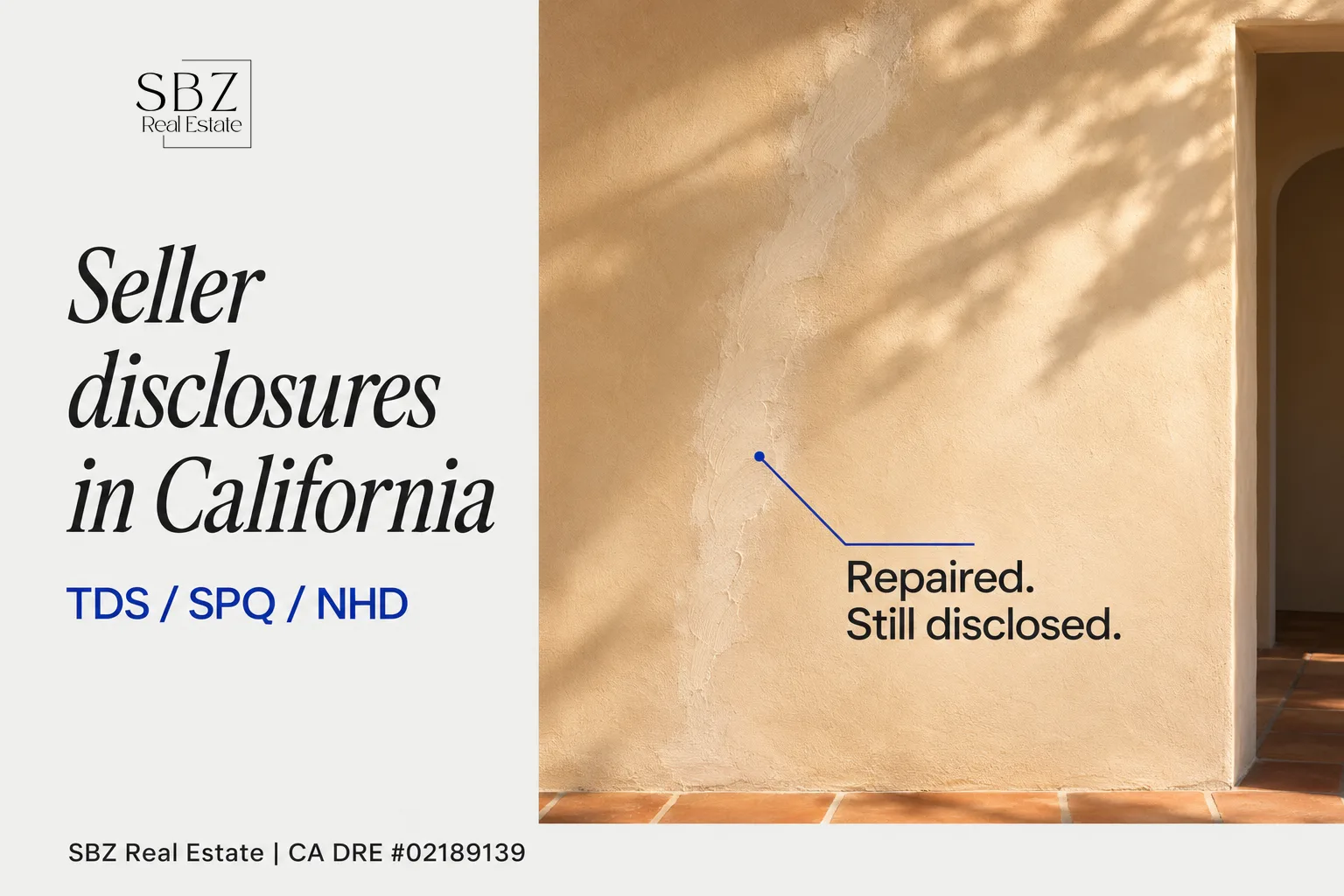
In California, most sellers of one-to-four-unit residential property must give buyers a written disclosure package that covers the home's condition, known defects, and local hazards, and they must deliver it as early as the transaction allows. Disclosure is the most common point where sellers feel unsure, and also the one where honest, thorough answers protect you the most. Here is what the package contains and how to approach it.
What do California sellers have to disclose?
The core principle is simple: you must tell buyers about material facts you know that could affect the value or desirability of the property. "Known" is the key word. You are not expected to be an inspector, but you cannot stay silent about a problem you are aware of, even if you have repaired it, and even if the home is being sold as-is.
The disclosure package typically includes several documents:
- Real Estate Transfer Disclosure Statement (TDS). A statutory form that asks you to describe the condition of the home's systems and features, and to flag known defects, additions made without permits, neighborhood noise or nuisances, and similar issues.
- Seller Property Questionnaire (SPQ). A longer companion form that asks follow-up questions about leaks, past repairs, boundary disputes, pest history, HOA matters, and more. Many sellers find this is where their memory gets tested.
- Natural Hazard Disclosure (NHD) report. A third-party report that states whether the property sits in a flood zone, fire hazard severity zone, earthquake fault zone, or seismic hazard zone, among other mapped areas.
- Agent Visual Inspection Disclosure. Your listing broker's own written observations from a reasonably competent visual walk-through of the accessible areas.
What else belongs in the package?
Beyond those core forms, California law attaches specific notices to specific situations. Not every item applies to every sale, so it helps to walk through them with your broker at the start rather than the week before you list.
- Lead-based paint. If the home was built before 1978, federal rules require a lead-based paint disclosure and a pamphlet for the buyer.
- Earthquake safety. Older homes may call for the earthquake hazards guidance and a statement about water heater bracing.
- Smoke and carbon monoxide alarms. State law requires a written statement of compliance on installation.
- Special taxes and assessments. If your property carries a Mello-Roos or similar special tax, buyers must be told. Our guide on Mello-Roos taxes in the Antelope Valley explains how these show up.
- Registered sex offender database notice. California requires a standard notice pointing buyers to the state's public database.
- HOA documents. If the home is in a common-interest development, the association's governing documents and financial information must be provided.
- Fire-related items. In mapped fire hazard areas, sellers may have additional defensible-space disclosure obligations.
Local ordinances can add requirements, and the rules change from time to time, so your broker should confirm the current list for your city and property type.
Do I still have to disclose if I'm selling as-is?
Yes. An as-is sale means you are not agreeing to make repairs. It does not remove your duty to disclose what you know. Selling as-is and disclosing fully work together, and buyers often feel more comfortable making an offer when the disclosures are detailed and candid. We cover this in depth in Selling a House As-Is in California: What You Still Have to Disclose.
What if the problem has been fixed?
Past issues often still matter. A roof leak you repaired three years ago, a foundation crack that was patched, or a pest treatment can all be relevant to a buyer, and the forms commonly ask about prior repairs directly. The usual approach is to disclose the issue, say what was done and when, and attach receipts or permits if you have them. A documented repair generally reads far better than a gap in the story.
What about unpermitted work?
This is the item sellers most often hope will go unnoticed, and it deserves a straight answer. If you know a room, garage conversion, or system was added without permits, the disclosure forms ask about it. Hiding it creates the exposure; disclosing it lets the buyer and their lender decide how to handle it. Your broker can help you think through your options before listing, including whether to resolve it, price around it, or sell with full disclosure.
When do disclosures need to be delivered?
As early as practical, and ideally before an offer is accepted. Delivering the package up front gives buyers the information they need to write a confident offer, and it reduces the chance of a renegotiation late in escrow. California law also gives buyers a right to rescind in certain circumstances when disclosures arrive after the offer, so late delivery can put a deal at risk. If you learn something new before closing, an amended disclosure is the correct response.
A smart sequence is to order the natural hazard report and a pre-listing home inspection early, complete the TDS and SPQ with your broker, and have everything ready to upload with the listing. Then your escrow officer has a clean file to work from.
What happens if I leave something out?
Incomplete or inaccurate disclosure can expose a seller to claims after closing, including claims for damages, and in some cases the transaction itself can be challenged. We can't predict how any individual dispute would turn out, and this is not legal advice. The practical takeaway is that the cheapest protection is accurate answers on the front end. If a question on a form leaves you unsure, ask your broker, and for legal questions about your specific situation, consult a real estate attorney.
How does a broker help with disclosures?
A good listing broker does more than hand you forms. They walk the property, document what they see, flag items sellers commonly forget, and make sure each notice that applies to your home and city is included. They also help you decide which fixes are worth making before listing, as outlined in what to fix before listing your house, and what to simply disclose and price accordingly.
That kind of preparation also feeds into your bottom line. Disclosure choices affect negotiation, so they belong in the same conversation as your cost of selling. If you're planning a sale in Palmdale, Santa Clarita, the San Fernando Valley, or elsewhere in our service area, see how we approach selling your home, or get in touch to talk through your specific property. A quick conversation costs nothing.
Related reading
Frequently asked questions
Is the Transfer Disclosure Statement required for every California home sale?
It applies to most sales of one-to-four-unit residential property, but some transfers are exempt, such as certain transfers by court order, between co-owners, or by estate fiduciaries. Your broker can confirm whether an exemption applies to your sale.
Do I have to disclose a death that occurred in the home?
California law generally requires disclosure of a death on the property within the prior three years, and sellers should not guess at the rules. Ask your broker how the current statute applies to your situation.
Can a buyer's inspection replace my disclosures?
No. The buyer's inspection and your disclosures serve different purposes. Your duty to disclose known material facts remains even if the buyer hires an inspector.
Who pays for the natural hazard disclosure report?
Who pays is negotiable and is set out in the purchase contract. In practice, the seller commonly orders it, but your broker can explain what is typical for your transaction.
When should I start preparing my disclosures?
Before you list. Gathering repair records, permits, and warranty paperwork early makes the forms faster and more accurate, and it lets buyers see the full picture when they write their offers.