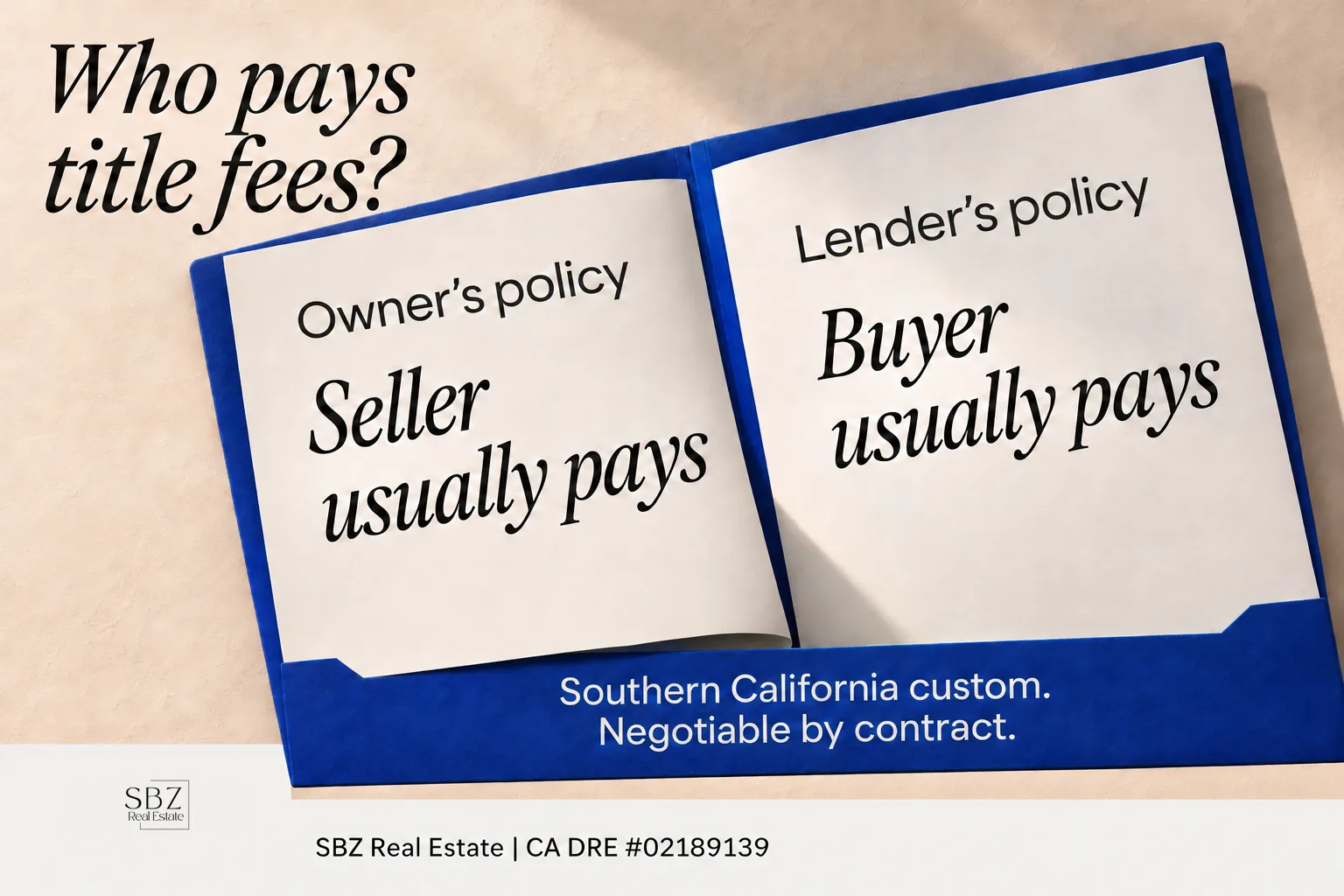
In California, no law says whether the buyer or the seller pays title fees. It comes down to local custom and what's written into the purchase contract. In most of Southern California, the seller customarily pays for the owner's title insurance policy and the buyer pays for the lender's policy, but every item is negotiable.
That split surprises many people, because "title fees" isn't one charge. It's a handful of separate line items, and each has its own customary payer. Here's what actually matters in this market.
What are "title fees" in a California home sale?
The phrase usually bundles several things that show up on the closing statement:
- Owner's title insurance policy. Protects the buyer against defects in ownership, such as a recording error or an unknown lien, that surface after closing.
- Lender's title insurance policy. Protects the buyer's lender. It's required when there's a loan and is priced separately from the owner's policy.
- Title search and examination. The work of tracing the property's recorded history. This is typically folded into the policy premium.
- Recording fees. Charged by the county to record the new deed and the loan documents.
- Endorsements. Optional or lender-required add-ons that extend coverage on a policy.
Title fees are also not the same thing as escrow fees. The two are often handled under one roof but are different services. If that distinction is fuzzy, how title and escrow companies differ in California walks through it.
Who usually pays for the owner's title policy?
Here's the thing most people miss: it depends on the county. In much of Southern California, including Los Angeles County, it's customary for the seller to pay for the owner's policy. In other parts of the state, particularly many Northern California counties, buyers commonly pay it instead.
"Customary" is the key word. A buyer's offer can ask the seller to pay, or can offer to pay it themselves, and that request becomes part of the negotiation. In a competitive situation, some buyers take on costs the seller would normally cover. In a slower market, they ask the seller to cover more.
Who pays for the lender's policy?
The buyer does, almost always. The lender requires the coverage as a condition of the loan, and the cost is part of the buyer's closing costs. If you're financing, expect it on your Loan Estimate alongside other third-party fees.
Buyers heading into escrow in the Antelope Valley can see a fuller picture in closing costs for home buyers in the Antelope Valley. The same line items apply across the region, even where the dollar amounts differ.
Who pays the other fees that sit near title?
These are often lumped in with title costs, so it helps to separate them:
- Escrow fees. Commonly split between buyer and seller in Southern California, though the split can vary by contract and by escrow company. More on that in real estate escrow services in California.
- Documentary transfer tax. Customarily paid by the seller. Some cities add their own transfer tax on top of the county's. What the transfer tax is based on explains how it's calculated.
- Recording fees. Typically the buyer pays to record the deed and loan documents, while the seller pays to record any documents that clear their own liens.
- Prorated property taxes. Neither side "pays" these in the usual sense. They're divided by the closing date. See who is responsible for property taxes after a sale in California.
For a sell-side view of everything that comes out of proceeds, what closing costs home sellers pay in California covers the full list.
Can the payer be negotiated?
Yes. The purchase agreement is where the allocation gets set, and the California Association of Realtors residential purchase agreement has specific lines for who pays for title and escrow items. Whatever is written there controls, regardless of local habit.
In real terms, this is a negotiating lever like any other. A seller who wants a clean, fast close might agree to cover more. A buyer who needs the seller to hold firm on price might offer to absorb the owner's policy. It's worth deciding early which items matter to you.
If you're a seller, a net sheet shows how these choices change your proceeds. What a seller net sheet is in California explains how to read one, and the cost of selling a house in California puts title charges in context with the rest.
How do I find out what's customary for my property?
Ask early, and ask in writing. Your broker should be able to tell you how it typically works for that county or city, and the escrow officer can confirm how their office handles it. Because custom varies even within Los Angeles County, it's worth confirming rather than assuming, especially if you've bought or sold in another part of the state before.
The right path also depends on your goals. A buyer weighing a stretch purchase in Palmdale or Lancaster may care about every dollar at closing. A seller in Burbank or Sherman Oaks may care more about speed and certainty. Either way, the title line items are a good place to have a plain conversation with your broker before an offer goes out.
If you're getting ready to buy a home or sell your home, a quick conversation can map out who is likely to pay what before you commit to anything. You can reach SBZ Real Estate here whenever you're ready.
Frequently asked questions
Does the buyer or the seller pay for title insurance in California?
It depends on the county and the contract. In much of Southern California the seller customarily pays for the owner's policy and the buyer pays for the lender's policy. Both can be negotiated in the purchase agreement.
Is an owner's title insurance policy required?
Not by law. A lender will require its own policy when you finance, but the owner's policy is optional. Most buyers choose to have it because it protects their own ownership interest after closing.
Are title fees part of closing costs?
Yes. Title insurance, title search, and recording fees are all part of closing costs. Which side pays each item determines whether it lands on the buyer's or the seller's closing statement.
Can a buyer ask the seller to pay their title fees?
A buyer can request it as part of an offer, and the seller can accept, decline, or counter. Whether it's a realistic ask depends on market conditions and the rest of the terms on the table.
Do title fees differ between cities in the same county?
The customary split is generally set at the county level, but some cities impose their own transfer taxes, which changes the totals. Your escrow officer can confirm exactly what applies to a specific property.