
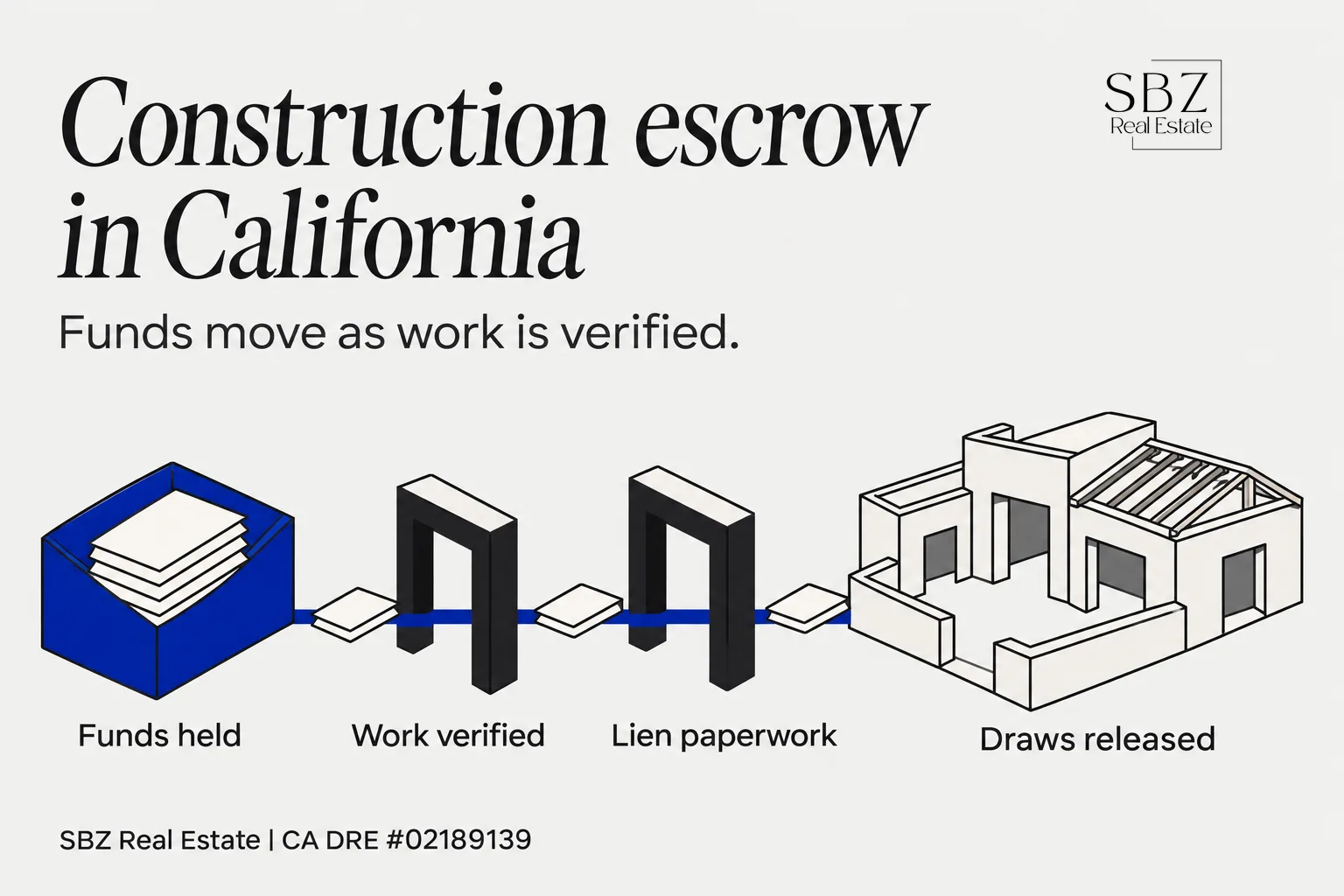
A construction escrow in California is a neutral account, run by an escrow or title company, that holds the money for a build and releases it in stages as the work is completed and verified. It keeps the lender, the owner, and the contractors from handling the funds directly, which protects each of them.
If you've only dealt with a standard purchase, this is a different animal. Instead of one closing, you have a series of disbursements over months. Here's how it works in real terms.
What is a construction escrow?
A construction escrow, sometimes called a construction control or disbursement account, is set up when a construction loan funds or when an owner places build money in the care of a neutral party. The escrow holder follows written instructions from the lender and the borrower. It doesn't decide what's owed. It pays out only when the conditions in those instructions are met.
That's the key difference from a standard home purchase escrow. A purchase escrow ends at recording and closing. A construction escrow stays open through the build and ends only when the project is finished and the final paperwork is in. For a broader look at the role of the escrow company itself, see our guide to real estate escrow services in California.
When do you need one?
You'll typically encounter a construction escrow in a few situations:
- A construction loan. Lenders almost always control disbursements so money follows progress.
- A ground-up build or major rebuild, where the owner wants a neutral party between them and the builder.
- Buying a lot and building, where the land purchase closes first and the build funds are managed afterward.
- New-construction purchases from a builder, which usually run on the builder's own escrow process. We cover that side in new construction homes in the Antelope Valley.
If you're self-funding a build, you can still ask for a third-party disbursement account. Many owners do it simply to keep a clean paper trail.
How do draws and disbursements work?
Funds are released in "draws," which follow a schedule agreed to in advance. The details vary by lender, but the sequence is usually similar:
- The contractor submits a draw request showing the work completed against the budget.
- An inspection happens. The lender or its inspector confirms the work is actually in place, not just billed.
- Lien paperwork is collected. Before paying, the escrow or title company generally wants conditional and unconditional lien waivers from the contractor and subcontractors, using the California statutory forms.
- The title company checks the property record for new liens or filings since the last draw.
- Funds are released to the contractor, and the account balance is updated.
The point of the sequence is that nobody gets paid for work that hasn't happened, and nobody gets paid without waiving lien rights for what they've already received.
How does escrow protect against mechanics liens?
This is the part owners miss. In California, contractors, subcontractors, and material suppliers who aren't paid can record a mechanics lien against your property, even if you paid your own contractor in full. That's how an owner can end up paying twice.
Construction escrow is designed to prevent that. Lien waivers collected with each draw document that earlier work has been paid for. The title company's checks between draws catch any recorded claims before the next payment goes out.
At the end of the job, the owner generally records a Notice of Completion, which starts shorter deadlines for others to file liens. Timing rules here are specific and have changed over the years, so confirm the current deadlines with your construction attorney or title officer rather than relying on a general summary.
What does a construction escrow cost?
Fees vary by company, loan size, and how many draws the project involves. Expect charges for opening the account, for each disbursement or inspection, and for title-related services such as date-down endorsements that update the title report between draws. Ask for a written fee schedule before you sign. Every extra draw adds cost, so a sensible draw schedule is worth negotiating up front.
What is retention, and who holds it?
Retention is a portion of each payment held back until the job is finished, as an incentive for the contractor to complete the work and fix punch-list items. In California, public and private projects have different rules, and the contract should state the percentage and release conditions. Your escrow instructions should match the contract exactly. If they don't, you'll have a dispute at the worst possible moment.
How does construction escrow close out?
Closeout usually requires several items together:
- Final inspection and sign-off from the lender and the local building department
- A recorded Notice of Completion
- Final unconditional lien waivers from the contractor and subs
- Release of retention once the conditions are met
- A final accounting of the account, with any leftover funds returned to the borrower or applied per the loan terms
If the loan converts to permanent financing, the lender will handle that step separately. Budget for the timing, because delays in final sign-offs push the conversion back.
What should buyers and owners watch for?
A few practical points we see matter most:
- Read the escrow instructions line by line. They govern what gets paid and when.
- Keep your budget and your draw schedule consistent. Mismatches cause rejected draws.
- Confirm your contractor's license and insurance before the first draw, not after.
- Plan for cost overruns. A contingency reserve is far easier to set up at the start than to find mid-build.
- Understand what a lot of this costs before you commit, so the escrow isn't the first place a budget gap shows up.
If you're buying land first, the usual home-buying steps apply to that purchase, and the build comes after. In the Antelope Valley, owners building in Palmdale or Lancaster also deal with local permitting timelines that can stretch a schedule, so build slack into the plan.
Where can a broker help?
A construction escrow is not something a broker administers, and it's no substitute for your attorney, lender, or title officer. What we can do is help you evaluate the lot, understand how the finished home is likely to be valued, and coordinate with the professionals who run the build. If you're weighing a build, a purchase, or a sale, get in touch and we'll talk through it. A quick conversation costs nothing.
Frequently asked questions
Who controls the money in a construction escrow?
The escrow or title company holds it, but it acts only on written instructions from the lender and borrower. It doesn't judge the quality of the work on its own.
Can I use construction escrow without a construction loan?
Often yes. Owners paying cash sometimes use a third-party disbursement account to keep payments tied to verified progress and lien waivers. Availability and fees depend on the company.
Does construction escrow eliminate the risk of a mechanics lien?
It reduces the risk by collecting lien waivers and checking the property record between draws, but it doesn't remove it entirely. Confirm the current California lien rules with a construction attorney.
How long does a construction escrow stay open?
For the life of the project, from the first disbursement through final closeout. The length depends on the size and schedule of the build, so there's no standard number.
Is construction escrow the same as a new-construction purchase escrow?
Not quite. A purchase from a builder usually runs on the builder's own escrow and closes when you take title. A construction escrow manages funds during the build itself.