
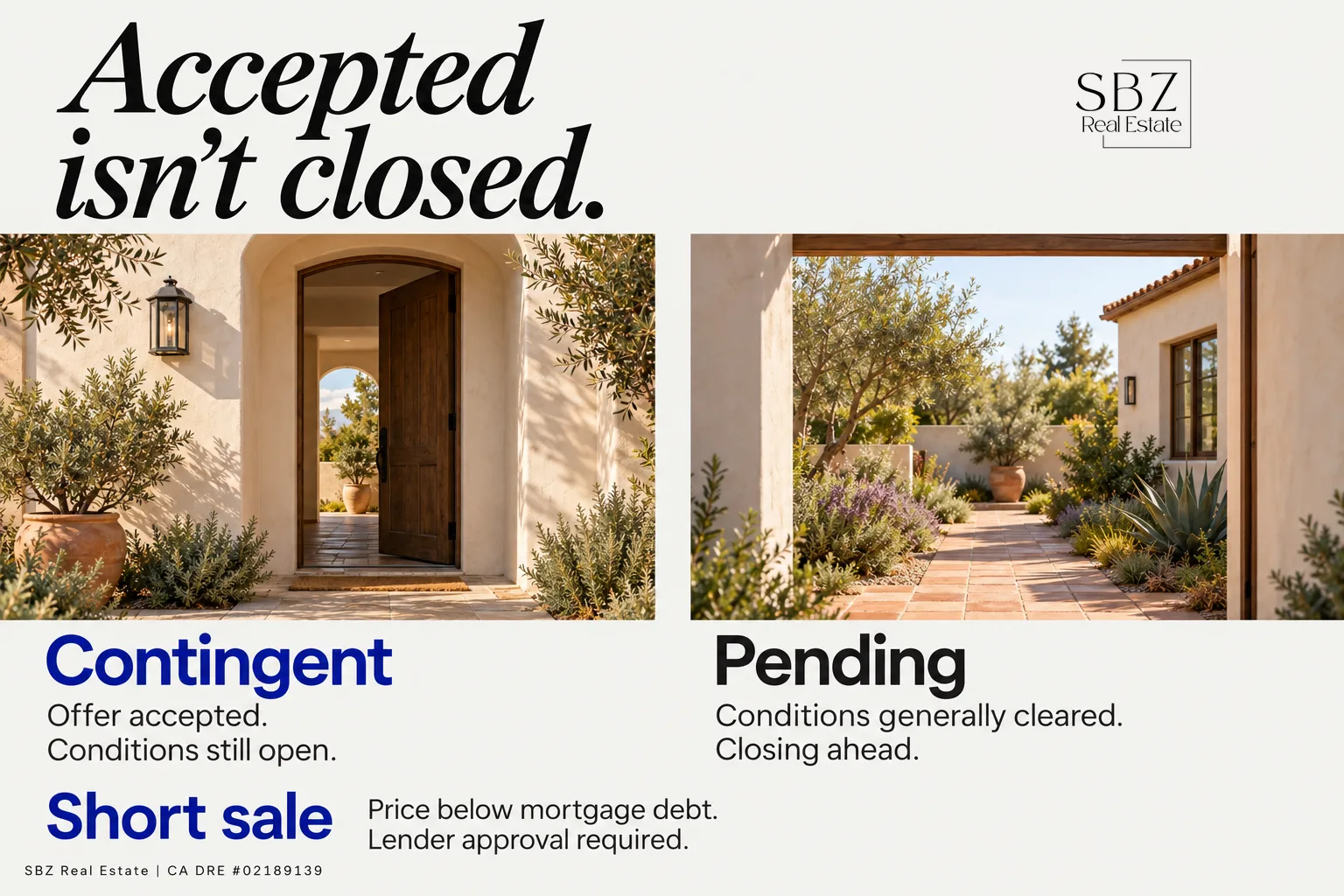
In real estate, "contingent" means a seller has accepted an offer, but the sale depends on specific conditions being met before it can close. If those conditions are met, the deal moves forward. If they aren't, the buyer may be able to cancel without penalty, depending on the contract.
Listings are full of shorthand, and a single word can change how you plan your next move. Here is what the most-searched terms mean in practice, and what they should mean for your decisions in Southern California.
What does "contingent" mean in real estate?
A contingent listing has an accepted offer that is not yet final. The buyer and seller have agreed on terms, but one or more conditions, called contingencies, are still open. The home usually stays off the "available" list, though status labels vary by listing system, so check how your local one defines them.
For a buyer, a contingent status on a home you love isn't always the end of the road. Deals can fall apart for ordinary reasons, and some sellers will accept backup offers. For a seller, the status simply means you are under contract with work left to do.
What is a contingency in a real estate contract?
A contingency is a written condition that must be satisfied for the contract to remain binding. It protects one side, usually the buyer, from being forced to complete a purchase if something material goes wrong.
In California, the most common ones are:
- Inspection contingency: the buyer's right to investigate the property and negotiate repairs or cancel based on what is found. What home inspections reveal in older Antelope Valley homes shows the kinds of findings that come up.
- Appraisal contingency: the home must appraise at a value that supports the loan, or the buyer can renegotiate or exit.
- Loan contingency: the buyer's financing must be approved within the agreed time.
- Title and disclosure review: the buyer can review the preliminary title report and seller disclosures and object to what they find.
- Sale-of-buyer's-home contingency: the purchase depends on the buyer selling their current property.
Each contingency has a deadline set in the purchase agreement. Those timelines are negotiable, and they are often the quiet difference between a strong offer and a weak one.
What's the difference between contingent and pending?
Contingent generally means conditions are still open. Pending generally means the contingencies have been removed or satisfied, and the deal is moving toward closing. The line isn't identical everywhere, and some listings use extra labels, so treat the status as a signal and not as a promise.
A contingency isn't removed until the buyer signs a written removal. Once that happens, the buyer has typically put their deposit at greater risk if they back out, which is why the removal step deserves a real conversation with your agent first.
How do contingencies affect sellers?
Contingencies add time and uncertainty, but they also make offers possible. A buyer who can't line up financing or a sale of their current home without protection may not be able to make an offer at all.
When you compare offers, the highest price isn't the only number that matters. A cleaner offer, with fewer contingencies and shorter deadlines, can carry less risk than a higher offer loaded with conditions. A seller net sheet helps you see what each offer would actually leave you with. If your buyer's offer depends on selling their own home, ask about a kick-out clause, which lets you keep marketing and accept a stronger offer if one arrives.
What is the meaning of a short sale in real estate?
A short sale is a sale where the price is less than what the owner owes on the mortgage, and the lender must approve the sale before it can close. The homeowner isn't walking away from a clean slate: the lender decides whether to accept the shortfall, and that approval can take time.
Short sales behave differently from a typical contingent deal, because the lender's approval acts as a major condition on the whole transaction. Buyers should expect a longer, less predictable timeline. Sellers should understand the possible consequences before listing, ideally with their lender, a tax professional and an attorney involved. Our practical guide to short sales walks through both sides in detail.
What other real estate terms do people mix up?
A few more terms come up constantly, and each has its own plain-English explanation:
- Escrow: a neutral third party holds funds and documents until all conditions are met. See what escrow is and how it works in California.
- CMA (comparative market analysis): an agent's estimate of value based on comparable sales, not a formal appraisal. Here is what a CMA is and how to read one.
- ARV (after-repair value): what a property might be worth after improvements, commonly used by investors. More in ARV in real estate.
- NOI (net operating income): a rental property's income after operating expenses, before financing. See what NOI means.
- Agent, broker, Realtor: these titles aren't interchangeable. The difference is explained here.
If you're buying with a loan, the down payment guide also explains how that money interacts with the contingency timeline.
How should I use these terms when I'm making a decision?
Treat the vocabulary as a map, not as the decision. The words tell you where a deal stands, but not whether it is right for you.
If you're buying, ask your agent which contingencies you'd be waiving and what you're protected from in return. If you're selling, ask which contingencies each offer carries and how each affects your timeline. Both are fair questions, and a good broker will answer them without hurry.
You can start at buying a home or selling your home, or browse the communities we serve to see where your search fits. If you'd rather talk it through, get in touch. A quick conversation costs nothing.
Frequently asked questions
What does "contingent" mean when a house is listed?
It means the seller has accepted an offer, but the sale still depends on conditions such as an inspection, an appraisal or financing. If they're met, the sale moves toward closing.
Can I still make an offer on a contingent home?
Often yes, as a backup offer, if the seller is willing to consider one. Whether it's worth pursuing depends on the seller's terms and how firm the existing contract looks.
Can a buyer back out of a contingent sale?
A buyer can typically cancel only for reasons covered by a contingency, and only within the deadline stated in the contract. Backing out outside those terms can put the deposit at risk, so review the contract with your agent first.
Is a short sale the same as a foreclosure?
No. A short sale is a sale the owner makes with the lender's approval, while a foreclosure is the lender taking the property. For buyers exploring distressed options, see how foreclosed homes are found and bought in Los Angeles.
Does "real estate" mean the same as "property"?
Roughly, yes. Real estate is land and anything permanently attached to it, such as buildings, while "property" can also include items you own that aren't attached to land.
