
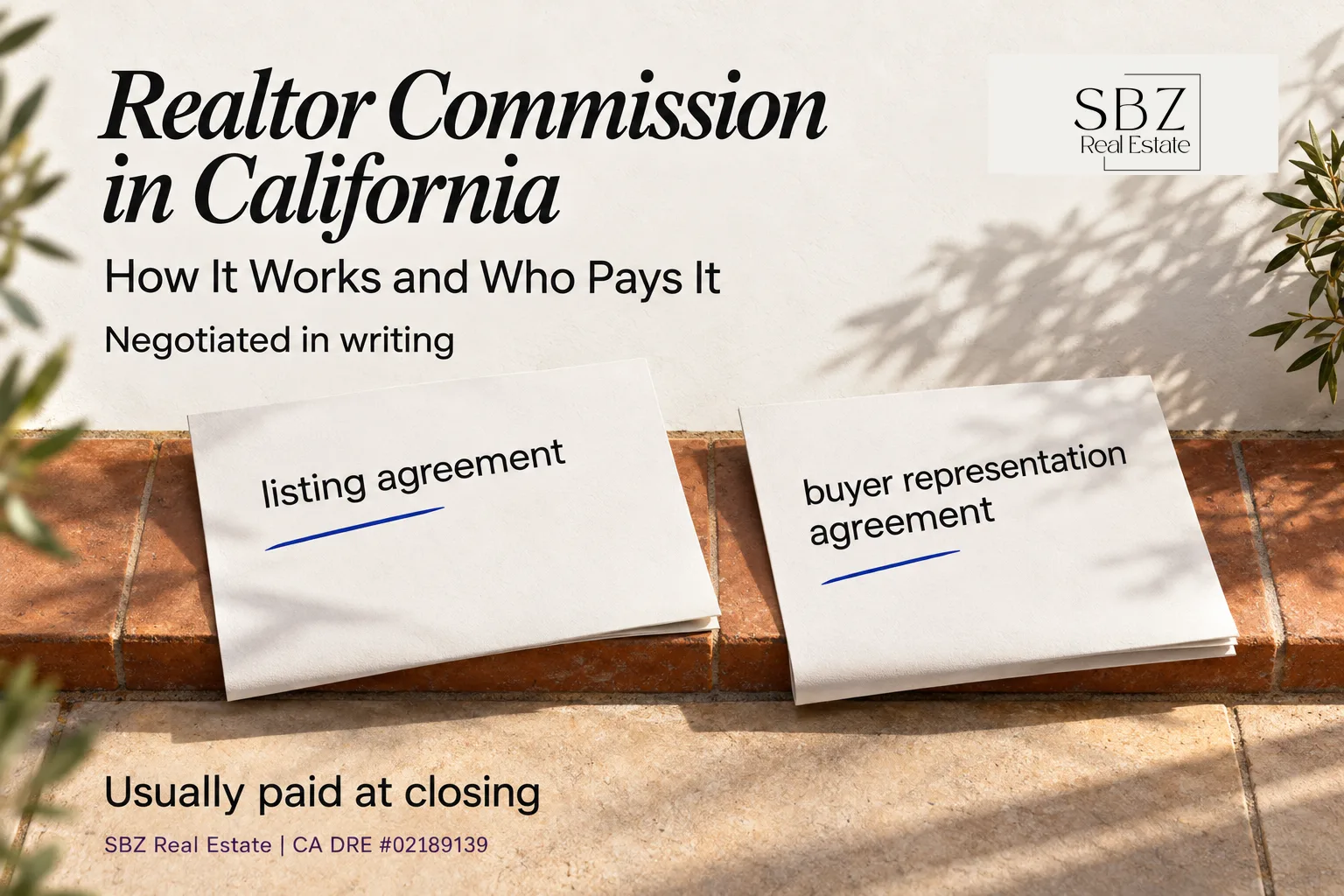
In California, realtor commission is a fee you negotiate with your brokerage in a written agreement. It is usually a percentage of the sale price, and it is paid out of escrow at closing. No law sets the rate. Since the 2024 changes to how agents get paid, the seller's agreement and the buyer's agreement are also handled separately.
Commission is often one of the largest items on a seller's closing statement, and for buyers it is now something you discuss before you tour your first home. Here's what actually matters, explained plainly.
How does realtor commission work?
A real estate commission is the fee for brokerage services. It is set out in a signed agreement, whether that's a listing agreement for sellers or a buyer representation agreement for buyers. It's usually written as a percentage of the final sale price, though a flat fee or a tiered structure is also allowed if both sides agree.
The fee is earned when the transaction closes. Escrow pays it directly from the sale proceeds, so a seller doesn't write a separate check. It shows up as a line item on the final settlement statement, next to the other closing costs California home sellers pay.
One detail that surprises people: the commission goes to the brokerage, not straight to the individual agent. The brokerage then pays the agent according to their own internal arrangement. If you've ever wondered why that is, our guide to agent vs. broker vs. Realtor titles explains who is licensed to do what.
Is realtor commission set by law in California?
No. California law requires listing agreements for one-to-four-unit residential property to include a notice saying that commission rates are not fixed by law. They are set by each broker individually and may be negotiable between the client and the broker.
That notice is more than boilerplate. It means you should hear any "standard rate" claim as a starting point for a conversation. A brokerage can decline a fee that doesn't fit the work, and a client can decline a brokerage. In both cases, the agreement in writing is what counts.
Who pays the realtor commission, the buyer or the seller?
This has changed, and many people are still working from the old model.
Before August 2024, the seller usually agreed to one total commission in the listing agreement. Part of it was then offered to whichever brokerage brought the buyer. Buyers rarely thought about commission because it was built into the seller's side.
Since the 2024 national settlement involving the National Association of Realtors, two things are different:
- Buyers sign a written agreement before touring homes with an agent. In California, this is typically a buyer representation and broker compensation agreement. It spells out what the buyer's agent will be paid and how.
- Offers of buyer-agent compensation no longer appear in MLS listings. Sellers can still agree to contribute toward the buyer's agent fee. That just gets negotiated separately, often inside the purchase offer.
In real terms, sellers still often end up covering some or all of the buyer's agent fee, because that is a negotiated term of the deal. It's no longer automatic, though. Buyers should go in knowing what they've agreed to pay and what they'll ask the seller to cover. If you're starting a search, our home buying page walks through how this fits into the process.
How do you calculate a realtor's commission?
The basic math takes three steps:
- Find the agreed rate or flat fee in your signed agreement.
- Multiply the rate by the final sale price. Use the actual closing price, not the list price. For example, 1% of $1,000,000 is $10,000, so each percentage point equals one-hundredth of the price.
- Add any separate amounts. If a seller is listing and has also agreed to contribute toward the buyer's agent, those are two different figures, and both come out of the seller's proceeds.
The thing most sellers miss is that commission is only one line on the sheet. Escrow and title fees, transfer taxes, payoff of your existing loan, prorated property taxes, and any repair credits also come out of the same proceeds. That's why we prepare a seller net sheet before a home is listed. You should see the estimated amount you'll walk away with before you sign anything, not after.
What is the average commission for a realtor?
Rates differ by brokerage, property, price point, and how much work the sale takes. We're not going to quote an "average" figure here. Any number without a current, named source would just be a guess, and it could anchor your expectations to something that doesn't fit your situation.
What we can say is that the factors behind a quoted fee are fairly consistent:
- Scope of service. Professional photography, staging guidance, marketing, open houses, and hands-on transaction management all take time and money.
- Property complexity. Tenant-occupied homes, probate or trust sales, short sales, and homes that need a lot of preparation take more work.
- Price point and market conditions. A home that needs more exposure or a longer marketing period asks more of the listing side.
- Whether a buyer-agent contribution is part of the plan. For sellers, it helps to decide this strategy upfront.
Some states, such as Texas or North Carolina, get a lot of their own search interest on this topic. The 2024 settlement applies nationally, but state disclosure rules and local practice still vary. Everything in this article is about California.
Can you negotiate realtor commission?
Yes, and a good brokerage will expect the conversation. The better question is what you're getting for the fee.
Before you compare quotes, ask each brokerage:
- Who will actually handle my sale day to day, and who answers when I call?
- What marketing is included, and what costs extra?
- How will you price the home, and can I see the comparable sales behind that number?
- How do you handle negotiation, inspection requests, and appraisal issues?
- What's your recommendation on a buyer-agent contribution, and why?
A lower fee can cost you more if the listing is priced or marketed badly. A higher fee isn't worth it if the service doesn't match. Our guide on how to choose a real estate agent in Southern California goes deeper on reading those answers. It also helps to understand what an agent does when selling your house, so you can compare services, not just percentages.
What if you don't want to pay a commission at all?
You can sell without a listing agent. Some homeowners do it successfully, especially when they already have a buyer lined up. You take on the pricing, disclosures, marketing, negotiation, and escrow coordination yourself, and California's seller disclosure requirements still apply in full. You may also still be asked to contribute toward a buyer's agent.
If you're considering that route, our article on for sale by owner homes in Southern California lays out the trade-offs honestly.
How SBZ Real Estate approaches commission
SBZ Real Estate is a licensed California brokerage (CA DRE #02189139) with more than 10 years in business. We serve buyers and sellers from the Antelope Valley to the San Fernando Valley, Greater Los Angeles, and Orange County. We explain our fee in writing and show you how it fits into your expected net proceeds. We walk through buyer-agent compensation before you list, not in the middle of an offer. You can read more about how we sell homes.
If you're weighing a move and want to see real numbers for your home, a quick conversation costs nothing. You can reach us here, call 818-696-0888, or email hello@sbzre.com.
Frequently asked questions
Is realtor commission paid upfront?
No. Commission is typically earned and paid when the sale closes. Escrow pays it from the transaction proceeds, and the terms are set in your signed agreement.
Does the buyer pay realtor commission in California now?
It depends on what's negotiated. Buyers now sign a written agreement that sets their agent's compensation. A seller may agree to cover some or all of it as part of the purchase terms.
Is realtor commission tax deductible when you sell a home?
For a home sale, selling expenses like commission generally reduce the amount you realize from the sale, which can lower any taxable gain. Your situation may differ, so confirm the details with a tax professional.
What's the difference between a realtor's commission and a broker's commission?
In practice, the commission is paid to the brokerage under the agreement, and the brokerage then compensates the individual agent. "Realtor" is a trade-association membership title, while "broker" is a California license level.
Can a commission be a flat fee instead of a percentage?
Yes. California law doesn't fix the rate or the structure, so a flat fee, a percentage, or a tiered arrangement are all allowed if both parties agree in writing.
