
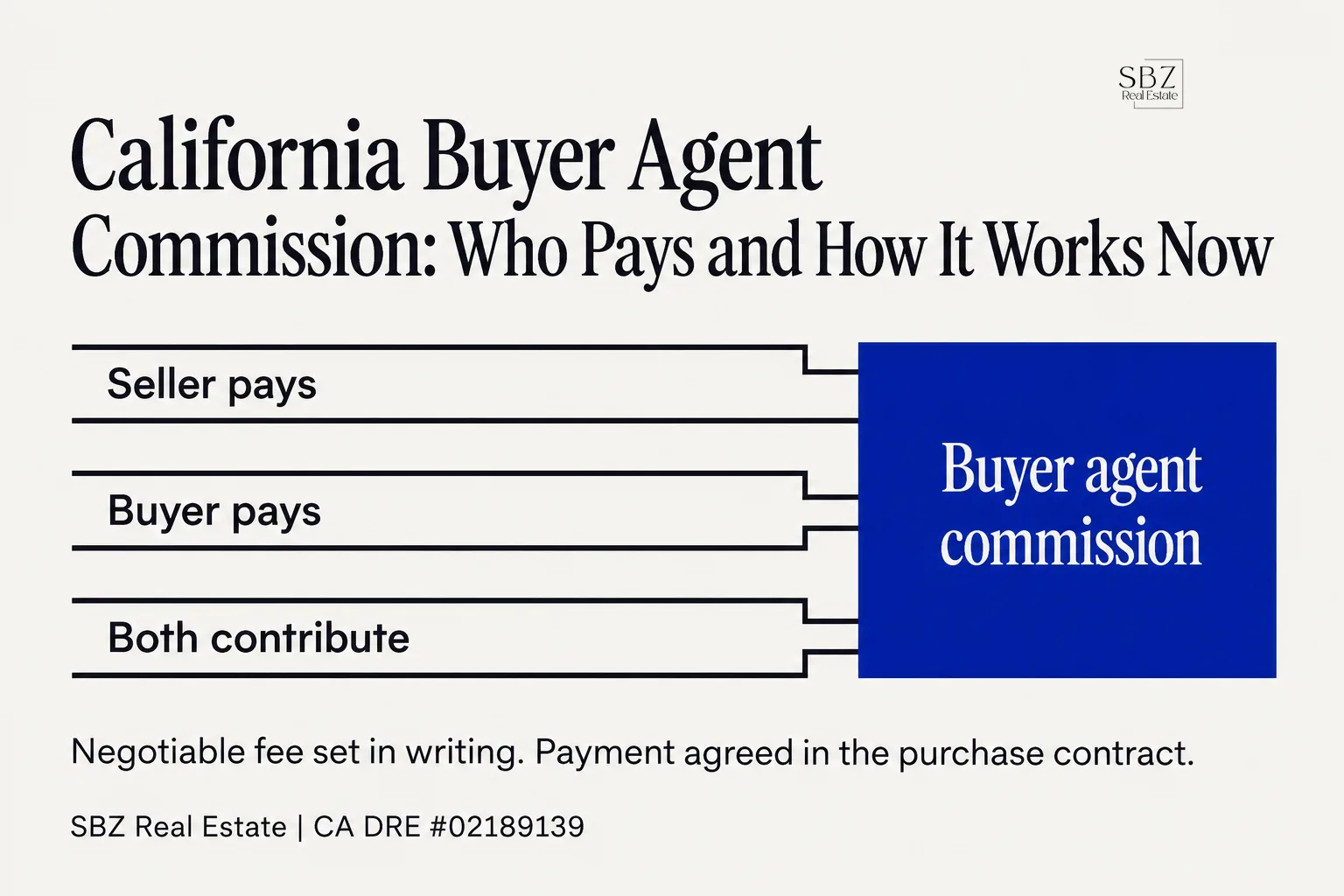
In California, buyer agent commission is negotiable, and it is set in a written agreement between you and your agent. The seller, the buyer, or both can pay it, and that gets decided in the purchase contract. No law or association sets a standard rate. What changed recently is mainly how the commission gets agreed to and disclosed.
This matters because the rules shifted in 2024 and 2025. Many buyers still go by what a friend told them a few years ago. Here is how it works today, in plain terms.
What changed with buyer agent commission?
Before the national settlement involving the National Association of REALTORS® took effect in August 2024, listing agreements often included an offer to pay the buyer's agent, and that offer was published on the MLS. Buyers rarely had to think about it. The seller's side handled it, and it was built into the price without anyone discussing it.
Two things are different now:
- Offers of compensation can no longer be posted on the MLS. A seller can still choose to pay the buyer's agent. The offer just has to be communicated some other way, or negotiated as part of the deal.
- Buyers sign a written agreement before touring. Agents who work with buyers through the MLS must now have a written agreement in place before showing homes. It has to state the compensation, or how it will be determined, in specific terms.
California went further. Starting in 2025, state law requires buyer representation agreements to be in writing and limits how long they can run. If an agent hands you an open-ended agreement with no end date, ask questions before you sign.
Who pays buyer agent commission in California?
Any of these can happen, and the answer often isn't settled until you're in escrow:
- The seller pays. Many sellers still offer to cover the buyer's agent because it widens their pool of buyers. That's especially true for buyers who are already stretching to cover the down payment and closing costs.
- The buyer asks the seller to pay as part of the offer. Your offer can request that the seller cover your agent's compensation, much like you'd request a credit for repairs. The seller can accept it, counter it, or decline.
- The buyer pays. If the seller won't contribute, or contributes less than your agreement says, the buyer usually covers the difference. That's spelled out in the agreement you signed.
- A combination. A seller may cover part of it, and the buyer covers the rest.
In real terms, the commission has become one more negotiated item in the deal, like the price, the escrow length or the repair requests. Sellers see the same change from their side, and it's one reason a clear seller net sheet matters more than it used to.
What's in a California buyer representation agreement?
Most agreements in California use standardized forms. The California Association of REALTORS® also publishes an advisory that explains to buyers how compensation works. Whatever form your agent uses, read for these items:
- The compensation amount or method. A flat fee, a percentage of the price, or another clear formula. Vague wording is a red flag.
- The term. When the agreement starts and ends.
- Scope. Whether it covers every home you look at, a specific property, or a specific area.
- What happens if the seller pays less. Whether you owe the difference, or whether the agent agrees to accept what the seller offers.
- Cancellation terms. How either side can end the agreement and what, if anything, is owed.
This is the thing most buyers miss: the agreement is negotiable before you sign it, not just afterward. If you're touring one property, an agreement limited to that property is a reasonable request. If you're early in your search, a shorter term lets you see how the relationship works before committing. Our guide to choosing a real estate agent in Southern California covers what to look for in the person behind the paperwork.
Can a buyer still get the seller to cover the commission?
Often, yes. It depends on the property and the market. A home that has been listed for a while, a seller who wants a smooth escrow, or a home that needs work can all create room for the seller to help. A competitive listing with several offers gives you less room, and asking for the seller to cover your agent may weaken your offer next to other buyers.
That's why local knowledge matters here. Conditions in Palmdale or Lancaster can differ a lot from conditions in Burbank or Sherman Oaks, even in the same month. A good buyer's agent will tell you honestly whether a compensation request will help or hurt you on a particular house.
If you're financing, check with your lender too. Loan programs limit how much a seller can contribute, and asking for too much can cause problems late in escrow.
Are buyer agent commission rebates legal in California?
Yes. California allows a licensed agent to share part of their commission with the buyer, often called a rebate or credit. Three conditions usually apply:
- It must be disclosed. The rebate should be in writing and appear on the closing statement.
- Your lender has to approve it. Most lenders require the rebate to go toward closing costs or show up as a credit, rather than going to you as cash. Some loan programs limit how it can be used.
- It has to come from the agent's compensation, not from a side deal outside escrow.
A rebate can be a fair arrangement, but it's not the only thing to compare. An agent who rebates part of the fee but misses a contingency deadline or a problem in the disclosures can cost you far more than the rebate saved. Compare service, not just price.
What does a buyer's agent actually do for the commission?
Much of the work doesn't show. Buyers see showings and offers. They usually don't see everything that keeps a deal on track:
- Pricing an offer against recent sales, not just the asking price
- Reading seller disclosures and reports for problems worth a closer look
- Tracking contingency deadlines so you don't lose your protections without realizing it
- Coordinating inspections, appraisal and lender conditions through escrow
- Negotiating repairs or credits after inspection
- Spotting off-market opportunities before they reach the public
The titles matter too. A licensed brokerage operates under a broker of record who is responsible for the work. If you're unsure who you're actually hiring, our breakdown of agent vs. broker vs. Realtor explains the difference.
How should you approach the commission conversation?
Bring it up early and directly. A good agent will be glad to explain how they're paid, what the agreement covers, and how they plan to approach seller compensation on the homes you like. If an agent avoids the question, that tells you something.
Moving is stressful enough without wondering what you'll owe at the closing table. A clear agreement upfront spares you that.
SBZ Real Estate (CA DRE #02189139) represents buyers across Greater Los Angeles, the Antelope Valley and Orange County. We explain compensation in writing before you tour a single home. If you're starting a search, see how we approach buying a home, or reach out. A quick conversation costs nothing.
Frequently asked questions
Is there a standard buyer agent commission in California?
No. Commission is fully negotiable, and no law or association sets a rate. The amount is whatever you and your agent agree to in writing.
Do I have to sign an agreement before touring a home in California?
In most cases, yes. Agents working through the MLS must have a written agreement with a buyer before showing homes. California law also requires buyer representation agreements to be in writing.
Who pays buyer agent commission in California if the seller refuses?
Usually the buyer, up to the amount in their representation agreement. Some agreements let the agent accept whatever the seller offers, so read that clause carefully before signing.
Can I roll my agent's commission into my mortgage?
Generally not directly. You can ask the seller to cover it as part of your offer, which can reduce your cash to close, but your loan program's limits on seller contributions still apply.
Is a buyer agent commission rebate legal in California?
Yes, as long as it's disclosed in writing, approved by your lender, and shown on the closing statement. Lenders usually require it to go toward closing costs rather than be paid out as cash.
