
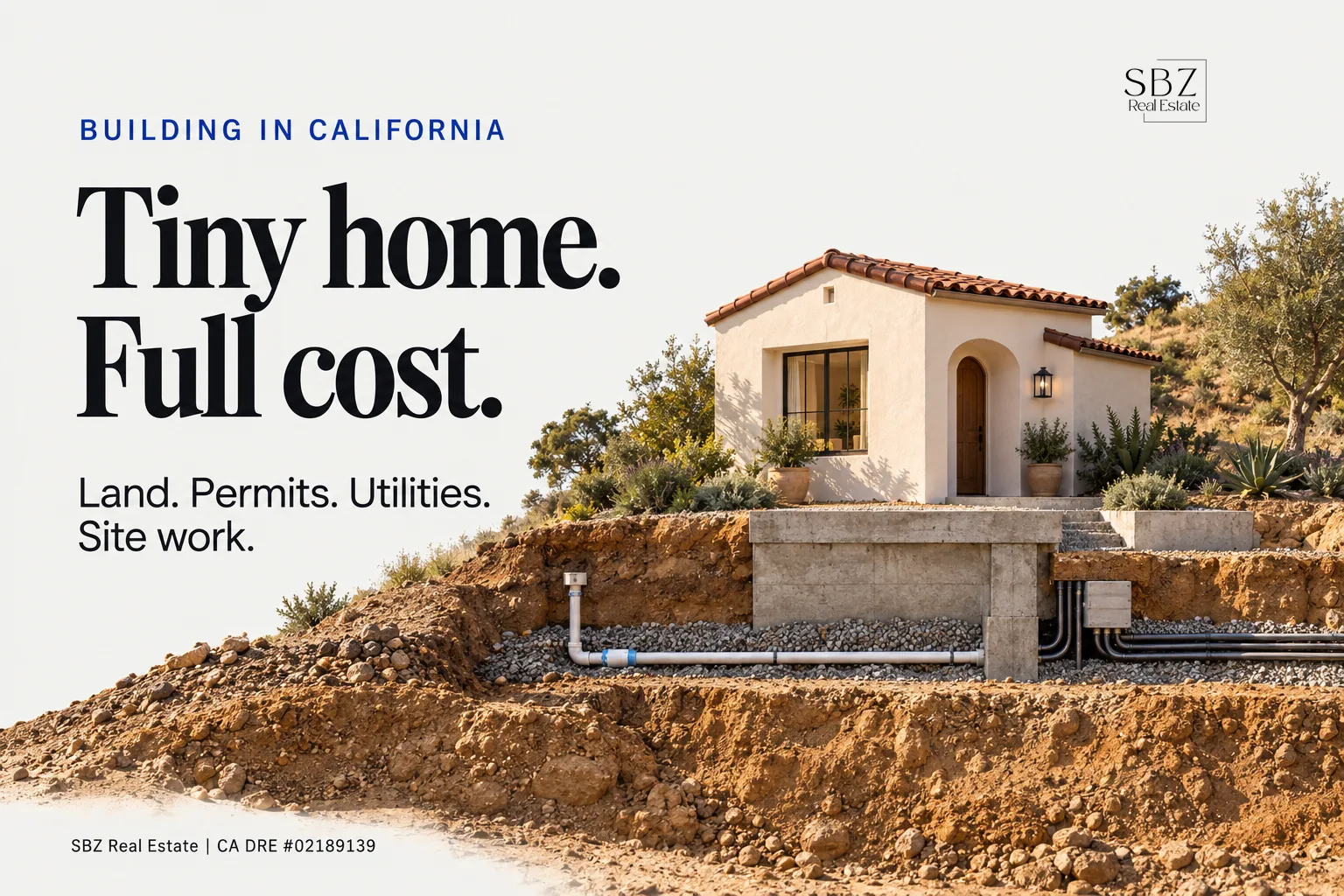
The cost to build a tiny home depends on three things: whether it sits on wheels or a foundation, whether you do the labor yourself, and what your land needs before anything can be built on it. In California, land, permits, and utility connections often matter as much as the structure itself. Any single number you see online is a starting point, not a quote.
I'd rather give you the framework for estimating your own number than a figure that was out of date by the time you read it. Here is how I walk people through it.
Why is there no single price for a tiny home?
"Tiny home" covers very different projects. A small trailer-mounted unit you build in a driveway has little in common with a detached, permitted dwelling on a foundation, even if the two have similar square footage.
Several variables move the total more than size does:
- Wheels or foundation. This determines how the unit is classified, inspected, and financed.
- Who builds it. Owner-built, kit, builder-built, and general-contractor-built projects can differ enormously.
- Finish level. Kitchen, bath, flooring, and mechanical systems are where budgets stretch.
- Site conditions. Slope, soil, access, and distance from existing utilities change the ground-up costs.
Small homes also don't scale down proportionally. Kitchens, bathrooms, and mechanical systems cost about the same regardless of square footage, so a tiny home can cost more per square foot than a larger house.
What goes into the cost of building a tiny home?
Think in categories instead of one lump sum. When you collect bids, ask for each of these separately:
- Land or lot. If you don't already own it, this is usually the largest single cost.
- Design and engineering. Plans, structural calculations, and energy compliance documents for a permitted build.
- Permits and fees. Building permits, plan review, and any local impact or connection fees.
- Site work. Grading, access, pad preparation, and foundation.
- The structure itself. Framing, roofing, windows, insulation, interior finishes.
- Utilities. Water, sewer or septic, electric, and gas or propane, plus trenching to reach them.
- Fixtures and appliances. Often underestimated in small-space builds.
- Contingency. Set aside a cushion for surprises, especially with older lots or rural parcels.
If you're buying land for the project, a boundary and topographic survey can prevent expensive surprises. I cover what that involves in how much it costs to get land surveyed in Southern California.
How much does it cost to build a tiny home on my property in California?
If you already own the lot, the math changes. You skip the land purchase, but you may still face utility extensions, permitting, and site preparation, which can be a surprising share of the total.
The first question is whether your property allows a second dwelling at all. California state law has made accessory dwelling units (ADUs) much easier to permit in recent years, and many "backyard tiny homes" are really built and permitted as ADUs. Local rules still vary by city and county on setbacks, size limits, utility requirements, and owner-occupancy details, so check with your local planning and building department before you spend money on plans.
Some practical points:
- Tiny homes on wheels are generally treated as recreational vehicles in California, not permanent housing. Living in one full time on a residential lot is often restricted or not allowed.
- A foundation-built tiny home that meets building code can be permitted as an ADU or a primary dwelling, depending on the lot and zoning.
- Utility connections are the line item people most often underbudget, especially on larger parcels where the nearest sewer or water line is far from the build site.
What does a tiny home cost to build in the backyard?
A backyard build can look cheaper because the land is already paid for. The cost still depends on how far the utilities have to travel, how much access the construction crew has, and whether existing infrastructure, such as your electrical panel or sewer lateral, can handle a second dwelling.
Get two or three written bids from licensed California contractors before you commit, and make sure each bid lists the same scope so you can compare them fairly. Ask specifically what is and isn't included: permits, utility hookups, site prep, and landscaping repair all get left out of early estimates.
Does building a tiny home make financial sense?
Sometimes. The honest answer depends on your goal.
- If you want lower housing cost and simplicity, a small home can be a good fit, but build costs, not just the sticker price of a kit, should drive the decision.
- If you want rental income or flexibility for family, a permitted ADU may serve you better than a movable unit.
- If you're thinking about resale value, the structure's permit status matters enormously. Unpermitted or hard-to-appraise units are difficult to sell or finance, and lenders and appraisers generally look for permitted, code-compliant square footage.
I'd also compare the build against simply buying. In some parts of the Antelope Valley, an existing small home or new construction may cost less in total than building from scratch once land, permits, and utilities are counted. If that comparison interests you, read about new construction homes in the Antelope Valley, and browse the Palmdale and Lancaster community pages for local context.
One more cost to understand before you build or buy: some newer developments carry special assessments. Our guide to Mello-Roos taxes in the Antelope Valley explains how to check.
How do I finance a tiny home build?
Financing is often the hardest part. Many conventional lenders won't finance a unit on wheels as real property, and a small structure with no comparable sales can be difficult to appraise.
Options people commonly explore include construction loans, financing against existing home equity, or paying cash. If you're buying land for the project, ask a lender early how they view the property type. For a broader look at the cash side, see how much to put down on a house, which covers the down payment thinking that applies to land and primary-home purchases alike.
How will a tiny home affect my property's value?
For a permitted, well-built structure on a foundation, an additional dwelling can add real utility and, in the right setting, value. How much depends on the local market, the quality of construction, and how an appraiser or buyer views it. That's something a comparative market analysis can help you evaluate rather than guess at.
An unpermitted structure works the other way. It can complicate a future sale, and in some cases buyers will walk away or ask for a significant price reduction. If you plan to sell someday, build it legally from the start. When that day comes, our selling guide and the article on what to fix before listing are good places to begin.
If you're weighing whether to build, buy, or sell and move on, a quick conversation costs nothing. You can reach out here, or learn more about SBZ Real Estate first.
Frequently asked questions
How much does it cost to build a tiny home?
It varies widely. The main drivers are whether the home is on wheels or a foundation, how much work you do yourself, the finish level, and your site's utility and permitting needs. Get itemized written bids from licensed contractors for a real number.
Is it cheaper to build a tiny home or buy one?
Not always. A tiny home can cost more per square foot than a conventional house, and once land, permits, and utilities are included, buying an existing small home can come out comparable or lower in some areas.
Can I build a tiny home in my backyard in California?
Often yes, usually as a permitted ADU, but rules differ by city and county. A tiny home on wheels is generally treated as an RV and typically can't be used as a full-time dwelling on a residential lot. Check with your local planning department first.
Do I need permits to build a tiny home?
For a permanent dwelling on a foundation, yes. Building without permits can create serious problems with insurance, financing, and resale, so treat permitting as a core part of the budget.
Will a tiny home hurt or help my resale value?
A permitted, code-compliant unit can add value depending on the local market. An unpermitted one can make selling harder. A local broker can review comparable sales to give you a clearer picture before you build.
