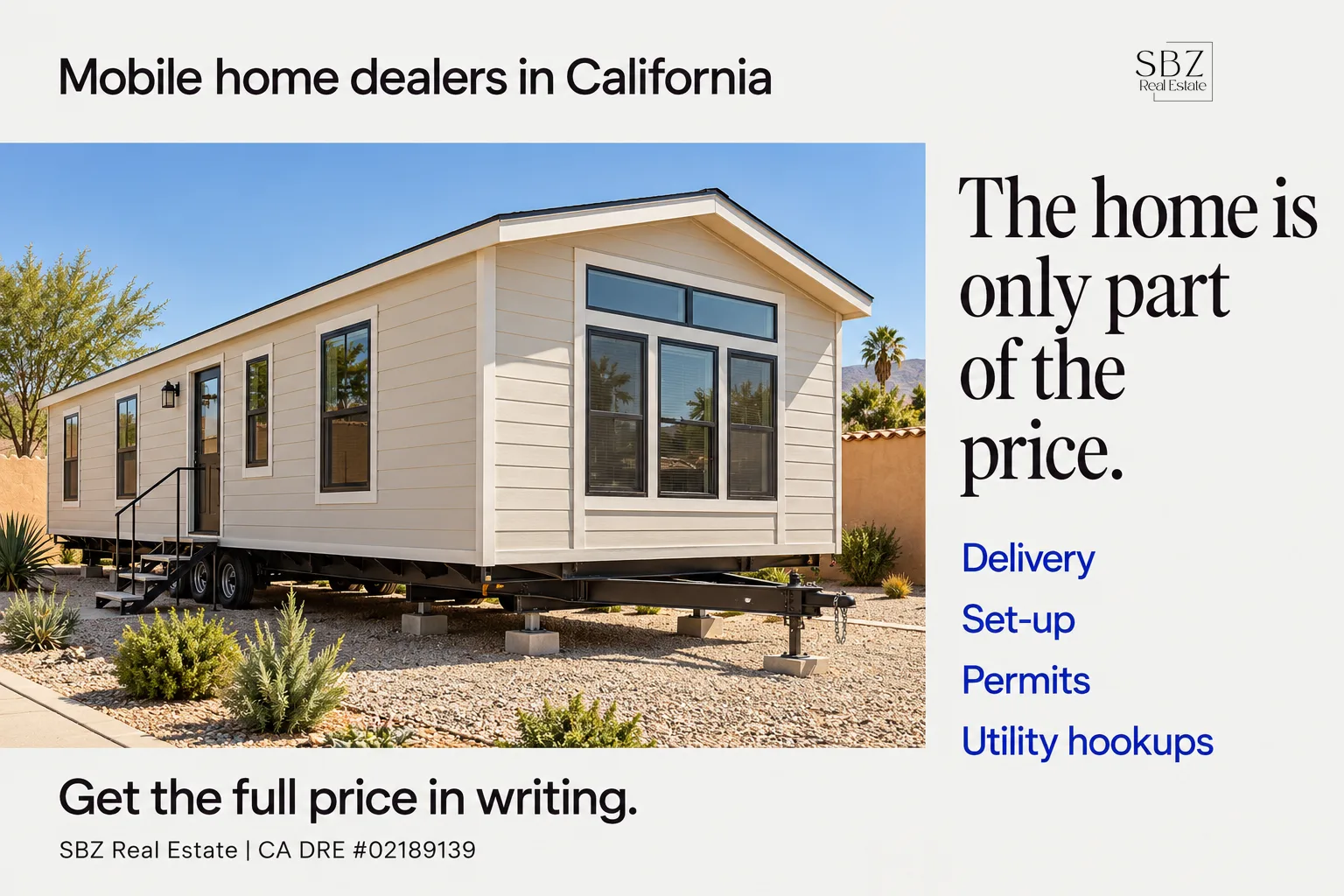
Mobile home dealers are businesses that sell new and used manufactured homes. The best way to choose one in California is to confirm their license, get the full out-the-door price in writing, and know before you sign whether the home will sit on land you own or in a rented space.
Most people searching for "mobile home dealers near me" are really asking a bigger question: is this a practical way into homeownership? Here is how dealers work, what to check, and where the purchase can go sideways.
What do mobile home dealers actually sell?
Dealers typically sell two things: new homes ordered from a manufacturer and used homes taken in on trade or resale. Many also sell installation, skirting, steps, and set-up services, and some sell parts and supplies.
The terminology matters. "Mobile home" technically describes a home built before June 15, 1976, when the federal HUD Code took effect. Anything built after that date is a manufactured home. Dealers use both terms interchangeably in ads, but the construction standard behind the home is worth asking about, because it affects insurance, financing, and resale.
How do I find mobile home dealers near me?
Start with a search for your own city or county, then check each dealer's website, reviews, and physical lot. Used homes also come through resale listings, park managers, and private owners, not just dealer lots. Our guide to buying a home from the owner in California covers the questions that apply to those private deals too.
A tip on search results: lists of "used mobile home dealers" in other states do not help you here. Titling, licensing, park-resident law, and installation rules are state-specific. Make sure any dealer you consider operates under California rules.
How do I vet a mobile home dealer before paying a deposit?
Treat it like any large purchase. A reputable dealer will not be bothered by these requests:
- Verify the license. California licenses dealers and salespeople who sell manufactured homes. Ask for the license number and confirm its status with the state before you hand over money.
- Ask for a written, itemized price. The number should include the home, delivery, set-up, permits, utility hookups, skirting, steps, taxes, and fees. A low sticker price with a long list of add-ons is a common surprise.
- Read the contract slowly. Look at the deposit terms, what happens if financing falls through, and who is responsible for permits and inspections.
- Confirm clean title on used homes. Ask to see ownership and registration records, and confirm there are no liens or unpaid fees attached to the home.
- Get an independent inspection. A dealer's own walkthrough is not an inspection. Our article on what a California home inspection covers explains how to use the report, and the same logic applies to a manufactured home.
Where will the home go: your land or a park?
This is the question that changes everything, and it should be answered before you pick a home.
On land you own. Buying a lot and placing a manufactured home on it brings you into the world of zoning, permits, utility connections, and a foundation system. When a home is installed on a permanent foundation on land you own, it can often be treated as real property rather than personal property. That can help with financing and resale. Local rules vary a lot, so check with the city or county planning office before you buy anything. If you are looking at land in the high desert, our community pages for Palmdale, Lancaster, and Quartz Hill are a good place to start learning the area.
In a mobile home park. You own the home but rent the space. California's Mobilehome Residency Law sets out rights and obligations for park residents and management, including notice requirements and park rules. Space rent, rent-increase rules (some cities have local ordinances), and park rules all affect your monthly cost, so read the park's rental agreement as carefully as the home's purchase contract. A home in a park can be hard to move, and a buyer is often limited by the park's approval process.
How is financing different for a manufactured home?
Financing depends heavily on how the home is classified. A home on a permanent foundation on owned land may qualify for a traditional mortgage. A home in a park, or one not permanently affixed, is often financed with a different kind of loan, and terms can differ from a standard home mortgage. Interest rates, down payment, and loan length may not look like what you would see on a house.
Ask the dealer which lenders they work with, then compare at least one outside quote. Our guide to how much to put down on a house walks through the down payment tradeoffs, and many of the same principles apply.
Do mobile home dealers also sell parts and supplies?
Some do, but "mobile home parts dealers" and "supply dealers" are often separate businesses. If you own a home and need skirting, tie-downs, plumbing fixtures, or roofing materials, a dedicated supplier may be cheaper than a sales lot. Anything structural, such as anchoring, a foundation, or electrical and gas connections, should go through a licensed contractor and, where required, a permit.
Is a manufactured home the right fit, or should I compare other options?
For some buyers, a manufactured home is the most accessible route to owning something. For others, a condo or a small resale house costs about the same once land, space rent, and set-up are included. Before you commit, compare real numbers side by side.
- Add up the full monthly cost: loan payment, space rent or land costs, insurance, utilities, and taxes.
- Think about resale. A home on owned land and a home in a park can behave very differently when it is time to sell.
- Look at alternatives. Our guide to affordable homes for sale in Southern California shows where site-built options might fit. If you are curious about building rather than buying, see what it costs per square foot to build a home and what a new construction purchase involves in the Antelope Valley.
If you are earlier in the process, our first-time home buyer guide for California and the Antelope Valley lays out the steps in order.
What to do next
A dealer sells a product. A broker's job is to help you decide whether that product is the right move. If you are weighing a manufactured home against a conventional purchase, a quick conversation costs nothing, and we will tell you plainly what we see. We are happy to be a second set of eyes on the numbers. You can also see how we work on our buying page.
Frequently asked questions
Are mobile homes and manufactured homes the same thing?
Not exactly. "Mobile home" refers to a home built before the HUD Code took effect on June 15, 1976, and "manufactured home" refers to one built after. Dealers often use the terms interchangeably.
How do I know a mobile home dealer is legitimate?
Ask for their license number and verify it with the state, then get an itemized written price and read the full contract. A dealer who avoids either request is worth walking away from.
Can I buy a mobile home without owning land?
Yes. Many buyers place a home in a mobile home park and pay monthly space rent. Read the park's rental agreement and California's Mobilehome Residency Law protections before you commit.
Is it harder to get a loan for a mobile home?
It can be, and the loan type often depends on whether the home is on owned land with a permanent foundation. Compare more than one lender, including one that is not tied to the dealer.
Should I get an inspection on a used mobile home?
Yes. An independent inspection can flag roof, plumbing, electrical, and structural concerns that are expensive to fix later, and the report gives you leverage to negotiate.