
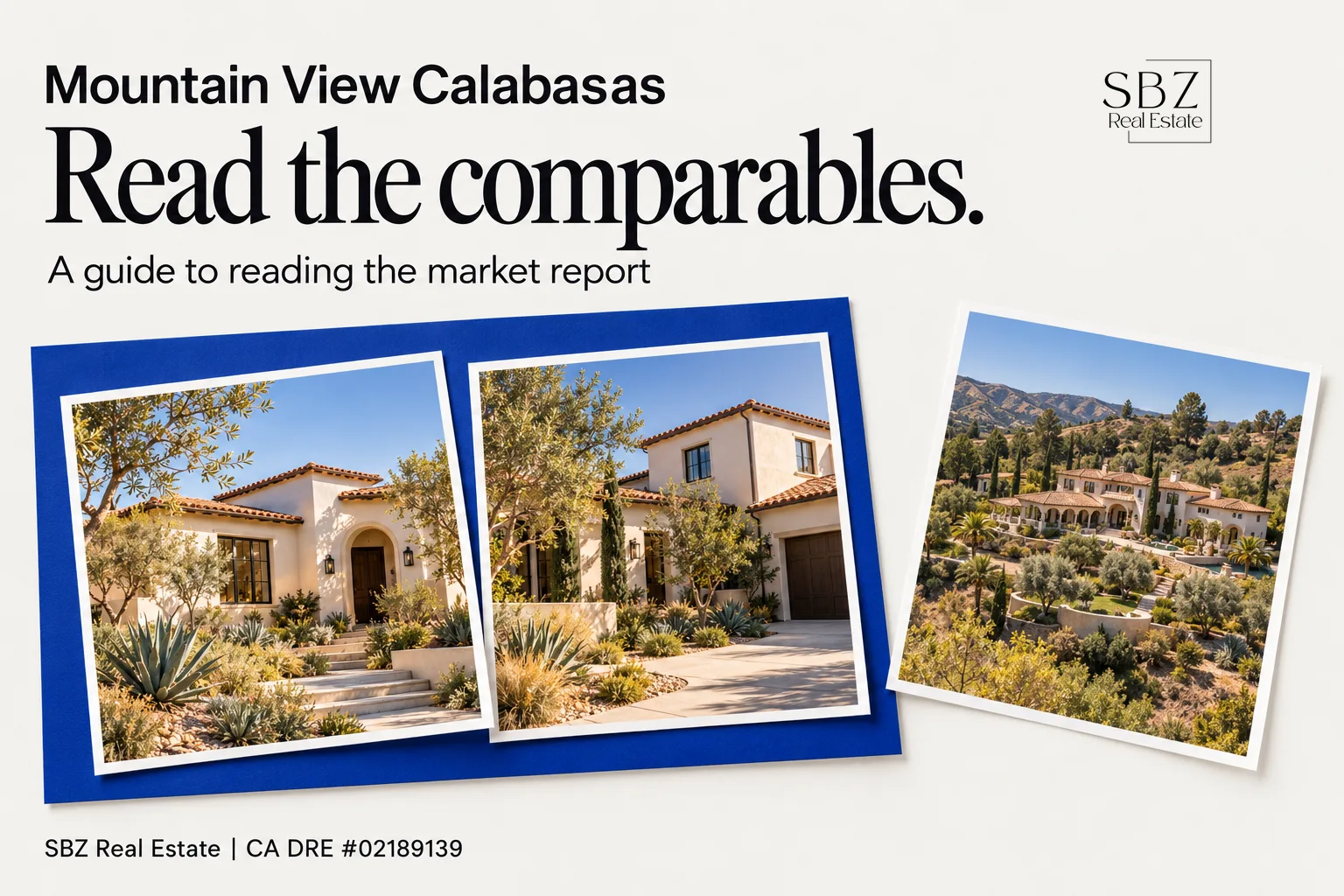
A Mountain View Calabasas market report is a snapshot of recent closed sales, current listings, and pricing patterns for homes in that part of Calabasas. The ones worth trusting are built from comparable properties close by, not from a single city-wide average. If you're deciding whether to buy or sell, the report matters less than how you read it.
This guide covers what a good report includes, where the numbers come from, and which signals deserve your attention. It doesn't quote price figures, because market data changes monthly and any number printed here would be stale quickly. For current figures on your specific street or tract, a broker-prepared analysis is the right tool.
What does a Mountain View Calabasas market report actually include?
A solid report has the same core pieces no matter who produces it:
- Closed sales over a defined window, with sale price, size, lot, and condition notes
- Active and pending listings, so you can see what you'd compete against or be compared to
- Price per square foot, used carefully, since lot size, views, and updates can swing it widely
- Days on market and list-to-sale price ratio, which show how much negotiating room exists
- Inventory, meaning how many homes are available relative to how many are selling
The thing most readers miss is the definition of the area. "Mountain View" can mean different things to different people, and Calabasas has several named neighborhoods, tracts, and gated communities that sit close together but trade very differently. Before you trust any report, check exactly which streets or subdivision it covers.
Where should the data come from?
The most dependable reports draw on closed-sale records from the local multiple listing service, supplemented by county records from the Los Angeles County Assessor. Consumer portals can be a useful starting point, but their automated estimates often miss renovations, lot quirks, and off-market transactions.
If you want a plain-English explanation of how listing data is shared among brokers, our guide on what MLS stands for in real estate covers the basics. And if a report gives you a number with no source and no date, treat it as a talking point rather than evidence.
Which numbers matter most for sellers?
If you're thinking about listing, three questions do most of the work:
- What did the most similar homes actually close for? Not what they were listed at. A comparative market analysis ties your pricing to recent, comparable sales. Here's what a CMA is and how it works.
- How long did those homes take to sell, and what happened to their asking prices along the way? A home that reduced its price twice tells a different story from one that sold at its first ask.
- What would you net after costs? A strong sale price can still disappoint if you haven't accounted for commissions, taxes, and closing costs. A seller net sheet puts those line items in front of you early.
For higher-end properties, pricing is rarely a formula. Unique lots, views, architecture, and privacy can make the closest comparable sale a poor match. Our article on selling a luxury home in Calabasas, Hidden Hills, or Encino goes deeper on pricing, staging, and discretion.
Which numbers matter most for buyers?
Buyers should read a market report as a negotiation tool. Pay attention to:
- The gap between list price and sale price in recent closings. A consistent gap suggests room to negotiate. A gap of zero or less suggests competition.
- Inventory trends. More homes on the market generally means more choice and more leverage. A shortage means preparing to move quickly.
- How long similar homes sit. Homes that linger often have a pricing, condition, or layout issue worth understanding before you make an offer.
Buyers also need to think about costs beyond the price tag. Property tax, HOA dues, and any special assessments can change what a home really costs each month, and those vary by tract. It's also worth understanding how buyer agent compensation works now in California before you start touring.
How do I compare Calabasas to nearby markets?
Sometimes the most useful move is to widen the lens. Buyers and sellers in Calabasas often cross-shop nearby San Fernando Valley communities, and a comparison can reveal whether a price is reasonable or an outlier. Our community pages for Woodland Hills and Sherman Oaks are good places to start, and the Sherman Oaks real estate data report guide shows how to read neighborhood data in general. The same habits apply in Calabasas.
Timing questions come up too. Seasonal patterns are real but modest, and local conditions can outweigh them. See the best time to sell a house in California for what the calendar does and doesn't tell you, and what forecasts mean for Southern California in 2026 for the bigger picture. Forecasts are projections, not promises.
What are the limits of any market report?
Even a well-built report can only describe the past. It can't promise a sale price, a timeline, or an outcome, and anyone who says otherwise is selling something. Here's what a report can't capture:
- Condition and updates. Two homes with the same square footage can be worth very different amounts.
- Privacy, views, and lot position. These carry real value but rarely show up in a spreadsheet.
- Off-market activity. Some transactions never appear on public listing channels. If discretion matters to you, read about off-market homes and how to find them and our overview of private client real estate.
- Small sample sizes. In a small area, a couple of unusual sales can distort the picture. That's why a good broker looks at the trend and the specific comparables, not just the headline average.
What's a sensible next step?
If you're weighing a move, start with the question you actually need answered: "What is my home likely worth?" or "What should I expect to pay for this kind of home?" Then get a tailored analysis rather than a generic report. You can explore our selling and buying pages to see how we work, or reach out through our contact page. A quick conversation costs nothing, and you'll leave with a clearer sense of where you stand.
Frequently asked questions
Is there a free Mountain View Calabasas market report I can rely on?
Public portals and county records offer a starting point, but they may lag behind actual closings and miss renovations. A broker-prepared analysis using recent, comparable closed sales for your exact area is more reliable than a generic online summary.
How often should I check the market before listing or buying?
Monthly is a reasonable rhythm, since local conditions can shift over a few weeks. If you're within a few months of making a move, ask for an updated comparable-sales review right before you set a price or write an offer.
Does a market report tell me what my home will sell for?
No. A report describes what similar homes did in the past, and it helps frame a pricing strategy. The final price depends on condition, presentation, timing, and what buyers are willing to pay when your home is on the market.
What's the difference between a market report and a CMA?
A market report summarizes trends across an area. A CMA focuses on your specific property and compares it to the most similar recent sales. Sellers and buyers usually need both, and the CMA is what drives an actual pricing decision.
Should I look at nearby communities too?
Yes, particularly if you're flexible on location. Comparing Calabasas with neighboring San Fernando Valley communities can show whether a home is priced in line with the broader market or standing apart from it.