
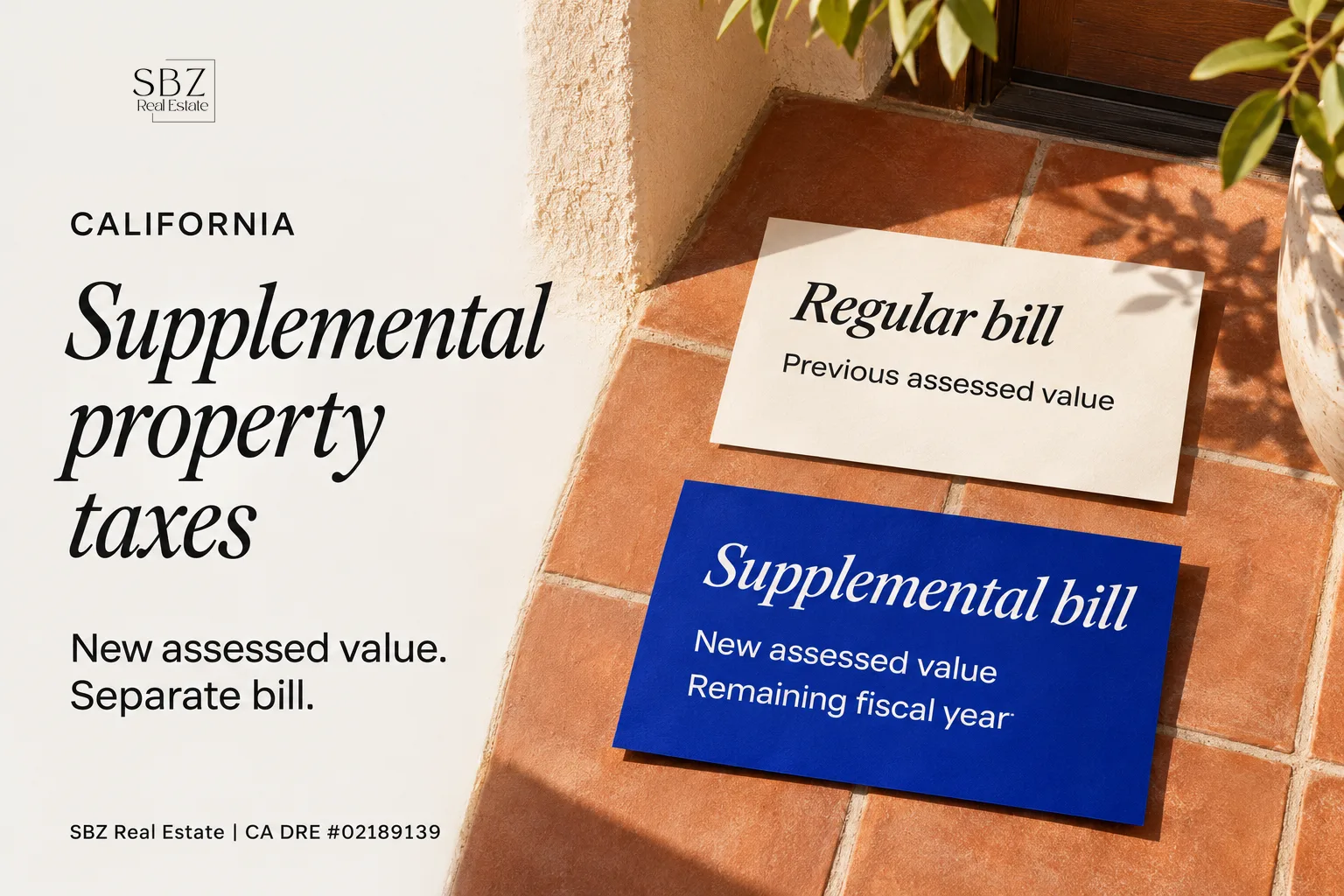
A supplemental property tax is an additional bill California counties send after a home changes ownership or finishes new construction. It covers the difference between the property's old assessed value and its new one, for the part of the fiscal year that remains. Many buyers never hear about it until the envelope shows up, so here is how it works and how to plan for it.
Why does California have supplemental property taxes?
California's Proposition 13 sets a property's assessed value at its purchase price and limits how fast that value can rise each year. The county doesn't reassess the home every year to match the market. It reassesses when something specific happens.
That creates a timing gap. The regular tax bill for a fiscal year (July 1 through June 30) is built on the old owner's assessed value. Without a supplemental bill, the county would collect tax on the outdated value until the next fiscal year began. The supplemental assessment closes that gap.
What triggers a supplemental tax bill?
Two events trigger one:
- A change in ownership. Buying a home is the obvious case. Other transfers can count too, unless an exclusion applies.
- Completion of new construction. Finishing an addition, a new build, or other qualifying improvements raises the assessed value of the part that was built.
If you're buying a resale home, the first trigger is the one that applies to you. If you're building, the second does. Our guide to new construction homes in the Antelope Valley covers the other costs to expect on that path.
How is a supplemental assessment calculated?
The county assessor determines the property's new assessed value as of the date of the ownership change or completion. It subtracts the previous assessed value. The difference, multiplied by the tax rate and prorated for the months left in the fiscal year, is your supplemental tax.
Here is a simplified, hypothetical illustration. It uses round numbers and is not a prediction for any property. Say the prior assessed value was $400,000 and the new one is $800,000. The increase is $400,000. At a base rate of about 1% (the Prop 13 rate, before any local voter-approved charges), the full-year tax on that increase would be $4,000. If six months remain in the fiscal year, the supplemental bill would be about half of that, or $2,000.
Your actual figure depends on the assessed value set by the Los Angeles County Assessor, the local tax rate, and the closing date. The month you close affects the proration. A closing early in the fiscal year leaves more months to bill than one near the end.
Is the supplemental bill part of my regular tax bill?
No. It arrives separately, and that is where buyers get caught off guard.
The county mails it directly to the owner of record. It does not go through your lender's impound account the way your regular property tax installments typically do. If you have a mortgage with an escrow account, don't assume the supplemental bill is covered. Check the bill and pay it by the due dates printed on it.
Depending on when you close, you may receive one supplemental bill or two. A purchase spanning two fiscal years can produce a bill for each. Each carries its own due dates, and missing them can lead to penalties, so read the bill when it arrives. For more on how escrow handles tax prorations at closing, see our explainer on what escrow is and how it works in California.
Who pays: the buyer or the seller?
The buyer. The supplemental assessment reflects the new owner's higher value, and the bill goes to the new owner. The seller's regular tax obligations through closing are typically handled through escrow proration, but the supplemental bill is separate from that.
For sellers, the practical point is simple. You generally don't owe the buyer's supplemental tax, but it helps to know it's coming for your buyer. If you're mapping out your own costs, our guide to the cost of selling a house in California walks through what sellers actually pay.
Can a supplemental assessment be lower, or avoided?
Sometimes. A few situations are worth knowing:
- Negative supplemental assessments. If the new assessed value is lower than the old one, for example after a decline in the market, the county can issue a refund rather than a bill.
- Exclusions from reassessment. Certain transfers between spouses, and some transfers between parents and children, may qualify for exclusion. These rules changed with Proposition 19, so details matter. Read our guides on inheriting a house under Prop 19 and transferring your property tax base under Prop 19.
- Exemptions. Homeowners can file for the homeowners' exemption, which reduces taxable value modestly. It is a separate claim with the county.
These are general descriptions, not tax advice. For your situation, the County Assessor's office or a licensed tax professional is the right authority.
How should I budget for it when buying a home?
Treat it as a cost that sits outside your closing statement. Here is what I tell buyers:
- Estimate it early. Ask your broker to help you approximate the new assessed value, which is generally your purchase price, and the likely tax on the increase over the prior value.
- Set the money aside. Keep it in cash so the bill doesn't land on top of moving expenses.
- Don't confuse it with your escrow impounds. Confirm with your lender what the monthly payment includes.
- Watch your mailbox, and your mail forwarding. The bill goes to the address on record, so make sure the county has the right one.
- Check the due dates the moment it arrives.
If you're comparing what different purchases cost, closing costs for home buyers in the Antelope Valley is a useful companion read. Local charges also vary by area. Some communities carry additional assessments, and Mello-Roos taxes in the Antelope Valley are worth understanding before you commit to a property.
Frequently asked questions
Is a supplemental property tax a one-time charge?
It is tied to the event that triggered it, so it is a one-time adjustment for that ownership change or construction. After the fiscal-year gap is covered, your regular annual bill reflects the new assessed value.
Will my lender pay the supplemental bill from my escrow account?
Usually not. Supplemental bills are mailed to the owner and are typically not included in impound accounts. Confirm with your lender, and plan to pay it yourself by the due dates on the bill.
Do I owe supplemental tax if I buy a newly built home?
Possibly. New construction can trigger its own assessment, and a first sale can trigger a change-in-ownership assessment. The amounts and timing depend on how the county assessed the property, so ask for details during the purchase.
Can I appeal a supplemental assessment?
Yes, if you believe the assessed value is wrong. California counties have an assessment appeals process with deadlines tied to the notice you receive. Contact the County Assessor or Assessment Appeals Board for specifics.
Planning your purchase with a local broker
Supplemental taxes are one of the less glamorous parts of buying in California, and one of the easiest to plan for once you know they exist. If you're buying a home or weighing a move, a quick conversation costs nothing, and we're happy to walk through the numbers with you.