
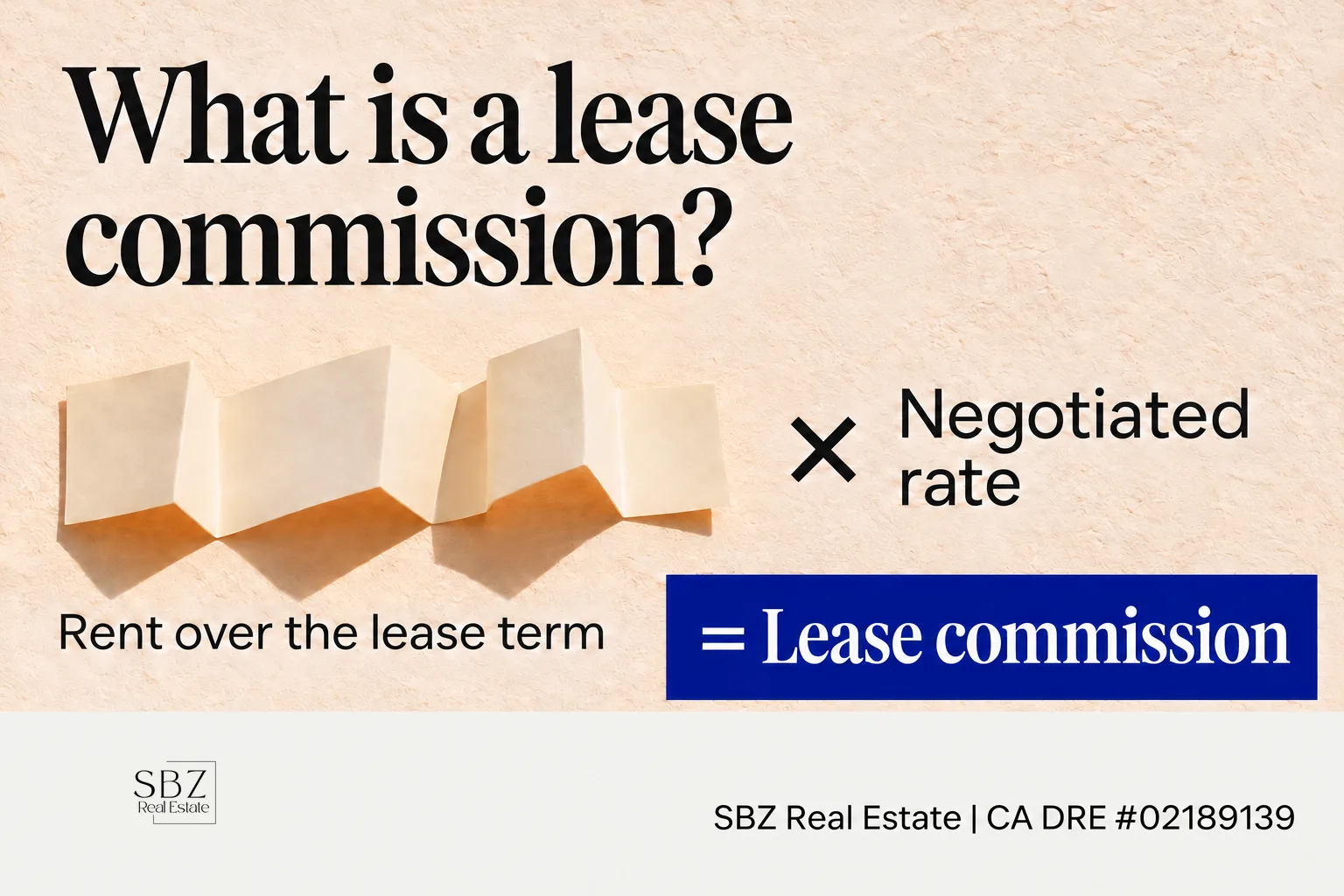
A lease commission is the fee a licensed real estate broker earns for bringing a landlord and a tenant together on a signed lease. It is typically paid by the landlord, calculated from the rent the tenant agrees to pay, and negotiated in writing before the work begins.
The concept is simple, but the details are where people get tripped up. Commercial and residential leases handle commissions quite differently, and the numbers you see quoted online are often averages that don't match your deal. Here is how it actually works.
What exactly is a lease commission?
It is compensation for a brokerage's services in a leasing transaction, the same way a sales commission compensates a brokerage for a sale. The commission is earned when the lease is signed (and sometimes paid in stages), not when a tenant first tours the space.
In California, a commission is not set by law. It is a negotiated term between the property owner and the brokerage, and it should be spelled out in a written agreement. That is also true of sales; our guide to realtor commission in California covers the same principle on the sales side.
How is a lease commission calculated?
Most commercial lease commissions are expressed as a percentage of the total rent due over the lease term. The percentage is negotiated, and it often changes depending on the length of the lease, the size of the space, and whether one broker or two are involved.
Because the base is the rent over the full term, a longer lease generally means a larger commission in dollar terms, even when the percentage stays the same. Some agreements reduce the percentage for the later years of a long lease, and some pay a different rate on renewals than on a brand-new lease. These are all points of negotiation, so there is no single correct figure. If someone quotes you a "standard" rate, ask what lease length and property type it applies to.
What is the standard commission for a commercial lease?
There isn't a universal standard, and anyone who gives you one number is oversimplifying. Rates vary by market, property type, lease length, and the leverage each side has. A large industrial tenant and a small retail tenant will not negotiate the same terms.
What is fairly consistent is the structure. The landlord agrees to pay a commission, the landlord's broker holds the listing, and when a tenant's broker brings the deal, the total commission is usually divided between the two. If you are evaluating a quote, ask for the percentage, the base it applies to, and when it is paid, all in writing.
Who pays the lease commission?
In most commercial deals, the landlord pays, whether the commission goes to the landlord's broker, the tenant's broker, or both. The cost is built into the economics of the lease, which is one reason rent and commission are often negotiated together.
Residential leasing works differently in practice. A landlord who hires a brokerage to find a tenant usually pays a leasing fee, often tied to the first month's rent or to a share of the rent. Practices vary by brokerage and by agreement, so the signed listing or management agreement is what controls. A tenant should not be asked to pay anything that wasn't disclosed in writing up front.
When is the commission paid?
It depends on the agreement. Some commissions are paid in full at lease signing. Others are split, with part due at signing and part due when the tenant takes possession or opens for business. For longer leases, an owner may negotiate to pay in installments.
Also look at what happens if the tenant renews or expands. Many agreements address renewal commissions, and it is far easier to settle that before the lease starts than after.
What should a landlord or tenant check before agreeing?
A short list covers most of the surprises:
- The rate and the base. Is it a percentage of base rent, or of all rent including extra charges?
- The term it applies to. Does it cover renewals, extensions, or expansion space?
- Who is being paid. One broker, or a split between the landlord's and tenant's brokers?
- When it's earned and when it's due. At signing, at move-in, or in installments?
- What happens if the deal falls through. Is any fee owed if the lease never closes?
- Whether the brokerage represents both sides. If so, that should be disclosed in writing.
If any of that is vague, ask for it to be clarified before you sign. The difference between an agent, a broker, and a Realtor also matters here, because it determines who is legally able to enter into the agreement and receive the fee.
How does a lease commission differ from a sales commission?
A sales commission is a one-time percentage of the purchase price, paid at closing. A lease commission is tied to the rent over time, which means the amount depends on how long the tenant commits. The sales side also comes up in what closing costs include, whereas lease commissions never touch a closing statement in the same way.
For owners who hold rental property, this distinction affects planning. If you are thinking about building a rental portfolio with a broker or watching the Antelope Valley rental market, leasing costs are one more line to account for when you model your returns.
Is a lease commission negotiable?
Yes. Rates, splits, renewal terms, and payment timing are all open to negotiation, and the strongest position is usually a clear scope of work. Ask what the brokerage will actually do: marketing, showings, screening, negotiation, lease review, and follow-through to move-in.
If you are weighing a bigger move, such as commercial property in Southern California, it helps to understand how leasing fees fit alongside financing and due diligence. SBZ Real Estate is a full-service residential brokerage, so for specialized commercial leasing, we'll tell you plainly what fits and what doesn't. For residential questions, you can read more about SBZ Real Estate or get in touch. A quick conversation costs nothing.
Frequently asked questions
What is a lease commission in simple terms?
It is the fee a broker earns for helping a landlord and tenant sign a lease. It is usually a negotiated percentage of the rent over the lease term and is generally paid by the landlord.
What is the standard commission for a commercial lease?
There is no single standard. The rate depends on the market, the property type, the lease length, and whether two brokers share the fee. Get the percentage, the rent base, and the payment timing in writing.
Who pays a lease commission, the landlord or the tenant?
In most commercial leases the landlord pays, and the fee may be split between the landlord's and tenant's brokers. In residential leasing, a landlord who hires a brokerage typically pays the leasing fee, as set out in the written agreement.
Do lease commissions apply to renewals?
Sometimes. Many agreements include a separate, often different, commission for renewals or expansions. If it isn't addressed in the original agreement, raise it before signing.
Is a lease commission set by law in California?
No. California does not set a required rate. It is negotiated between the parties and should be documented in a written agreement.