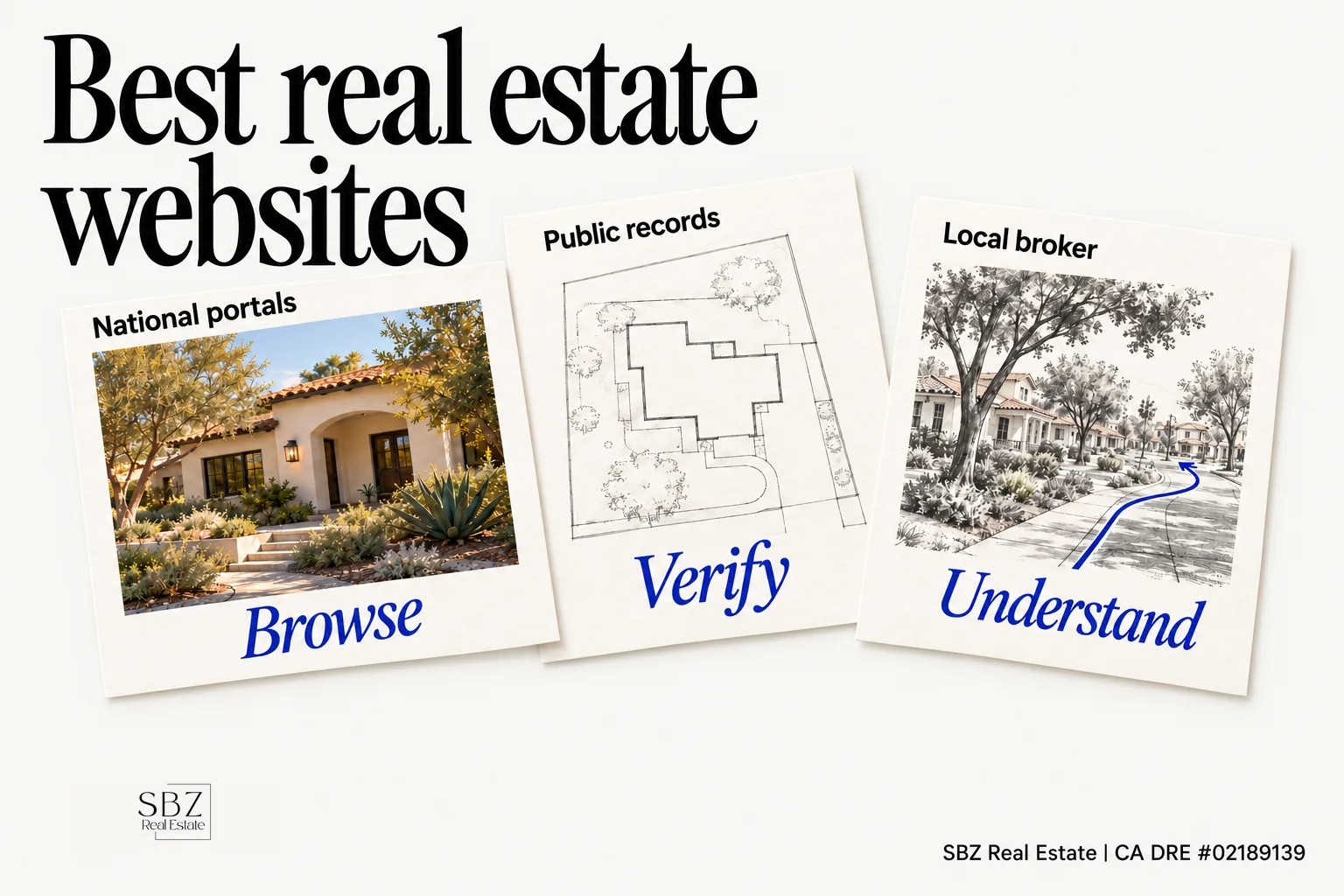
The best real estate websites aren't one site. They are three kinds of site, each good at a different job: national portals for browsing listings, public record sites for verified facts, and a local broker's website for market context and guidance. Most people lean on only the first kind, which is where the confusion usually starts.
Here's how I'd use each, what to trust, and what to double-check before you act on it.
What are the best websites for browsing homes?
The large national portals, such as Zillow, Redfin, and Realtor.com, are the right place to start a search. They pull listing data together in one place, offer map-based filters, and send alerts when something new appears. For browsing and getting a feel for what's out there, they do the job well.
Their limits are worth knowing. Listing details can lag behind reality, and a home that shows as active may already be in negotiation. Photos and descriptions are written to attract clicks, not to tell you what a home inspection will find. The listings themselves generally originate in the local MLS, which is why the same home appears on many sites. If you want to understand where that data comes from, what the MLS actually is is a good primer.
Can I trust the home value estimates on those sites?
Treat them as a starting point, not an answer. Automated estimates are generated by a model that sees public records and recent sales, but it can't see your kitchen, your roof, or the street noise. In a market with a wide mix of home types, the gap between an estimate and a real sale price can be meaningful.
For buyers and sellers, a broker's comparative market analysis is a more reliable tool because it accounts for condition, updates, and what is actually competing right now. What a CMA is and how it's built explains the difference. If you're in the Antelope Valley, how to think about what your Palmdale house is worth walks through it locally.
Which websites give you verified property facts?
Government and public record sites are less polished and more dependable. These are the ones I send clients to when accuracy matters:
- The county assessor's site. Parcel details, lot size, assessed value, and ownership records. For Los Angeles County properties, this is the Los Angeles County Assessor's online property search.
- The California Department of Real Estate (DRE) license lookup. Confirms that an agent or brokerage is actually licensed and shows their license status.
- City and county planning or permit portals. Useful for checking permits, zoning, and whether past work was done with approvals.
- The U.S. Census Bureau. Reliable general demographic and housing data, for background research on a region.
These sites won't help you browse, but they settle questions that listings can't. Before you rely on a number from any portal, check it against the record.
What makes a good real estate broker website?
If you're evaluating brokerages, the website tells you a lot. A good broker website should do the following:
- Say who is responsible. You should be able to find out who the licensed broker is, and the site should display a DRE license number you can verify. The About page is the first place to look.
- Explain the service plainly. Clear pages for buying and selling that describe how the process works, not just slogans.
- Offer real local content. Market information for the specific areas served, rather than generic national advice.
- Make contact easy. A working phone number, an email, and a contact page that gets a human reply.
- Show listings and search tools that stay current. Many broker sites display listings through an IDX feed from the local MLS, so you aren't limited to the national portals.
Notice what's not on the list: flashy animation, countdown timers, or "act now" pressure. A professional site is built for clarity.
What should a local broker's website add that portals can't?
Context. A portal can show you ten homes. It can't tell you how an area behaves through the year, what buyers there typically trade off, or what a particular type of home needs after closing.
That's the value of community-level guides. On this site, our communities pages are built around data-backed market guides refreshed monthly, with sourcing from Redfin and Zillow data. If you're looking at the Antelope Valley, you can read about Palmdale, Lancaster, and Quartz Hill before ever picking up the phone. For the Valley and beyond, there are pages for Santa Clarita, Glendale, and Burbank as well.
A good local site should also help you choose who to work with. If that's your next step, how to choose a real estate agent in Southern California covers the questions worth asking, and agent vs. broker vs. Realtor clears up the titles.
Are there homes that no website will show you?
Yes. Some homes are sold quietly, without ever appearing on a public portal. If you've exhausted the portals and haven't found the right fit, off-market homes and how to find them explains how those transactions work and why they depend on relationships rather than search bars.
This is one of the clearest limits of any website. Software can aggregate what's public. It can't introduce you to a seller who hasn't listed yet.
How should I put these together?
A practical routine looks like this:
- Use a national portal to browse and set alerts.
- Use the county assessor and permit records to verify anything you're serious about.
- Use a local broker's site for area guides, and to find someone accountable to talk to.
- Use a broker's analysis, not an automated estimate, when you're deciding on a price.
None of that takes more than a few evenings, and it replaces a lot of second-guessing later.
If you're weighing a move and want a straight answer about a specific home or area, a quick conversation costs nothing. You can reach us through the contact page.
Frequently asked questions
What is the best website to search for homes in Southern California?
For broad browsing, the national portals are the most convenient. For the most current availability and local guidance, pair them with a local broker's site, which often displays listings from the regional MLS.
Are real estate websites accurate?
Mostly for basic listing details, less so for value estimates and timing. Verify important facts, such as lot size, permits, and ownership, against county records.
How do I check that a real estate broker is licensed in California?
Use the California Department of Real Estate's public license lookup. It shows whether the license is current and who the broker of record is.
Do I need a broker if I can search listings myself?
Searching is the easy part. A broker adds pricing judgment, negotiation, contract handling, and access to homes that never reach a public portal.
Why do the same homes appear on so many sites?
Most listings originate in the local MLS and are shared with portals and broker websites through data feeds. The differences between sites are mainly presentation, filters, and how quickly each updates.