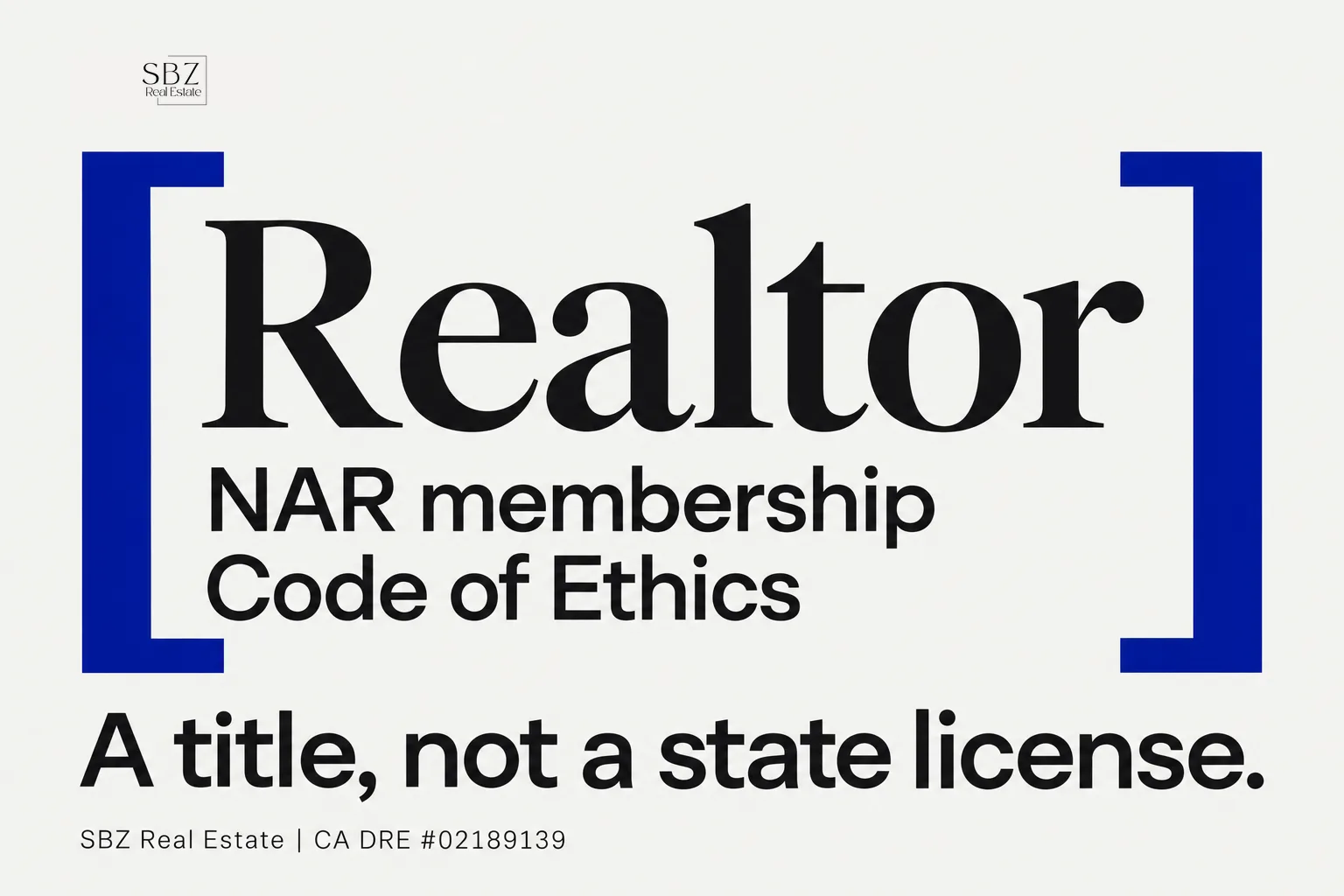
A NAR Realtor is a licensed real estate professional who has joined the National Association of Realtors (NAR) and agreed to follow its Code of Ethics. "Realtor" is a membership designation, not a state license. Anyone can hold a California license without being a Realtor, and the license is what lets someone legally represent you.
The distinction matters whenever you're choosing who to hire, so here's what the title does and doesn't tell you.
What does "Realtor" actually mean?
"Realtor" is a registered collective membership mark that belongs to NAR. Only members may use it, and it's meant to be written with a capital R. That's why you'll see the word on business cards, signs, and websites, usually alongside the association's logo.
Membership is layered. A member joins a local association, and that membership carries with it membership in the state association (in California, the California Association of Realtors) and in NAR itself. The dues are paid by the agent or broker, not by you.
The title is voluntary, and it describes what someone has chosen to join. It says nothing on its own about how many transactions they've handled or how well they'll fit your situation.
Is a Realtor the same as a real estate agent or a broker?
No. The three terms overlap, but each means something different:
- Agent (salesperson): holds a state license and works under a supervising broker.
- Broker: holds a broker license, which requires additional experience and exams, and can operate a brokerage independently.
- Realtor: an agent or broker, of either license type, who is also a member of NAR.
So every Realtor is licensed, but not every licensee is a Realtor. We walk through the difference in more detail in Real Estate Agent vs. Broker vs. Realtor.
What is the NAR Code of Ethics?
The Code of Ethics is the main thing a Realtor signs up for. It's a written standard of professional conduct covering how members treat clients, customers, the public, and each other. Its themes include honesty in advertising, putting the client's interests first, avoiding misrepresentation, and cooperating with other professionals in a transaction.
Members are required to complete ethics training on a recurring cycle. If a consumer or another member believes the Code was violated, a complaint can be filed with the local association, which has a hearing process and can impose discipline.
That process sits alongside, not in place of, the state's own oversight. A complaint about unlicensed activity, trust-fund handling, or fraud goes to the California Department of Real Estate (DRE), which can act on the license itself. An association can only act on the membership.
Does being a Realtor mean a better agent?
Not automatically, and anyone who says otherwise is selling the logo. The designation adds a layer of accountability through a published ethics standard and a complaint process. It doesn't measure skill, local knowledge, responsiveness, or negotiating ability.
Here's what actually matters in this market when you're choosing someone:
- License status. Confirm it on the DRE's public license lookup. Check that it's active and see whether there are any disciplinary actions.
- Local knowledge. Someone who knows Palmdale, Burbank, or Sherman Oaks street by street will serve you better than a credential alone.
- Who does the work. Ask whether the person you're meeting is the person who will actually handle your transaction.
- Communication. Pay attention to how quickly and clearly they answer before you hire them.
Our guide on how to choose a real estate agent in Southern California goes deeper on the interview questions that reveal the most.
What are the benefits of being a NAR Realtor?
Most of the benefits go to the member, but some reach clients indirectly. Members typically get access to:
- Continuing education and professional training
- Market research and legal guidance from the association
- Standard forms and contract resources through the state association
- Member discounts on products and services
- Dispute resolution, including arbitration, between members
Members sign in to the association's member portal for these resources. As a consumer, you don't need a login for any of it.
The practical benefit to you is mostly the ethics framework and the training that supports it. Membership also often connects an agent to the local listing-sharing network, which is a separate system. We explain how that works in What Does MLS Stand For in Real Estate?
How do NAR and commissions fit together?
NAR set many of the industry's practice rules, including how listings share compensation offers. Those rules changed substantially after a series of lawsuits and settlements, and buyer compensation is now handled more explicitly in writing. That affects what you'll sign and how you'll discuss fees.
Commissions are negotiable between you and your broker. They are not set by NAR or by law. For how this plays out in California today, read California Buyer Agent Commission: Who Pays and How It Works Now and Realtor Commission in California.
How can I check whether someone is a Realtor?
Start by asking, since an agent who holds the designation will tell you directly. Then verify it independently instead of relying on a logo on a flyer. The local association can generally confirm membership, and the DRE lookup confirms the license no matter what title is printed on a card.
If you're weighing a move and want to talk through what to look for, we're glad to talk it through. You can also learn how we work on our about page, or start with the basics of buying or selling a home.
Frequently asked questions
Is a Realtor the same as a licensed real estate agent?
No. Every Realtor holds a state license, but a Realtor is also a member of the National Association of Realtors and has agreed to its Code of Ethics. Plenty of licensed agents and brokers are not members.
Can anyone call themselves a Realtor?
No. The term is a registered membership mark, and only active NAR members may use it. Using it without membership can lead to action by the association.
Is the NAR Code of Ethics enforceable by law?
It's enforced by the associations, not by the government. A complaint can lead to association discipline, while violations of state law, such as fraud or mishandling client funds, are matters for the DRE and the courts.
Does a Realtor charge less or more than other agents?
Neither. Commission is negotiated between you and your broker and isn't tied to NAR membership, so ask for the terms in writing before you sign anything.
Do I need a Realtor to buy or sell a home in California?
You don't need one specifically, but you do want a licensed professional you trust. Whether they also hold the Realtor designation is one factor among several, alongside experience, local knowledge, and how well you communicate.