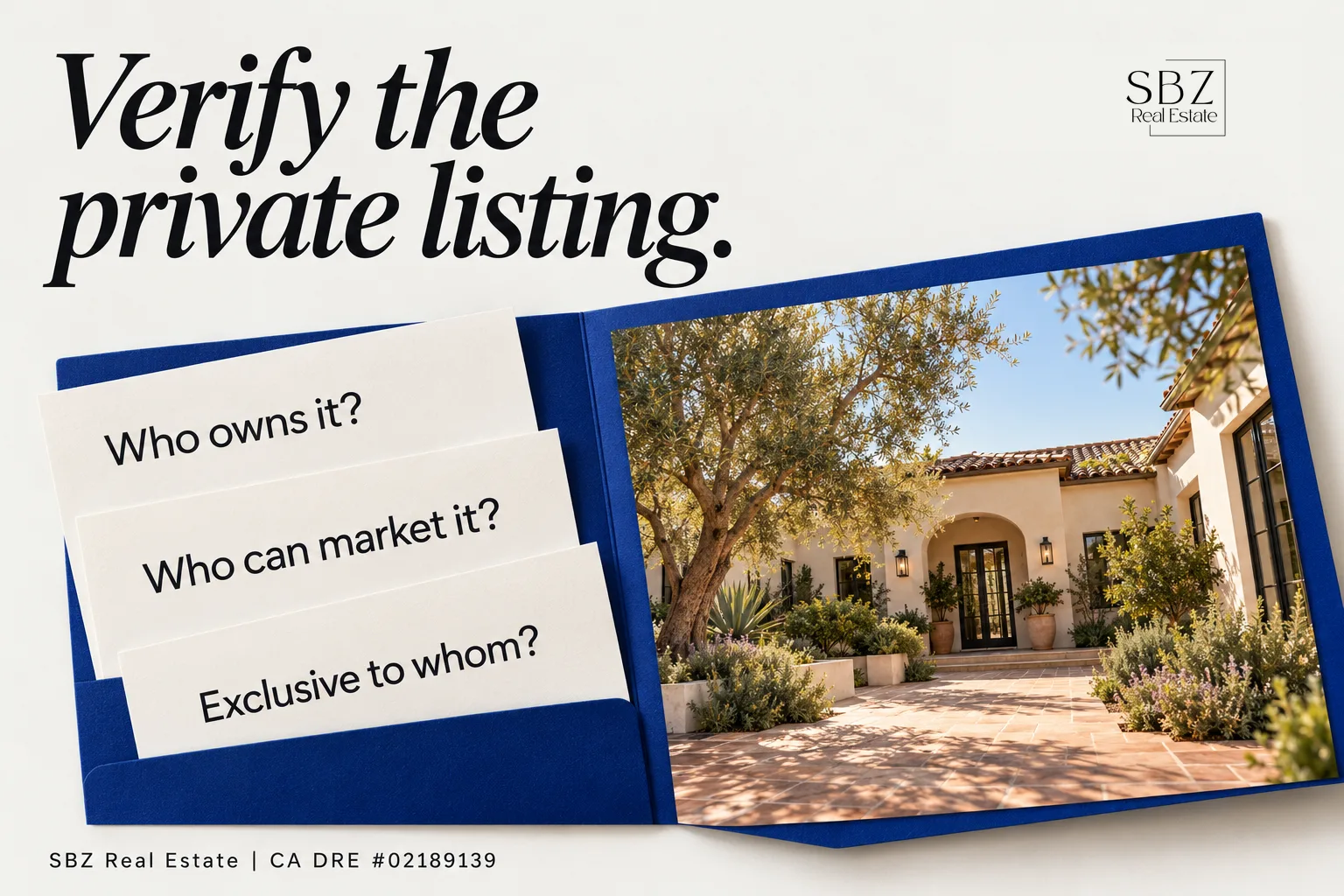
To verify an off-market listing, confirm three things independently: that the person offering the home actually has the legal right to sell it, that a licensed California broker is authorized in writing to market it, and that "exclusive" means what you think it means. None of that requires trusting anyone's word, because each point can be checked with public records and a few direct questions.
Off-market homes are appealing because they promise less competition and more privacy. They also sit outside the public checks a listing on the MLS goes through, so more of the due diligence falls to you. For a broader primer on how these homes surface, see our guide to off-market homes for sale.
What does "off-market" actually mean?
An off-market home is simply a property that is available, or might be, without being publicly advertised. It can be a quiet listing a brokerage shares with a limited audience, a seller who has told a few people they'd consider an offer, or a home that has never been formally listed at all.
The term is not a legal category, which is why it's so easy to misuse. Some off-market homes are genuine. Others are marketing language for a property that isn't under anyone's control. Your job is to find out which kind is in front of you.
How do I confirm the seller really owns the property?
Start with the public record. In Los Angeles County, the Registrar-Recorder/County Clerk holds recorded deeds, and the County Assessor shows the owner of record and the assessed parcel details. Compare the name on the deed to the person or entity you're dealing with.
If the owner is a trust, LLC, or estate, ask who has authority to sign. A trustee, a manager, or an executor can sell, but only with the right documentation behind them. A title company can tell you this quickly, and a preliminary title report, ordered once you're in escrow or about to open it, shows liens, easements, and anyone else with a claim on the property.
Be especially careful if the person pitching the home says they have it "under contract" rather than owning it. That's a different arrangement, often an assignment of a purchase contract, and it changes what you're actually buying and from whom. Ask for the underlying contract and have your broker or attorney review it before you commit to anything. Our article on buying a home from the owner in California covers many of the same checks.
How do I check the broker or agent?
Every California real estate licensee can be looked up on the Department of Real Estate's public license search. Confirm that the license is current, that the name matches, and which brokerage the agent works under. A real broker will give you the license number without hesitation.
Then ask three direct questions:
- Who is the listing brokerage, and who is the broker of record?
- Is there a signed listing agreement with the owner, and does it permit off-market marketing?
- Has the seller approved this property being shown to me specifically?
You're not asking to see the seller's private paperwork. You're asking the broker to confirm, in writing if possible, that they're authorized to represent the property. A hesitant or evasive answer is information in itself. It's also worth understanding the roles involved, which we break down in real estate agent vs. broker vs. Realtor.
What does "exclusive" really mean?
This is where buyers most often get misled. In a listing context, "exclusive" normally describes the seller's relationship with one brokerage: the seller signed an exclusive right-to-sell agreement, so only that brokerage can market the home. It does not automatically mean that only you have been offered the property.
Ask the question plainly: "Exclusive to whom, and for how long?" Possible answers include:
- Exclusive to one brokerage, but shared with that brokerage's own clients.
- Exclusive to a small group of buyers for a stated period.
- Exclusive to you, with a written commitment from the seller.
Only the last is exclusivity in the sense most buyers imagine, and it's uncommon. A claim of exclusivity with nothing in writing is a sales line, not a fact. If a home is later marketed publicly, MLS participation rules can also come into play, so a broker who understands them is an advantage here. Our explainer on what MLS stands for gives helpful background.
What are the red flags of a fake or misrepresented listing?
Most problems announce themselves early. Be cautious when you see any of these:
- Pressure to move fast or to wire money before you've seen the property or met the broker.
- No address until you sign something or pay a fee.
- A price that looks unreasonably low with no explanation for why the seller would accept it.
- A request to send a deposit directly to an individual, rather than to an escrow holder.
- Photos or details you can't match to a real parcel or recorded owner.
- Inconsistent answers about who owns it and who is authorized to sell.
Wire fraud targets real estate transactions of every size. In California, your earnest money should go to a neutral escrow company, never to an agent's personal account or to a seller directly. If you want to know how that process works, read what escrow is and how it works in California.
How do I know the price is fair without public comparables?
A quiet listing has no days-on-market history for you to study, so you have to build your own picture. Ask your broker for a comparative market analysis based on recent closed sales and nearby competing homes. Our guide to what a CMA is explains how that analysis works.
Then protect yourself the same way you would on any purchase: a professional inspection, review of the seller's disclosures, and a title review. A California home inspection matters even more when the sale happened quietly, because there's less public information about the home's history.
Is it worth working with a broker who handles private sales?
For many buyers, yes, mostly because verification is what a good broker does by default. A broker who handles these transactions regularly knows which questions to ask, can confirm authority and licensing quickly, and can tell you when a so-called opportunity isn't real. At SBZ Real Estate, buying a home means one dedicated point of contact backed by a full team, and the same standard applies whether a property is publicly listed or not. If discretion is part of your goal, our overview of private-client real estate explains how confidentiality is handled in practice.
If you're weighing an off-market opportunity right now, a quick conversation costs nothing. You can reach out here and we'll talk through what to verify before you go further.
Frequently asked questions
Are off-market listings legal in California?
Yes. A seller can choose to market a home privately, and a brokerage can share it with a limited audience. What matters is that the broker is licensed, the seller has authorized the marketing, and the transaction follows normal disclosure and escrow rules.
Can I verify an off-market listing myself?
Much of it, yes. You can check the owner of record through county records, look up the agent's license on the Department of Real Estate's website, and ask the broker to confirm authorization in writing. A title company or your own broker can verify the rest.
Does "exclusive" mean no one else can see the property?
Not necessarily. It usually means one brokerage holds the right to sell, not that only one buyer has been offered the home. Ask who else has been told about it and get any exclusivity commitment in writing.
Should I pay a fee to access an off-market listing?
Be skeptical. Paying to see an address or to "unlock" a listing is a common warning sign. Legitimate deposits go into escrow after you have a real property and a real agreement, not to an individual in advance.
Do off-market homes always sell for less?
No. Without public competition, pricing can go either way, and there's no guarantee of a discount. Verify value with comparable sales and an inspection rather than assuming a quiet deal is a good one.