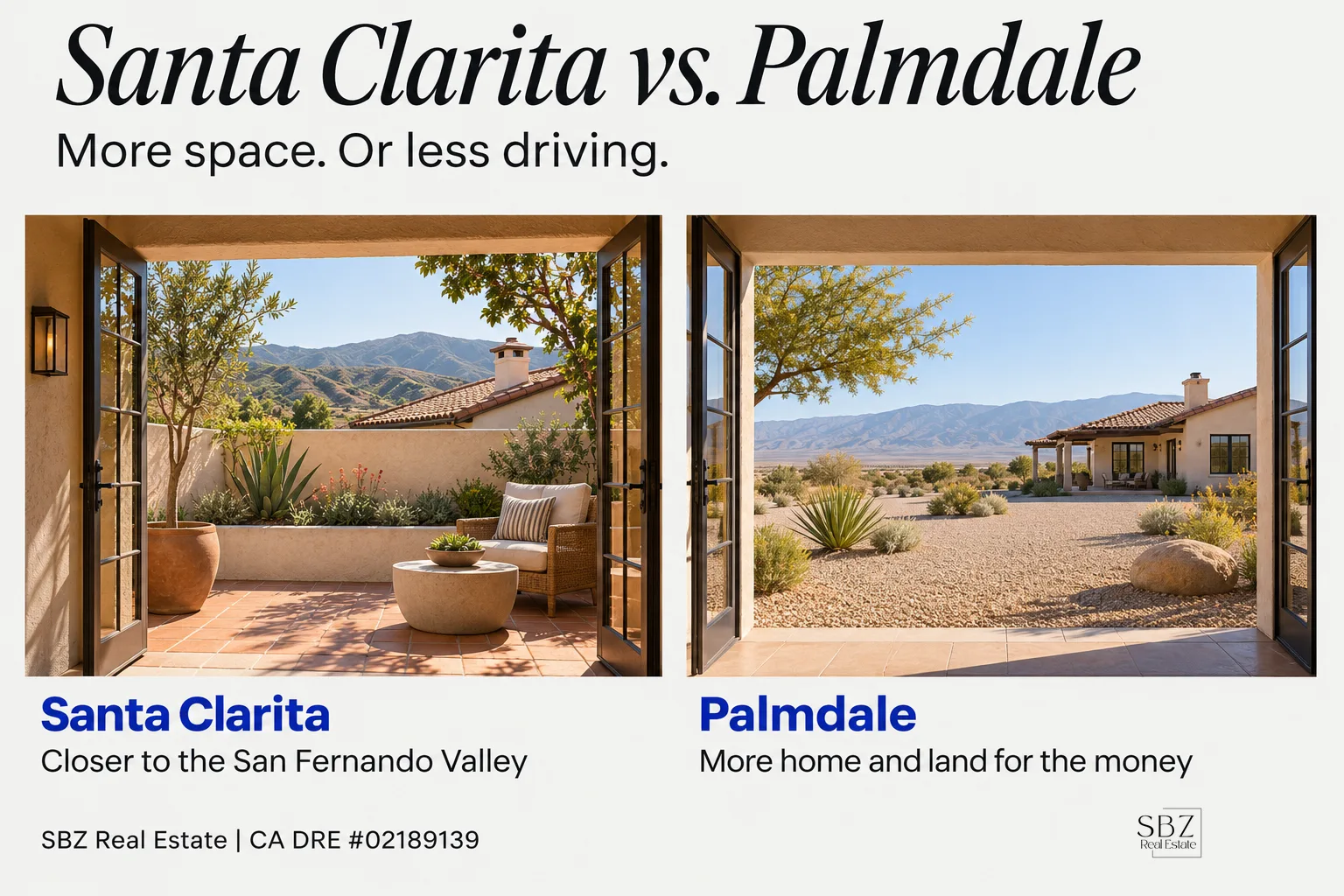
Santa Clarita generally asks for a higher price per home but puts you closer to the San Fernando Valley and central Los Angeles, while Palmdale usually gives you more house and more land for the money in exchange for a longer drive south. Both are real, established markets along the Highway 14 corridor, and neither is simply "better." The right answer depends on your budget, your commute, and how you want to live day to day.
Below is how I walk buyers through the comparison, with the factors that actually move the decision.
Which is more affordable, Santa Clarita or Palmdale?
In general terms, Palmdale has historically been the more affordable of the two, and buyers who are priced out of the Santa Clarita Valley often look north for that reason. Lower entry prices in the Antelope Valley can mean a larger floor plan, a bigger lot, or a newer home at the same budget.
I won't quote a median price here, because those numbers shift month to month and a stale figure does more harm than good. For current, sourced numbers, ask for a market snapshot on the specific property type and neighborhood you're considering. Our Palmdale community page and Santa Clarita community page are a good starting point, and our piece on reading housing market trends in Southern California explains how to interpret what you see.
One caution: a lower price per square foot is not the whole story. Property taxes, any special assessments, insurance, and commuting costs all change what a home really costs you each month.
How different is the commute?
This is usually the deciding factor. Santa Clarita sits at the top of the San Fernando Valley, so it is the more natural fit if your work is in the Valley, Burbank, Glendale, or elsewhere in central Los Angeles. Palmdale is farther up Highway 14, which adds distance and, at peak hours, a real chunk of time.
Before you commit, drive your actual route at the actual hour you'd be traveling. A map estimate at midday tells you very little. If you'll be on the road five days a week, that drive deserves as much weight as the purchase price.
If your work is remote or hybrid, the commute matters less, and Palmdale's price advantage becomes more attractive. If you're curious how the move feels from the other direction, we wrote about moving from Los Angeles to the Antelope Valley.
What about lot size, home age, and new construction?
The Antelope Valley has a lot of open land, and that shows up in the housing stock: larger lots are common, and there is ongoing new construction. Santa Clarita is more built out, with a mix of established neighborhoods and planned communities, so land tends to be tighter and buyers pay for the location.
If you're considering a new build in either place, read the contract carefully. We cover that in new construction homes in the Antelope Valley, including upgrades, deposits, and timelines. For older homes in the high desert, a thorough inspection matters, and what inspections reveal in older Antelope Valley homes lists what we see most.
Do property taxes and Mello-Roos differ?
Base property tax in California follows the same statewide framework in both cities, but the extras can differ from one tract to the next. Some newer communities carry Mello-Roos or other special assessments that raise the annual bill above what the sale price alone suggests.
Ask for the full tax bill, not just the base rate, on every home you seriously consider. Our explainer on Mello-Roos taxes in the Antelope Valley shows how to spot them and what they mean for your monthly payment. Also budget for closing costs, which come on top of your down payment.
How do the climate and daily lifestyle compare?
Palmdale is high desert: hotter summers, colder winter nights, and frequent wind. Cooling costs and landscaping choices are worth planning for. Santa Clarita has its own heat, but it sits at a lower elevation and is closer to the coastal side of the mountains.
Day to day, Santa Clarita offers more of a suburban town-center feel with established shopping, dining, and trails. Palmdale offers space and a quieter pace. These are lifestyle descriptions, not judgments, and the best way to know which suits you is to spend a weekend in each: grocery run, coffee, a walk through a neighborhood you like.
Should I also look at Lancaster or Quartz Hill?
If Palmdale appeals to you, it's worth looking at its neighbors, because they can shift the price-versus-feel balance. See Palmdale vs. Lancaster, plus our pages for Lancaster and Quartz Hill. For a wider view of one city's day-to-day, Is Palmdale a good place to live? covers the practical details.
A simple way to decide
Work through these in order:
- Set your real monthly ceiling, including taxes, insurance, and any assessments, not just the loan payment.
- Test the commute at the hours you'll actually drive it.
- Decide what you can't compromise on: space, location, a specific school-district boundary you verify yourself, or a newer build.
- Tour both on the same day, so the comparison is fresh.
- Price each shortlisted home against recent comparable sales, not the listing price alone.
If you're weighing a move, a quick conversation costs nothing. Contact us or read more about buying with SBZ Real Estate, and we'll help you compare specific homes rather than whole cities.
Related reading
Frequently asked questions
Is Palmdale cheaper than Santa Clarita?
Historically, yes. Palmdale has generally offered lower prices for comparable homes, though the gap changes with the market. Ask for current, sourced comparables before relying on any general statement.
Which is better for a long commute to the San Fernando Valley?
Santa Clarita is closer, so it's usually the easier option. Palmdale adds meaningful distance, so test the drive at your real travel hours first.
Do both cities have new construction?
Both have had new development, but the Antelope Valley has more open land, so new construction is often more available there. Always review assessments and builder contract terms.
Can I use the same loan type in both cities?
Loan eligibility depends on your finances and the property, not the city. A lender can confirm what you qualify for and any limits that apply to a specific home.
How do I know which area fits me?
Spend time in each, run the numbers on total monthly cost, and compare specific homes. A broker can pull recent sales so you're deciding on data, not impressions.