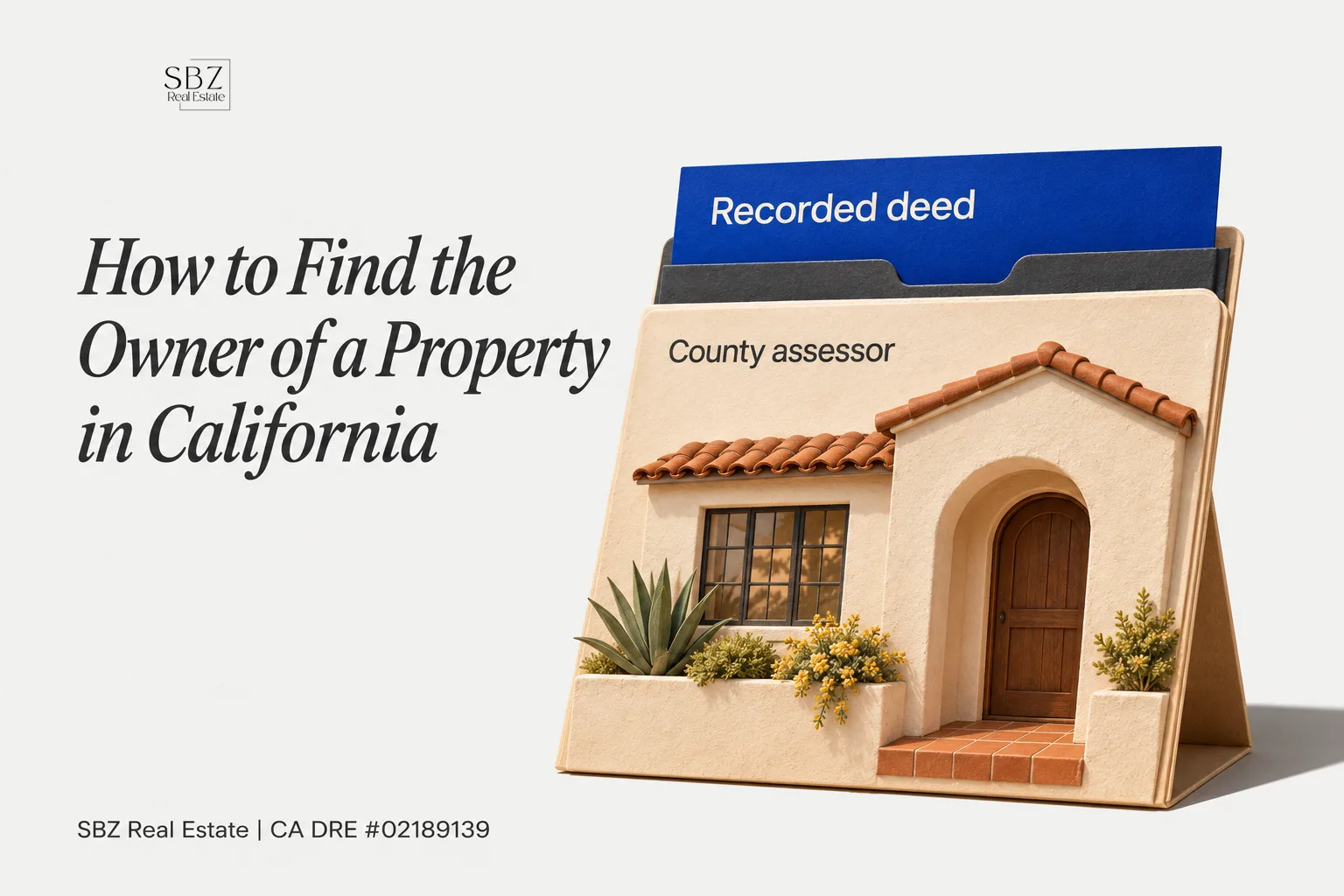
The fastest way to find a property owner in California is to look up the parcel in the county assessor's records, then confirm the name against the recorded deed at the county recorder's office. Both are public records, and most counties let you search them online for free or for a small copy fee.
Ownership information can be simple or layered, depending on whether the property is held by a person, a trust, or a company. Here is how to work through it, in the order I'd do it.
Where do I start looking for a property owner?
Start with the county assessor. Every parcel in California has an Assessor's Parcel Number (APN), and the assessor keeps a roll showing the assessed owner of record and the mailing address used for the property tax bill.
If you only have a street address, most county assessor websites let you search by address and return the APN. Los Angeles County and Orange County both offer online parcel lookups. Our guide to real property search in California walks through how to look up any home or parcel step by step.
One caution: the assessor's roll is a tax record, not a title record. It can lag behind a recent sale, so treat it as a strong lead rather than the final word.
How do I confirm who actually holds title?
Go to the county recorder. In Los Angeles County that is the Registrar-Recorder/County Clerk. The recorder keeps the documents that transfer ownership, such as the grant deed, quitclaim deed, or trust transfer deed.
Search by APN, address, or the owner's name and request a copy of the most recent deed. The deed shows the exact legal name of the owner, how title is held, and the recording date. Some counties offer a free index search and charge only for certified or plain copies.
The recorded deed is the best public evidence of who owns a property. If the assessor and the recorder disagree, the recorder generally has the more current picture.
What if the owner is an LLC, trust, or corporation?
You'll often find a company or trust name instead of a person. That is common and entirely legal. Many owners, including investors and privacy-minded buyers, hold property this way. We cover the reasons in buying a home privately in Los Angeles through trusts and LLCs.
For a business entity, you can check the California Secretary of State's business search to see the entity's status, its registered agent for service of process, and its listed address. That is often enough to send a letter or serve a legal notice.
For a trust, the public record usually shows only the trustee's name and the trust's name. The trust's terms and beneficiaries are generally not public, and you shouldn't expect to find them.
Can a title company or broker pull this information?
Yes. A title company can produce a property profile (sometimes called a "prelim" or "owner and lien report") showing the vesting, the legal description, the APN, and recorded liens. Brokers commonly request these during a purchase or listing. If you want to understand the role title plays in a transaction, see how title and escrow companies differ in California.
If you're a buyer interested in a particular home that isn't listed, a broker can research the owner of record and make a respectful, direct approach on your behalf. That is how many off-market purchases begin, and it's covered in more detail in our piece on finding off-market homes.
What can I do with the owner's information once I find it?
Most people look up an owner for practical reasons. A few common ones:
- Making an offer on a home that isn't for sale. A written letter to the mailing address is the standard first step.
- Resolving a boundary, fence, or easement question with a neighbor.
- Checking a seller's identity before you buy, especially in a private sale.
- Sorting out a tax bill or lien that came in the mail.
- Serving legal notice, which usually calls for an attorney.
If property taxes are part of the question, our guides on who is responsible for property taxes after a sale and unsecured property tax in California explain how those bills get assigned.
Are there limits on how I can use owner information?
Yes. Public records are public, but how you use them still matters. A few ground rules:
- Use the information for lawful purposes. Harassing, threatening, or repeatedly contacting an owner who has asked you to stop can create legal problems.
- Some people have a legal right to keep their home address out of public records. For example, California runs an Address Confidentiality Program for certain survivors of violence, and some public officials can restrict address access. If a record is withheld, that is by design.
- Commercial data sites repackage public records and can be out of date. Verify anything important at the county level.
If you're unsure whether a use is appropriate, ask an attorney before acting.
A simple checklist
- Get the address and the APN from the county assessor's parcel search.
- Note the assessed owner and mailing address.
- Pull the latest recorded deed from the county recorder.
- If an entity holds title, search the Secretary of State's business records.
- If you need certainty, order a title company property profile.
- Reach out in writing, and keep it courteous.
If you're weighing a purchase and want help identifying and approaching an owner, reach out to our team. A short conversation costs nothing, and you can read more about how we work with buyers.
Frequently asked questions
Is property ownership public record in California?
Generally yes. Assessor rolls and recorded deeds are public records that anyone can search. A few exceptions exist for people with legally protected address confidentiality.
Can I find a property owner by address only?
Yes. Enter the address in the county assessor's parcel search to get the APN and owner of record, then look up the deed at the county recorder.
Is it free to look up a property owner in California?
Basic online searches at county assessor and recorder sites are often free. Copies of recorded documents typically carry a fee, which varies by county.
What if the owner is listed as a trust or an LLC?
The record will show the trust or company name rather than a person. For an LLC, the Secretary of State's business search lists its registered agent. Trust beneficiaries are generally not public.
How current is the assessor's ownership information?
It can lag behind recent sales. For the most accurate ownership picture, confirm against the latest recorded deed or a title company property profile.