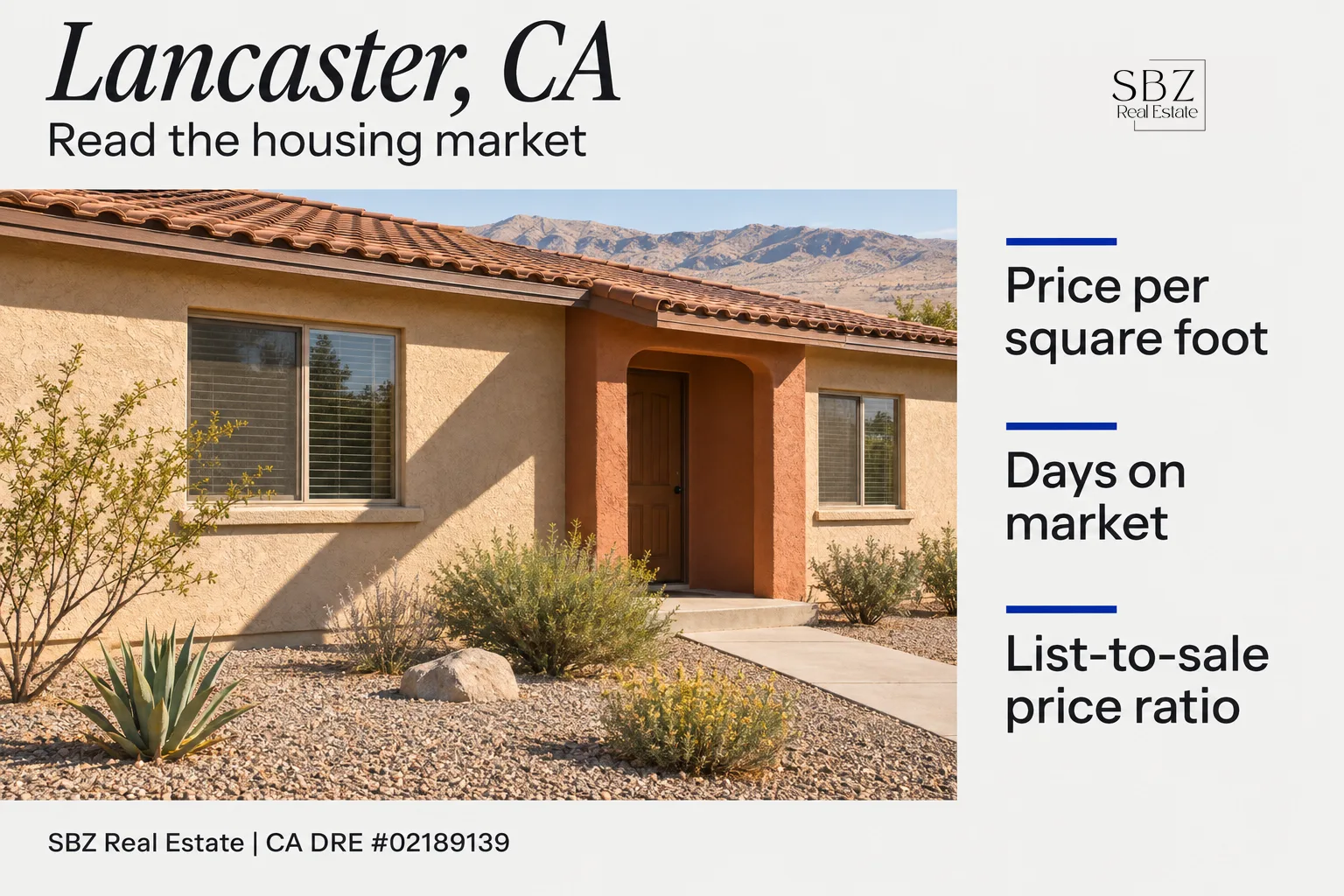
The Lancaster, CA housing market is a high-desert market in the Antelope Valley of northern Los Angeles County, and the best way to understand it is to track a few local measures, such as price per square foot, days on market, and the gap between list price and sale price, rather than relying on a single headline number. If you searched "Lancaster housing market" and landed here, note that this guide covers Lancaster, California, not Lancaster, Pennsylvania.
We are deliberately not quoting a median price or a percentage change in this article. Those figures shift month to month, and a stale number does more harm than good. What follows is how the market works and how to pull current, reliable data for yourself.
What makes the Lancaster, CA market different from the rest of Los Angeles County?
Lancaster sits in the Antelope Valley alongside Palmdale and Quartz Hill, and its housing stock and lot sizes look quite different from the coastal and Valley markets closer to downtown Los Angeles. Many neighborhoods feature single-story homes on larger lots, and a good portion of the inventory was built in distinct waves of development, which affects condition, systems, and price.
Because it is a commuter-linked and regionally oriented market, Lancaster tends to respond to broader forces: mortgage rates, employment patterns across the region, and how buyers weigh space against distance. In real terms, that means the local market can move differently from the Westside or the San Fernando Valley, even when the headlines say "Los Angeles."
For a wider frame on how the county works, our guide to real estate in Los Angeles County explains why one county can contain many separate markets.
Which numbers actually matter when reading the Lancaster housing market?
Most people fixate on the median price. It is a useful starting point, but it can mislead because it mixes together very different homes. These measures tell you more:
- Price per square foot for homes similar in size, age, and lot to yours.
- Days on market for comparable listings, and how that is trending over recent months.
- List-to-sale price ratio, which shows whether buyers are paying above, at, or below asking.
- Active inventory, meaning how many homes are for sale compared with how many are going under contract.
- Price reductions, which signal where sellers are overreaching.
Pull these for the specific neighborhood and property type, not the whole city. A tract home and a custom property on acreage can sit in the same zip code and behave like different markets.
Our article on reading housing market trends in Southern California walks through how to interpret these numbers together, and our Lancaster community page is a good place to start with local market information.
Is it a buyer's market or a seller's market in Lancaster?
It depends on the month, the price band, and the condition of the home, so any blanket answer should make you cautious. A market can favor sellers in one price range and buyers in another at the same time.
Here is how to tell for yourself. When well-priced homes in your target range are going under contract quickly and sale prices are meeting or exceeding asking, sellers have the leverage. When homes sit, reductions are common, and buyers are negotiating repairs and credits, leverage shifts toward buyers. Neither condition lasts forever, and neither should be treated as a promise about what will happen with your specific transaction.
What should Lancaster buyers pay attention to?
The listing price is only part of the picture. A few things matter more here than buyers sometimes expect:
- Condition and age of systems. Roof, HVAC, and cooling performance matter in high-desert heat. Read about what inspections reveal in older Antelope Valley homes before you write an offer.
- Total cost of ownership. Property tax, any special assessments, and insurance all shape your monthly payment. See what Mello-Roos taxes mean for Antelope Valley homes.
- Closing costs. Budget for them early. Our guide to closing costs for Antelope Valley buyers breaks down the line items.
- Appraisal risk. If a home appraises below your offer, you need a plan. Here is what happens when a house appraises for less.
If credit is a concern, it is not necessarily a dead end. We cover that in how to buy a home in Lancaster with bad credit. When you are ready to talk through a search, see how we help with buying a home.
What should Lancaster sellers pay attention to?
The thing most sellers miss is that pricing is a market-reading exercise, not a negotiation with your own expectations. A price set by what you hope to net, rather than by what comparable homes actually sold for, is the most common reason a listing stalls.
Start with a comparative market analysis based on recent closed sales, not asking prices. Then work backward through your costs with a net sheet so you know what you would actually walk away with. Our guides to pricing your home to sell and the seller net sheet show how to do this.
Preparation matters too. Know what to fix before listing and what to skip, and understand your disclosure obligations as a California seller. Timing varies a lot, so use our overview of how long it takes to sell in the Antelope Valley as a planning guide rather than a prediction. If you are weighing a sale, our approach to selling your home is a useful next read.
How do I get current Lancaster market data?
Public listing portals give you a decent overview, but they have limits: reported figures can lag, and category averages hide the details that matter. A local broker can pull recent closed sales for your exact street, property type, and size range, and explain which comparable sales are relevant and which are noise.
For a wider look at the region, compare Lancaster with its neighbor in Palmdale vs. Lancaster: which is better for buying a home. If you are relocating, moving from Los Angeles to the Antelope Valley covers what to expect.
If you are weighing a move, a quick conversation costs nothing. You can reach us here and we will walk through current numbers for the part of Lancaster you care about.
Related reading
- Living in Quartz Hill, CA: What Day-to-Day Life and Buying Here Are Really Like
- Horse Property in Acton, CA: What Buyers Should Check Before Making an Offer
- Palmdale Housing Market: How to Read It Before You Buy or Sell
- Best Neighborhoods in Lancaster, CA: How to Choose the Right Part of Town
Frequently asked questions
Is this about Lancaster, CA or Lancaster, PA?
This guide covers Lancaster, California, in the Antelope Valley of northern Los Angeles County. The two markets are in different states and are driven by different forces, so data for one does not apply to the other.
Are home prices in Lancaster, CA going up or down?
That changes over time, and a single number rarely tells the story. Check recent closed sales for comparable homes in your neighborhood and look at the trend over several months before drawing conclusions.
Is now a good time to buy or sell in Lancaster?
The right timing depends on your finances, your goals, and the property, not just the market. A local broker can compare current conditions with your situation, and nothing about the market guarantees a particular price or timeline.
How is the Lancaster market different from Palmdale?
They are neighboring Antelope Valley cities with overlapping buyers, but housing stock, neighborhoods, and pricing can differ block by block. Compare comparable sales in each rather than assuming they move together.
How do I find out what my Lancaster home is worth?
Request a comparative market analysis based on recently closed sales of similar homes nearby. Online estimates are a rough starting point, but they cannot see your home's condition or upgrades.